
More cool retro C64 type synths coming your way – introducing Raider
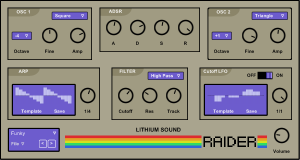
Raider is a 2 oscillator modulation sequencer based synthesizer. Raider allows you to modulate pitch and filter cutoff via two step sequencers. Each sequencer allows one to simply draw in their own pitch and filter modulations or use one of the pre-configured templates. Both sequencers are tempo synced and the filter sequencer can be switched on or off. Raider makes sounds suitable for techno, electro, house, breakbeat, glitch and many other styles. Sounds are remanecent of the 303 and 8-bit game sounds of the 1980’s and one can produce a wide range of sounds from FX and screaming acid leads to Arps and house grooves to percussion and a whole lot more.
Features:
- 2 oscillators (sine, saw, square, triangle)
- 1 step sequencer pitch control
- 1 step sequencer filter control
- 1 ADSR Amp envelope
- 1 State Variable Filter (Lowpass,Highpass,Bandpass)
- 32 presets
Listen to it:

Raider Audio Demo (Raider + drum kits)
ElectraX virtual synth gets polished
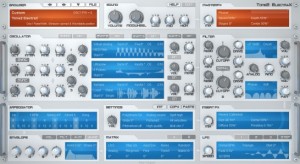
Tone2 has announced ElectraX 1.2, an update to its software synthesizer for Windows and Mac.
New in ElectraX 1.2:
- Filter section has been extended with Fractal Filters. These completely new filter types are excusive and not available from any other company.
- Native 64 Bit standalone version.
- Create 4x stereo unison patches with ‘copy’ button.
- ‘Load patch to synth’ allows to stack up to 4 patches for fat multitimbral sounds.
- The OSCs support drag&drop for wav import and resynthesis.
- Samples longer than 10 seconds can be loaded now.
- Analog modeled ‘Moog’ filter (analog controls self oscillation and non-linearity).
- Analog modeled State Variable Lowpass with Filter-FM (analog controls FM amount).
- Nonlinear 12dB Lowpass ‘LP Shaped’.
- Mod Matrix destination ‘Start’ sets OSC start phase or Sample start point.
- Mod Matrix destination ‘Mix’ crossblends between filter1 and filter2.
- Mod Matrix sources ‘Midi CC’, ‘Breath’, ‘Foot’, ‘Expression’, ‘Hold’…
- Mod Matrix source ‘VoiceNr’ returns a value which depends on the current voice number.
- Mod Matrix source ‘NumKeys’ counts the number of pressed keys for more dynamic expression.
- Mod Matrix source ‘KeySat.’ returns a saturated version of key follow.
- Mod Matrix source ‘Impulse’ returns a 1ms long impulse which can be used for attack sounds.
- 12 additional analog ‘Decay’ envelopes as sources in Mod Matrix.
- Loop/Single is automatically set on sample import.
- Octave/Semi is automatically detected from sample name (e.g. Piano_A-3.wav).
- Last directory is remembered on wav load and fxp load/save.
Other improvements:
- Improved graphics with 4 new skins.
- FM on/off, OSC on/off, Distortion type and Sync can also be changed during playback now.
- An OSC which is FM modulated by a deactived source does not longer output noise.
- Many improvements in sample handling.
- Up/down controls show an arrow and are more smooth to handle.
- Improved sound in glide mode.
- ElectraX is more robust against broken Midi data which is sent from hosts.
- Improved CPU compatibility.
- Waiting icon is show during patch load.
- Improved ‘analog’ psycoacoustic mode.
Version 1.2 is expected to be available in June 2011. ElectraX for Mac & WIndows is available for US $199/189 EUR.
Constructing a drum synthesizer
“I recently finished the second of my analog drum synth projects. The upper box is a Thomas Henry MPS (Mega Percussive Synth) along with Richarious Liquid Hi Hat, 2 Ian Fritz AD/AR and two simple VCA’s, Foniks VC Pattern Sequencer and VC Clock a couple LFO’s and a simple Mixer. The lower box is four Bass++ voices (Mr. Henry) and a bunch of CMOS for sequencing and dividing up clocks.
Many strange beats possible here – and a long time between repeats if I really get the VCPS and Logic working together! This is a very simple demo to give an idea of what it does. Much better sounds and more interesting beats are available!”
Naive Lead – polyphonic synthesizer instrument plugin
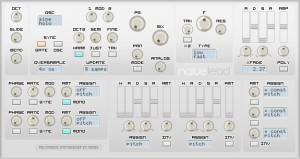
xoxos has announced the release of Naive Lead, a polyphonic synthesizer instrument plugin for Windows.
Naive Lad is a concept synth.. oversampling is used to antialias (to an extent) trivially rendered oscillators. This may offer some benefit in contrast to other methods (especially if you like aliasing!). This VST is presented to offer some insight into dsp to promote informed application of synthesis. If you know what you’re using, you’ll know when it’s best used.
Up to five filter algorithms are available (fast, Stilson/Smith Moog, Karlsen, SV, biquad) for four modes. The licensed version has 6 voices of polyphony (or more at request). Two banks of presets contributed by ten sound designers are included.
Naive Lead for Windows (VST) is available to purchase bundled with W VST for $10 USD.
Quasimidi The Raven Max Synthesizer from the year 1996
The Raven is a great quality German made performance synthesizer for creating pumpin’ dance tracks – live or in the studio (or at home)! In essence the Raven is like having a Rave-O-Lution 309 inside a professional keyboard with a sleek look and interface. Strongly aimed at the dance music genre, the Raven offers up great sounds including: Basses, LeadSynths, SynthPads, Natural Sounds, Organs, FM-Percussion, Effects, Drumsets, Tuned Drums and multitimbral Performance patches. An on-board interactive 8-track sequencer, arpeggiators, real-time control knobs and effects equip this nice synthesizer for any electronic musical venture.

The Raven can be upgraded with the RavenMAX card. This increases the sample wave memory from 6 to 14 MB. There are tons of new sounds emphasizing drums, percussion, synths and effect sounds. “Motivator” real-time tweaks can be recorded into the on-board sequencer and there are about 100 “motifs” from other artists and users for instant groove patterns! Note however that the Raven has only 24 voices of polyphony which usually means your songs may be sparse in their arrangement. But creative planning and tricks can still get you by the Raven’s limited polyphony, live and in the studio.
In this video:
synthesizer demo by RetroSound
Quasimidi The Raven Max Synthesizer from the year 1996
part1: some sequencer pattern + drums, mute, transpose…
part2: Raven Max sounds + Motivator (arpeggiator, gater, chord-trigger)
Teaser: DXi FM synthesizer ver 2.2.0 playing with External MIDI Controller via Camera Connection Kit
DXi is a FM synthesizer application inspired by 80’s most popular FM synthesizer. You will enjoy creating sounds as well as playing music with this application. FM synthesizer is still popular among many people by its unique tone. We carefully selected parameters from original synthesizer so you will be enjoy editing tone with them easily. You need to know some technique to tweak the tone, but you will be able to get DXi’s special tone and effects while having some fun! Creating sound effects is another idea to enjoy DXi. If you remember the days of FM synthesizers, try creating the tone you remember from them.
If you have no experience with any FM synthesizer, we are sure you will be enjoying the unique tone world!
* 4 operators FM synthesizer
* 8 algorithms
* Envelope, frequency (Ratio or Fixed) can be set each operators.
* Feedback control on operator number 4.
* 2 master effects (LPF with Resonance and Delay)
* Import/Export function to save the tone you created. (URL schema text string format)
* Audio recording function. And you can transport recorded audio file, .wav, onto Mac/PC via iTunes file sharing.
* Clipboard audio sharing support. You can export recorded waveform to other application via clipboard. It’s compatible with Intua’s clipboard.
In this video:
DXi is a FM synthesizer application inspired by 80’s most popular synthesizer. Enjoy making music and creating sound by FM synthesis engine easily.
The movie show you the new great features about DXi version 2.2.
Demo of the Benjolin suitcase synth
Description:
Just finished the Benjolin. It’s in the suitcase synth i’m currently building. the ‘sun bear’ module to the left is a MFOS dual LFO. Enjoy!
Full mix down made with the legendary Roland System 100M
As reported in the interview we did with Nitzer Ebb the Roland System 100M was their absolute favorite. Now this video was released that gives a neat overview of its capabilities.

The System 100m is Roland’s contribution to professional analog modular synthesis. It was based on the more limited, semi-modular System 100, but is several steps of ahead of its predecessor. The System 100m offers over 20 modular components to pick and choose to design a custom modular set-up. The Main unit is the M-110 which has a single VCO oscillator, VCF, and VCA section. You can then build upon this system adding any number and configurations of the various other modules which include dual VCOs, ring modulators, dual VCFs, eq, dual VCAs, dual envelopes, LFOs, various effects, mixers, sequencers, and control interfaces including 3 different keyboard controllers.
Modules are assembled into racks. The System 100m has 3 rack sizes, the M-190 holds 3 modules, the M-191 and M-191J hold 5 modules. Each rack provides the necessary 8-pin DIN power connectors and internal CV/gate connections between the modules. You still need to do some external patching, however, to send your signal through the modules of your choice to create any sounds. As for sounds, the System is basically monophonic, unless you get several racks of them for lots and lots of money! Its sound is not as warm as the System 100 before it, but it offers much more capability, as seen in Hans Zimmer’s system below!
Hans Zimmer’s massive System 100m, image and info courtesy of Kevin Lightner. “It features 58 VCOs, 37 VCFs, 32 ENVs, 12 VC Phase shifters, 9 Sequencers, 1 Remote controlled 4-space rack-mount power supply (25′ away.), and 24 Trunk lines go to his large Moog synth across the room. The unit can link the “Keyboard” inputs for all the modules, and with this feature, all VCO’s can track one input with only one patch cord. The unit was built into 6 flight cases on casters with removable front and rear covers, then later encased in wood and built into his studio. “—-Kevin Lightner
System 100’s have been used by Orbital, Hans Zimmer, Vince Clarke, Depeche Mode, Heaven 17, Freddy Fresh, Luke Vibert, Meat Beat Manifesto, Electronic Dream Planet, Jamiroquai, Human League, and Peter Howell of the BBC Radiophonic Workshop.
Analog gestural interface controlling a Bugbrand Modular
The Bugbrand Modular is an interesting synth mostly consisting of a huge number of banana jacks. Banana jacks are only used in a handful of other modular systems – notably Serge, Modcan and Fenix, plus in the control signals of Buchla. There are are certain electronic and aesthetic differences between each system, but that does not completely rule out cross-patching between systems. Differences in signal levels (and banana socket colour schemes!) should be considered and amplification / attenuation / offsetting may be necessary to achieve best results. A common ground connection must also be made between different systems – the BugBrand system has a black banana socket ground terminal on the power supply.
Read more about Bugbrand here >>

In this video:
This is a live performance by Palle Dahlstedt on a custom built instrument, using a simple pencil drawing as a gestural interface for controlling complex analog synthesis (on a Bugbrand Modular). The instrument works by creating a voltage potential field in the graphite/pencil markings on the paper using custom movable electrodes made from coins. Then, various control voltages are extracted from other points on the paper, controlling various aspects of the synthesized sound.
A big thanks to Tom Bugs for very valuable electronics advice!
The sound is recorded directly from the BugBrand Modular (with a slight reverb), and from contact mics on the pencil sharpener. There is no normal microphone, which explains the slightly awkward silence in the beginning, while I’m drawing.
Recorded at the second performance (of two), May 6th, 2011, Gothenburg, Sweden. Concert arranged by Levande Musik (www.levandemusik.org)
This work is part of the research project Creative Performance at University of Gothenburg, funded by the Swedish Research Council.
Short notice: DSK TechSynth Pro
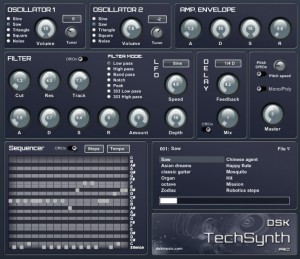
We don´t know much about this one more then that it has recently been rleased :-). DSK Music has released DSK TechSynth Pro, a free virtual synthesizer instrument for Windows. DSK TechSynth Pro features 32 steps sequencer.
– 2 Osc with 5 waveforms
– Amp. envelope and detune control
– Advanced filter with ADSR and LFO
– Delay filter
– Pitch / poly control
– +60 patches
– Velocity response
– 32 steps sequencer
*Turn on the sequencer and enjoy it 😉
DATAMASKIN

