
Beefy analogue sound engine with a very unique edge
Analogue Solutions new synth: the Leipzig-s.
A very beefy analogue sound engine with a very unique edge, more on the rougher sound side. I’ve grown a soft spot for AS synthesizers eversince I got their Telemark which I cannot praise enough. Being a modular and semi-modular fan I do miss patch points on the Leipzig-s and maybe a multi-mode filter to enhance the already vast sonic flexibility of this machine. But aside from my wishlist and personal preferences I must admit that the Leipzig-s is a most powerful musical instrument.
Here I teamed the Leipzig-s up with the Telemark, Vermona DRM1 MKIII drums, the Doepfer A-100 and a string pad from the Roland JX 8-P – ALL sounds are purely analogue.
It’s a fairly large file – apologies for that. Headphones recommended. The predominance of the Leipzig-s in the mix is intended.
Amos iPad application with a modular synthesizer
“Im using the ipad app Amos, using the camera connector / m udio uno into a Encore Expressionist midi to cv converter to control 5 oscillators in my modular synth. Each oscillator is assigned a diff midi channel, each midi channel is a ball in Amos”
Beast of a synth – Leipzig-s Synthesizer
(headphones required due to lower frequencies)
Here’s a brief first look at the Analogue Solutions Leipzig-s analogue synthesizer.
This beast of a synth represents the latest in Analogue Solutions’ Leipzig line and incorporates a vast number of new features, most notably the 8-step on-board sequencer which can be synced and controlled in a vast number of innovative ways (midi, LFO, VCO, etc.)
This video serves as a first glimpse of the synth – yes, it’s a teaser. The evolving sound uses the Leipzig’s on-board step sequencer, however the pitch of the notes is controlled via MIDI. The sequencer can also be stepped manually via a MIDI keyboard.
Sequencer reset is handled via accent (or using heavy velocity on a MIDI note).
A beat was added to provide some context for the evolving bass line.
New James Bond synth from Waldorf
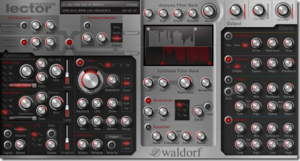
Waldorf Music continues their James Bond naming theme with the announcement of their new software vocoder Lector.
They describe Lector as follows:
“Robot voices, whispering strings, talking drum loops, rhythmic pads, the resonant ringing of bells, dripping water – the possibilities are all but infinite. With a quick tweak here and there, the Lector turns any incoming signal into novel sounds and effects. Tremendously versatile, the Lector puts in your hands a sonic toolset for a wide range of diverse applications. Just about anything goes, from distorting the human voice to adding subtle harmonies to lead vocals and getting creative with movie soundtracks.
The analysis filter bank splits the incoming audio signal into as many as 100 frequency bands, the intensity of which modulates the volume levels of an equal number of band-pass filters in the synthesis filter bank. The integrated 16-voice synthesizer or an external source provides the input signal for the synthesis filter bank. This lets you do fun things like apply a melody line or chord sequence to articulate vocals or speech.”
Lector Features:
- 3 to 100 band Vocoder
- Adjustable range of Analysis Filter Bank
- Adjustable offsets and LFO modulation of Synthesis Filter Bank
- 3-band Equalizer with variable mid band
- Individual Compressors for Speech and Carrier signal
- Voiced / Unvoiced Detector
- Overdrive (types Tube, Diode, Clip)
- Stereo Chorus / Flanger, 2 to 6 stages
- Stereo Delay, syncronizable
- Reverb
- Sidechain input (VST 3 and Audio Unit)
- Carrier plug-in (VST 2)
16-voice Synthesizer (per voice):
- Polyphonic, Monophonic or Free-Running
- 2 Oscillators, waveforms sine, triangle, sawtooth, pulse with pulse width modulation, sample&hold, noise, single and multi sample playback
- FM
- Ring Modulation
- Portamento / Glissando
- 1 Filter, types Lowpass, Bandpass, Highpass, Notch (12dB and 24dB), Whitening
- 1 LFO, synchronizable, waveforms sine, triangle, sawtooth, square, sample&hold, noise
- 2 AR envelopes
Lector will run on Windows or Mac. There is no buy button or pricing yet, but you can read more details here http://www.waldorfmusic.de/en/lector-overview.html.
Introducing the Synergist synth
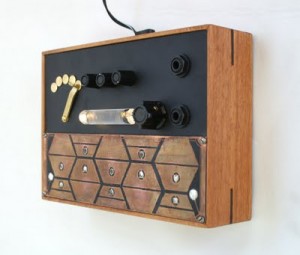
The Synergist is a touch synth with 8 osc. and an 8 note polyphony – each tuned in correspondence to one another to create a full body of notes in addition to touch-based noise and time control. The oscillators tie into a delay, the timing of which controls the global pitch of the oscillation (when the time on the delay is lowered or raised, the frequency of all 8 oscillators are lowered or raised accordingly). The delay ranges from extremely tight to a longer approx. 2 seconds (getting gradualy dirty and grimier toward the lower end)
The oscillators can be feedback driven to create decay and the level of all touch points can be lowered or raised to either overload the delay completely or create more subtle background drone. This all helps to mix the level with any incoming sound as the an input signal can be sent into the 1/4″ in jack allowing for processing of external sources. The selector switch switches between a variety of clean feedback and altered feedback (altered feedback being a more compressed droning sound)
The result is a piece capable of drone or synth lines, very nasty noise and dub massacre. The layout of the touch plate is designed to make it easily playable in a percussive manner. It’s also laid out so that metal pieces (coins work well) can be placed between points to acts as switches for drone or connect points to alter the delay signal.
More info on the site and more to come: [link]”
Punch – virtual drum synthesis and sampler featuring built-in samples and groove sequencers
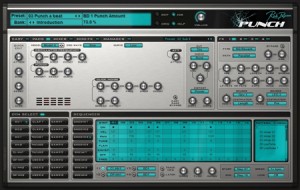
Later on this Spring, Rob Papen will be releasing Punch (Mac / Win), a virtual drum synthesis and sampler instrument featuring built-in samples and groove sequencers.
According to Rob Papen, Punch is one heck of a “speaker busting, body rattling software instrument.” The Punch plugin is said to deliver synthesized drums in the finest audio quality, with “breathtaking” features for the contemporary producer.
With the new plugin, you can can create your own sounds, use the included samples, or build your own unique sounding drum-kit. You can also load your own samples into Punch to complete your kit.
Punch boasts built-in sequencers, which give you instant access to multiple patterns. According to the maker, these grooves can be triggered in a live environment to build a song, as well as be used for improve and jam sessions.
What’s in the Punch:
- Drums
- 2 Bass Drum with 4 different models and built-in 4 classic samples and 19 punch samples
- 2 Snare Drum with 2 different models and build in 4 classic samples 61 built-in punch samples
- 2 Open Hi-hat and 2 Closed Hi-hat, with 3 models and build in 4 classic samples and 7 built-in samples
- 3 Tom / User with 2 Tom models and 8 built-in Tom samples (classic / punch)
- 2 Claps with 3 models, and 13 built-in samples
- 3 User Drum, with 9 models and 37 samples
- 8 Dual Sample slot, each with there own amp / pitch envelopes and filter and filter envelope
- Each drum has its own “easy controls,” distortion (20 different models), output destination (to dry or any of the 4 FX channels), and choke groups
- Each drum can be preview and selected by clicking in the Drum Preview Pad
- Classic samples are samples taken from several classic analog drum machines and punch samples are RP library samples
- Sequencer Patterns (4x groove and 4x breaks)
- Punch has its own internal sequencer that can play 8 different patterns of up to 16 steps long
- 4 Grooves and 4 Break patterns
- Each pattern is composed of 4 tracks, each track having its own drum output, and each step in each track can have different velocity, panning, pitch, envelope speed, flaming, time offset, and free row
- Each pattern also has free row for modulation step values which can be used to modulate controls
- Swing amount, flaming time, and humanization controls
- Modulators: Punch has 2 envelopes, 2 LFOs, and 8 modulation slots, which allow you to use a wide variety of modulation sources to control Punch’s controls
- Mixer: A full screen shows the volume and panning of all the controls, plus the FX mix and panning allows you to easily mix the drum sounds
- Easy Screen: Easy to use sliders allow to alter the main controls on the fly during use
- Effects: 4 FXs, each with 26 different type of FX (delays, reverbs, chorus, filter, distortions, and so forth), which can arrange in 5 different ways. In the multi-channel version of Punch, these FX are output to the different output channels
- Manager Screen: Big manager screen shows you all the presets, banks, and presets; allows you to load, save, copy and paste, and so forth
Rob Papen plans on releasing Punch (AU / VST / RTAS) by the end of May, 2011. For more details, visit robpapen.com.
Last Flight Out – live modular synthesizer
Live modular synthesizer.
Q960 sequencer for the bass line through a Oakley Super Diode Ladder Filter. Six voices comprised of nine oscillators and four VCF’s. Additional filters included Grove Audio PM Resonator, Q127 Fixed Filter Bank, two Oakley Equinoxe phasers and a Cyndustries Quad Low Pass Gates. Three sequencers included Q960, Q119 and STG Mini-Stores. A Yusynth Random Gates selected triggering for the percussion sounds and the high drone voice. FX included a TC Electronics D-Two delay and Lexicon MX200.
I’m handling the Q960 skip/reset points and using a Q149 Signal Selector to route cv’s for the pitch to the bass line with a Q123 Standards module for pitch/octave modulation. Almost everything else is automated and just faded in and out.
How to make similar lead to Black Eyed Peas – Just Can’t Get Enough
I like sound design and overall synthesis, and this short tutorial will show you some few synthesis tricks. The the final result, we are aiming at, should be similar (but not the same – musicians should be creative  ) to well know BEP – Just Can’t Get Enough Lead Sound. Synth used – Toxic Biohazard.
Just follow the tutorial and you’ll end up with pretty nice, free preset or visit designasound.com and get a full 97 lead / synth presets soundbank.
The Teletron
My version of the Teletron, a mind-to-synthesizer interface conceived by Robert Schneider of The Apples in Stereo based on Mattel’s Mindflex game. Using a wireless (2.4ghz) headset, my brainwaves are converted to a variable DC voltage. This voltage can be used as a control voltage for analog synthesizers.
What you are hearing is the Moog Voyager modulated by my brain waves amplified and converted to voltage. The DC output of the Mindflex is routed to the Moog CP-251 and sent to the Voyager’s pitch and filter as well as the rate of the Moog Murf.
Xenobioz- Kruud
Kruud VSTI is a synthesizer with a drawable low resolution Oscillator.
1 LFO/SUB OSC
2 LFOS
3 ADSRS
2 Delays of which one can be used to make crude physical modelling.
An Arpeggiator
A multimode filter
The main Osc has 5 basic waveforms , Pink and white Noise and a drawable user waveform.
The waveforms have different modes like Phase Mod, PWM (Square only) and a special morph mode (listed as PWM in the synth) for all but the square wave.
The user waveform can mix or morph between two waveforms.
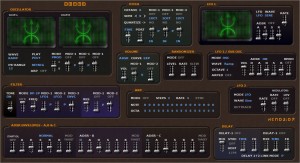
DATAMASKIN

