
Tyrell – N6, a software synthesizer based on Amazona’s Tyrell
Urs of u-he will be developing the Tyrell – N6, a software synthesizer based on Amazona’s Tyrell.
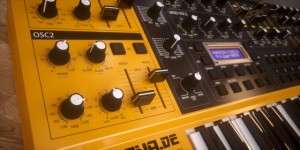
Tyrell is the result of some 10.000 Amazona.de readers who in a number of surveys and articles in various forums shared their thoughts about what a polyphonic, affordable analog synthesizer should look like. About one year later the concept is worked out as a proper “virtual” analog synth.
Amazon’s Peter Grandl writes:
our project TYRELL will become reality.
))
First as a Software Synthesizer, programmed by U-He (from the inventors of ZEBRA 2) and hopefully later as an analog hardware device.Urs Heckman (see picture) is working on a Synth-project called DIVA. One part of the project is developing a module which is based on the ROLAND Juno 60. Exactly this synth was also the base for the AMAZONA.de Reader-Survey. Now, Urs will bring both ideas together and will create TYRELL – N6 as the first TYRELL Clone.
Since the last letter we have been contacted by three companies from Europe and China. Each of these companies has expressed interest to realize TYRELL.
PS: BTW – the Software Version of U-He will be free of charge for amazona.de readers. We expected a beta-version before Christmas this year!!
Via CDM
Close look at the KORG Mono/Poly
Here is a higher-quality version of the Korg Monopoly video
Vintage synth guru Marc Doty takes a look at the Korg Mono/Poly – a “mono-polyphonic” analog synthesizer manufactured by Korg from 1981 to 1984.
“It’s like playing 4 cheap synthesizers at once,” said Vince Clarke about the Korg Mono/Poly.
Features include 4 VCOs with tuning, footage (16, 8, 4, 2), waveshape (triangle, saw, pulse-width, and pulse-width modulated), and amplitude.
The main drawback of the Mono/Poly is that the 4 VCOs shared one common VCA and VCF envelope. Other drawbacks are its chipboard construction on the base and sides of the unit and the rubber contacts under the keyboard tend to wear over time, resulting in dead keys.
Korg Mono/Poly Synthesizer Resources:
- Korg has released a software synth version of the Korg Mono/Poly, Mono/Poly:Legacy
- Korg Mono/Poly at Vintage Synth Explorer
- Korg Mono/Poly at Synthmuseum
Via ST
New flash-based modular synthesizer on the web
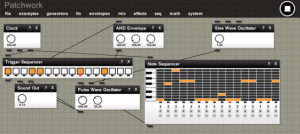
Developer Peter van der Noord has announced Patchwork, a free Flash-based modular synthesizer:
Patchwork is a Flash application for realtime modular sound synthesis. You can connect basic sound generation or modification modules to create either music, effects or utter noisy crap. Although at the moment it has an interface for creating a so-called patch, you will in the future be able to run your creations standalone, which means: in your own site or game.
Patchwork is inspired by applications like Max/MSP & Reaktor, but van der Noord says it’s “a proof of concept.”
Check it out at petervandernoord.nl
Analog Labratory is now shipping
Arturia announces that Analog Laboratory is now shipping. The Analog Laboratory is an extremely powerful software synthesizer solution. It offers 3500 legendary classic synthesizer sounds with a unique interface to tweak them all as well as the ability to edit each of them in depth, in the original synthesizer. With the addition of 200 scenes organized by genres, including drum loops and advanced arpeggiation melodies, Analog Laboratory is likely to become the reference synth workstation.
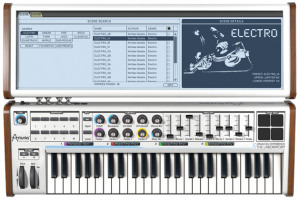
Main Features:
o 3500 synthesizer sounds selected from the Arturia Classic Synths (minimoog-V, Moog modular V, CS-80V, Prophet-V, ARP2600 V and Jupiter-8V).
o Full screen preset editing (for owners of Arturia Classic Analog recreations only): Analog Laboratory allows opening any other Arturia Classic Synth plugin for in depth patch edition in a separate window. It is also possible to assign any of the 4 key parameters of the Laboratory to one knob of choice inside the favourite software synthesizer.
o Scene mode: It allows to:
– Combine 2 synthesizer sounds over a MIDI keyboard in either split, layer or multi configuration.
– Assign melodic phrases based on advanced arpeggiation thanks to the library of 200 melodies organized by genres.
– Trigger Drum loops from the pads thanks to a library of 350 Rex files.
o Organize Presets view by Name, Instrument, Type, CPU usage, Favorites, or User Preset.
o Fast filter the presets to meet requirements: by Instrument, Type and Characteristics
o TAE® powered sounds with unparalleled audio quality.
o Midi Learn Controllers: 1 clickable encoder, 10 encoders, 8 sliders, 11 switches, 1 modulation wheel, 1 pitch bend wheel.
MSRP: $299/Euro 269. INTRODUCTORY OFFER: The first 1000 units are sold at discount price: Buy Analog Laboratory for the price of Analog Factory. Instead of $299/Euro 269, pay $249/Euro 229.
Via GJ
Martin Peters in synth action
Here’s another one of synthesist Martin Peters‘ Berlin School style synth jams, Incredible.
“Yesterday evening I was dialing in some sequences and it sounded very nice. But after recording a video it appeared that the sound recording was not alright, very distorted. So this evening I made a new video after first testing the sound recording. Now it is OK and the session is way better that yesterday evening so I guess this was meant to be. The song starts with an 8-step sequence on the Doepfer MAQ16/3 driving the the Ian Fritz Teezer Through-Zero VCO/Blacet MiniWave voice and a bass tone from the Synthesizers.com which is driven by the Q960. The Q963 is used to turn on and off individual stages for the bass tones. After that arpeggiated tones from the Waldorf Q Keyboard are introduced. Then the volume of the 8-step sequence from the MAQ16/3 for the self-built Modular is turned up. Strings are played on the Roland XP-80 and the solo on the Clavia Nord Lead 1.
The title refers to my friend Anne; she is a truly incredible woman.”
The whole video is just over 20 minutes long and you can download the video and/or the music from Martins website.
96-knobs dedicated MIDI controller for the Rhodes Chroma
The Enabler is a custom made 96-knob dedicated MIDI controller for the CC+ equipped Rhodes Chroma synthesizer.
The Rhodes Chroma is considered by many to be one of the great synthesizers – but it buries a lot of power, because of its limited number of hands-on controls. The Enabler is designed to enhance the Chroma will full-on hardware controls.
The Enabler retails for $2,600.
Features:
- Inspired by the industrial design of the Chroma
- All exposed woodwork is solid cherry
- 2×16 amber LCD display shows parameter name and value when a knob is adjusted
- LED indicator lights to indicate the selected patch type
- Powered by external 9-12v DC supply
via randelosborne:
This is a brief demonstration of the ENABLER, my 97-knob controller for the CC+ equipped Rhodes Chroma.
Death skull synth
a lovely 4093 quad nand synth inside a cheapo halloween skull.
4 cascaded oscillators and a voltage starve as standard. A colour changing LED which can be switched on and off and a trigger button and switch for making the noises happen.
Dune, previously PC-only, is now available for Macs
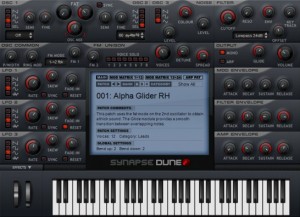
Synapse Audio has announced that its software synthesizer Dune, previously PC-only, is now available for Macs.
DUNE is Synapse Audio’s flagship synthesizer, a massively deep, versatile, high-quality instrument developed for the needs of professional music producers.
The differential unison engine (DUNE) takes the concept of subtractive synthesis to the next level, by allowing full control of each unison voice. This greatly extends the range of possible sounds, reaching deep into FM and Wavetable synthesis.
Whether you’re looking for lush pads, fat basses, punchy kicks, cutting leads, multi-layered pads and textures, complex FX sounds or morphing – anything is possible in Dune! Use the menu on the left to find out more details about its concepts, but most importantly, download the free demo and see for yourself.
Despite its complexity, Dune is easy to use. This is because it is conceptually a subtractive synth, hence it will be familiar to many musicians who are used to work with (virtual-)analog gear.
As you can see on the screenshot, it uses the familiar Oscillator, LFO and ADSR envelope sections on the surface, known from many synthesizers. All knobs can be remote-controlled via MIDI for hands-on access.
Dune is available now for PC and Mac (VST/AU) for $139.
How to turn your guitar into a Moog synthesizer
Well here’s the answer
Moog is a trademark of Moog Music, Inc.
Electro-Harmonix Effectology, Vol.19 “How to turn your guitar into a Moog synthesizer”
By Bill Ruppert
Welcome to Electro-Harmonix’s “Effectology” series, in which we create a remarkable collection of impossible sounds using just a regular guitar and EHX effect pedals!
No keyboards, samplers or midi pickups were used.
In this episode I show how to turn a regular guitar into a Moog synthesizer!
There is a demonstration of the famous recording Switched-on Bach and Emerson Lake and Palmer’s classic synthesizer solo from the song ‘Lucky Man”.
Both records featured the epic original Moog modular synthesizer.
Updated NLogSynth Pro – virtual analog synth for the iPad
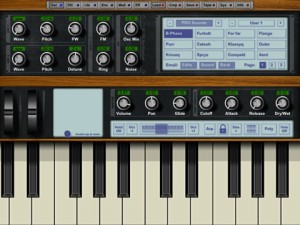
Tempo Rubato has released an update to NLogSynth Pro (App Store link), a virtual analog synth for the iPad, adding hardware MIDI support via the iPad Camera Connector Kit.
Here’s what’s new in version 3.1:
- iOS 4.2 support
- CoreMIDI support for controlling NLogSynth PRO with USB devices via Camera Connection Kit
- MIDI Out support (in addition to MIDI In) for Line6′ Midi Mobilizer, e.g. for controlling MIDI Sound Modules with NLogSynth PRO or for interfacing to Computer via MIDI Serial Line
- Rotation: NLogSynth PRO keeps now the orientation it has started with
- Bug fixes
DATAMASKIN

