
Time machine: Roland SH-101
Vintage synthesizer demo track by RetroSound
“Therapy”
The SH-101 is very cool, especially for techno, drum&bass and ACID! It’s a monophonic bass synthesizer. Its sound lies somewhere between the TB-303 and a Juno bass sound. It has a lot of simple but cool features. You can control the VCF, pitch, LFO or all from the pitch bender. It has a white noise generator, arpeggiator with up, down and up/down patterns and a simple real-time sequencer. The LFO offers random, sine, square or noise waveforms. And normal or auto portamento effects give you that elastic bass sound. There are external clock inputs for the sequencer and arpeggiator, CV/GATE inputs and outputs and a CV hold pedal.
Unfortunately there is no patch memory storage and although it has no MIDI there are upgrades available for it from many analog service companies that will allow you to incorporate it into any MIDI studio environment. It can also be controlled by MIDI using a CV/MIDI converter. It’s great for bass sounds or bubbly analog effects. They come in three different flavors – gray, blue or red (there was a VERY rare white version too)! It can also be strapped on like a guitar for live performance using the optional Hand Grip.
all synthesizer sounds: Roland SH-101 Analog Synthesizer (1983)
drums: Roland TR-808
recording: multi-tracking without midi
fx: a bit reverb and delay
more info: http://www.retrosound.de
Time machine: KORG SUPER SECTION PSS-50 from 1984
The Korg “Super Section” PSS-50 is a little accompaniment box from 1984. It contains 8-bit drum samples and analog sound generation for bass and chord. It sounds similar to the Korg SAS-20. The synth engine sounds similar to the Poly-800. No MIDI.
“It’s rather a funny toy for collectors than a serious musical instrument. Not really programmable. It has that typical Poly-800 design – I guess the same product designers did the work.”
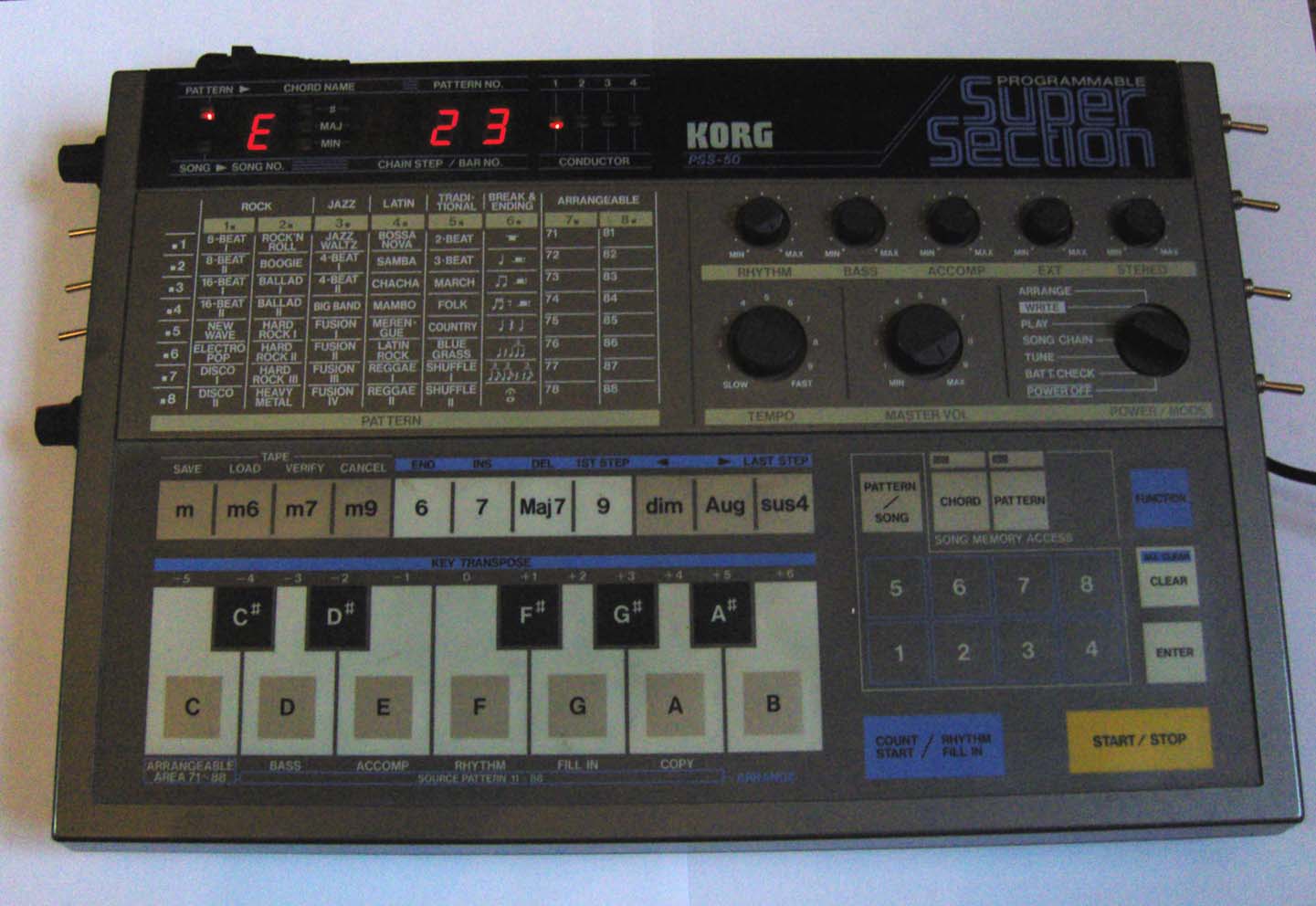
The name “Programmable Super Section” is a bit confusing, as only 40 preset patterns and 8 interchangeable fills/ endings are available, making 16 of “your very own” variations storable.
These variations are composed of drum sounds, bass and accompaniment, each volume level being separately controllable. The membrane keys, offering 12 different types of chords, can be used to transpose variations to different pitches.
The bass drum, snare, rimshot, open/closed hihat, hi/lo tom and handclaps sound like early PCM samples, just with their own, peculiar charm. The warm, analog-like bass and chords synth sounds could originate from a simplified subtractive synthesis similar to the Korg Poly 800, with only 1 bass and 12 chord sounds.
Time machine: YAMAHA CS-5 Analog Synthesizer 1978
Time for a new vintage synth feature – this time the Yamaha CS-5, details below:
The YAMAHA CS-5 came out 1978. It is a monophonic synthesizer equipped with 1 VCO, 1 multimode resonant filter (highpass, lowpass, bandpass), 1 LFO, 1 noise generator, 1 envelope. It also has an external signal input. This is great for processing signals – a bit like Korg MS-20. The LFO is very fast. It has CV and trigger inputs/outputs.
The CS-5 has the S&H waveform in the LFO, which the CS-10 does not have. This is very important to produce great FX sounds! On the other hand the CS-5 has only 1 envelope.
A nice little synth with some great sounds!
I played the CS-5 along with a Roland DEP-5 (delay) and a Lexicon MPX-500 (reverb).
Time machine: PPG Waveterm A – Original Factory Sample Library (8bit)
Vintage synthesizer demo of the PPG Waveterm. The PPG Waveterm A – or just PPG Waveterm – was PPG’s first entry into a full studio solution. The PPG Waveterm A does NOT produce any sound itself meaning you will need a PPG Component like the PPG Wave 2.2, PPG Wave 2.3 or PPG EVU if you want to hear anything you do on it. The PPG Waveterm made PPG owners able to produce their own wavetables and to save their own programs to floppy disk instead of tape using the Cassette interface. It also made PPG owners able to create songs and to – most importantly to most – sample something and play it back using the PPG Wave 2.2. The PPG Waveterm is based on an old german computer called Eltec Eurocom II based on the Motorola 6809 processor, and can be set up to run the ‘ordinary’ Eurocom II software (Flex 9). You can also hook up a keyboard and a printer to it to have a ‘fully featured’ home computer – a very expensive one though. The PPG Waveterm was not cheap – but it was a giant leap in music technology, and the quality of the samples you could produce using the PPG Waveterm was astonishing back then in all its 8 bit glory.
all 8 bit samples are from the original PPG Waveterm A sample library (1982) played over the PPG wave 2.2 synth.
no PPG wave 2.2 sounds used!
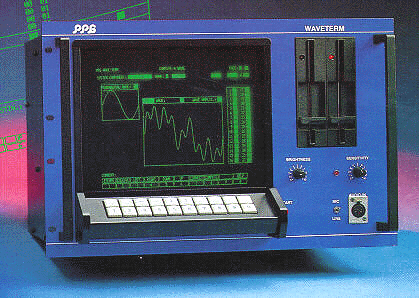
The Waveterm A is the heart of the legendary PPG system and based on an old german computer called Eltec Eurocom II with Motorola 6809 processor.
– creation of Waves and Wavetables
– fourier analysis / resonator
– additive synthesis
– 8 bit Sampling for the WAVE 2.2
– sequencer / event generator
– storage of sounds on 8″ disc
more info over the PPG Waveterm A:
http://www.retrosound.de/PPG-Waveterm…
Time machine: Birotron B90
The rarest manufactured instrument – the extinct and impossible to find Birotron playing worn out mixed tapes of string section, brass, violas, choir, and flutes across the keyboard.
The Birotron (pronounced By-ro-tron) is a tape replay keyboard conceived by Dave Biro of Yalesville, Connecticut, USA, and funded by Rick Wakeman of the progressive-rock group Yes, and Campbell Soup Company-Pepperidge Farm Foods in the mid-late 1970s. A Mellotron-like instrument in the prototype stage, and intended for mass production – it was featured on a hit single and used on several albums and tours. It appeared in advertisements and received press in several newspapers as the next ‘latest and greatest’ keyboard instrument. It also received over 1000 advance orders from many prominent musicians worldwide including members of the Beatles and Led Zeppelin. Despite this success, it is now generally considered the world’s rarest keyboard instrument in the genres of pop/rock music. It also retains the highest selling price for any Mellotron related keyboard, and since its inception, has been one of the most difficult to find, seldom seen, and least recorded instruments in the entire world.
“The musician is Chris Dale who very kindly let me do the video.
So what did this instrument sound like with a decent set of unworn tapes???? That is a mystery…..Sadly we may never know.”
Time machine: Exploring the PPG wave 2.2
The German made PPG (Palm Products GmbH) Wave 2 series of synthesizers are incredibly great sounding analog/digital hybrid vintage synths. They use digital samples of wavetables and feature analog VCA envelope and VCF (filter) sections for a classic and warm sound. The Wave 2.2 has oscillators that can generate over 2,000 different single-cycle 8-bit digital waveforms! Covered by knobs, the Wave still looks analog and this comprises the “Analog Control Panel”. More complex and new-wave editing of the wavetables and samples is covered by the “Digital Control Panel” where there are several key-pad buttons and an LCD screen. Another familiar treat to analog junkies is the inclusion of an 8-track sequencer which features automation of pitch, loudness, filter cutoff, waveforms and more. A cool feature – its onboard sequencer will also record any filtering and wave changes, in real-time!!
The more commonly encountered Wave 2.3 (pictured) followed the 2.2 and had enhanced sample-playback capabilities. The sampler was pretty full-featured for its time and included upgraded 12-bit digital waveforms, Fourier analysis and linear playback of samples. The 2.3 model also featured 8-parts multitimbrality and MIDI implementation. The PPG Waves are know to create excellent pads, brass and bass sounds.
In fact it was Tangerine Dream who helped the company and the Wave develop. 1978 saw the development of the PPG Wave Computer 360. But the Wave Computer sounded harsh and tinny. In 1981, the PPG Wave 2 was released which added analog VCF and VCA filter and envelopes to warm the digital sound. The original Wave 2 had 8-voice polyphony, like the 2.2 and 2.3, but it had only one oscillator per voice. The 2.2 offered two oscillators per voice which opened up a whole new realm of sonic possibilities because two separate wavetable sounds could now be combined.
Vintage synthesizer track by RetroSound
“Miami Nights”
all synthesizer sounds: PPG wave 2.2 Wavetable Synthesizer (1982)
drums: Roland TR-707
sequencing: internal sequencer
recording: multi-tracking without midi
fx: a bit reverb and delay
more info: http://www.retrosound.de
Time machine: ROLAND TR-505 Vintage Drum Machine 1986
The Roland TR-505 is a little programmable digital drum machine from 1986. This demo shows some of AnalogAudio1’s own patterns.
Accent is programmable. It’s some kind of mini-combination of a TR-707 and TR-727 since it has percussion sounds in addition. It has similar sounds. It has MIDI but no single outputs and no Roland SYNC-Interface. Shuffle functions available.
A cheap (budget) drum machine. It features 16 drum tones which unfortunately, are only mediocre samples. Its memory contains 48 patterns and 6 songs. Unlike its TR cousins it does not have individual drum tone outputs. There is no drum tone editing capability either. It does however feature extensive MIDI implementation, even the pads will transmit MIDI data. The 505 works well with a computer and sequencer or as a stand alone drum machine. It is extremely basic and unexciting but does make a good starter or play-along drum machine.
Time machine: HOHNER STRING PERFORMER String Machine 1977
This german early eighties string keyboard was one of the last variations on building a string ensemble keyboard with or without some extras added. The Hohner String Performer is a string machine made in Germany. It has strings in 3 footages (CELLO, VIOLA, VIOLIN), which are mixable via volume faders. Also CLAVICHORD and PIANO presets, all free mixable. Each half of the keyboard has these features. A bass preset can be added to the left half of the keyboard. Like most string machines, the keyboard is split in the middle so that you can adjust the volumes seperately for the lower and upper part of the keyboard. The sliders for adjusting the volume of each basic sound works upside-down, like drawbars, i.e. you pull the slider towards yourself for raising the volume of a sound. Also, each sound can be muted with a corresponding button. The Performer has a minimal amount of control for adjusting the sound: only the release (called “sustain” on the Performer) time can be controlled. Also, the ensemble effect is a part of the string sound and cannot be switched off or variated. Fortunately, the string sound is really good.
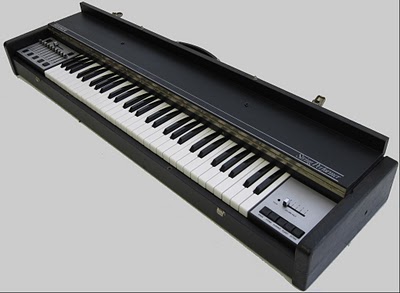
“On the right, there is a simple monophonic preset synthesizer with 4 presets: BRASS, STRING, CLARINET and PLANET. To be honest, I didn’t know that a planet could be a musical instrument – but Hohner should know 
The String Performer is fully polyphonic and has a decent analog string tone. It is quite large and heavy.”
Time machine: ROLAND TR-707 Vintage Drum Machine 1985
The Roland TR-707 is a classic programmable digital drum machine from 1985.
Accent is programmable. It has MIDI and also the Roland SYNC-Interface. It has single outputs for the drum sounds. The TR-707 has fifteen digitally sampled sounds and also shuffle functions.
The TR-707 was a staple in early house music, particularly with acid house.
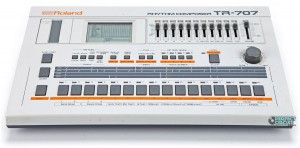
Additional information:
A very underrated drum machine! It resembles the popular TR-909, and better yet, its hi-hat, cymbals, and clap sound almost identical to the TR-909! The TR-707 is a great source for cheap 909 samples. It has some other cool features too such as its Matrix display which clearly maps out your pattern for you in an easy to read display panel. It also features both MIDI in/out and DIN sync control – the best of both worlds. Why this unit even has individual outputs for each of its drum tones!
For programming, it features a shuffle and flam effect and its programming abilities are very impressive. But it does have its limitations, the only adjustment you can make to each drum tone is volume. And all of its other drum tones are boring (especially ride, kick and snare).
Tme machine: YAMAHA AN1x “X-Rays”
The AN1x is a powerful retro-analog synth with a really cool new feature that lets you record real-time editing and filtering and be able to store it as part of the sound! A major contender in the new wave of analog-digital synths using DSP modeling of analog waveforms to recreate the coveted sounds of analog synths with modern digital specifications. It offers truly traditional yet modern methods of analog synthesizing, 10 notes of polyphony, 8 knobs for tweaking, and an arpeggiator with dozens of inspiring patterns!
Although the AN1x is not a follow-up to the CS1x (which has since been followed by the CS2x and the CS6x) it has borrowed many functions and technologies from the CS1x synth. First, it’s built in an almost identical case with the same layout of buttons and knobs as the CS1x. However the function of every knob and button has been greatly expanded. The AN1x also has 2 Scene memories for instant recall of any envelope and filter settings and the mod-wheel can be used to morph between the two scenes. On-board effects and a state-of-the-art arpeggiator section also are on-board for giving your sounds life and motion.
The AN1x adds a new Ribbon controller for increased real-time control. It also includes pulse width modulation, ring modulation and oscillator syncing. The AN1x may not be the next evolution of the CS1x but it is basically a more advanced synth capable of increased sound potential and quality. It has a better feeling keyboard than the CS1x as well assuming that the AN1x is for those looking for something more professional than the CS1x.
Synthesizer demo track by RetroSound
“X-Rays”
all synthesizer sounds and drums: YAMAHA AN1x VA Synthesizer (1997)
sequencing: internal step-sequencer
recording: multi-tracking without midi
X-Rays (Röntgen X-radiation) is a form of electromagnetic radiation. X-rays have a wavelength in the range of 0.01 to 10 nanometers. (wikipedia)
I know this is the vintage synth channel but for me is the YAMAHA AN1x synthesizer from the year 1997 the best virtual-analog synth ever. absolut deep and unique sound. so underrated in my opinion.
more info: http://www.retrosound.de and
http://www.facebook.com/pages/RetroSo…
DATAMASKIN

