
Pokemon one man band
Pretty funny I must say 
Introducing the Chipophone – 8bit organ
Linus Akesson’s Chipophone is a homemade 8-bit synthesizer, designed for live chiptune playing.
It has been built inside an old electronic organ. All the original tone-generating parts have been disconnected, and the keys, pedals, knobs and switches rerouted to a microcontroller which transforms them into MIDI signals. Those are then parsed by a second microcontroller, which acts as a synthesizer.
Details at the Linusakkeson site.
Tutorial: creating impact sound effects
This sound design tutorial, via Jim Stout of designingsound, takes a look at creating impact sound effects, starting with the sound of a tap on his garage door.
Native Instruments is using a live appearance to tease new hardware
There are two jog wheels, so two “decks” in the sense of platters you can control physically at once. There indeed appear to be mix controls for up to four decks, which makes perfect sense for Traktor’s up-to-four-deck controls.
DJs have some choices when it comes to controller hardware for Traktor; NI themselves have pushed compatibility with a variety of hardware, NI will support MIDI, as that could open up fun applications well beyond just Traktor.
Cool 4 KILOBYTE demo from Offence for the Commodore C64.
Very cool 4 KILOBYTE demo from Offence for the Commodore C64.
The effects are tightly synced to the audio, which didn’t come through very well thanks to YouTube being poop. So download it for your C64 and test it on the real thing.
What seems to be quite impressive is that the creator of the demo (who assumed the roles of coder, graphician and musician) started doing stuff for the C64 only one year ago. Impressive!
MicDroid is a free AutoTune-style app for Android.
MicDroid is a free AutoTune-style app for Android.
According to the developer, it’s similar to the I Am T-Pain app for the iPhone, but not as fully featured.
It’s based on the AutoTalent LADSPA plugin, by Tom Baran.
MicDroid gives you many options to adjust the pitch of you vocal recordings and gives users the ability to save recordings, make ringtones out of them, and even email them to friends.
It’s available on the Android Market for free, although there is a donation version for $2..99 (in case you want to show support to the developer). The app is purely for entertainment purposes and will probably result in lots of laughter (unless you can actually sing).
Amazingly sounding vocoder for iPhone/iPod and iPad
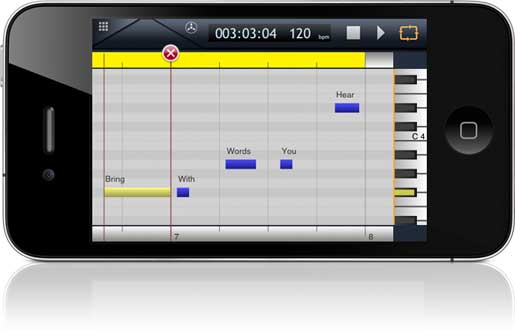
Virsyn have announced iVoxel, the singing vocoder. Here’s what they have to say about it…
iVoxel is not only an amazingly sounding vocoder for iPhone/iPod and iPad – the unique concept of iVoxel turns this vocoder into a singing machine. iVoxel is a combination of a voice optimized synthesizer and a vocoder. The vocoder part is based on the Matrix vocoder from VirSyn used by many famous artists – one of them the well known german group Kraftwerk. The channel filters used by iVoxel are based on the Sennheiser Vocoder VSM201 resulting in a rich and fat analogue sound characteristic.
You can use iVoxel in two different ways:
As a realtime vocoder talking into the microphone while playing tunes on the keyboard. The sound character of your voice can be changed in many different aspects like pitch, gender or breath noise.
Record the analyzed spectrum of phrases and words from your own voice. Then use these voxels to play with your own voice on the keyboard or with the build in sequencer. Over 200 hundred prerecorded voxels are already included.
The output of your creations can be recorded to an audio file which you can use with other Apps and programs for further processing.
Features:
- Realtime analysis/resynthesis of your voice
- 20 Channel vocoder
- Voice spectrum recorder (voxels)
- Over 200 prerecorded voxels included
- Play your vocoded voice live on keyboard. Drag for slides and vibrato.
- Sequencer for notes & lyrics
- Voice optimized monophonic synthesizer
- Time warping of voxels
- Gender changer
- Breath noise
- 12dB Lowpass filter
- Pitch vibrato with delay
- Chorus/Delay effects
- Export/Import of projects and voxels
- Export of audio recordings
Enthusiastic SuperCollider user
Code 64 on the move
All is set for the new Code 64 album
Swedish/Norwegian electropop band Code 64 is on the move again, after the excellent single “Stasis”. A full length album called “Trialogue” is out on September 8 in Scandinavia, and on September 10 in the rest of the world. It’s on Progress Productions, and as usual when they are involved the first 200 copies will be a special edition, featuring remixes from amongst others Mind.in.a.box. You can listen to two of the songs on the Progress web site.
Sir Elliot has released Brass Instrument Equaliser, a freeware equalizer
It was solely designed for Trombones, Saxophones, Trumpets and so forth. Jazz, & Classical Music is the concept behind this Parametric Equaliser.
There is also the option to configure the Q in a very narrow mode. This enables you to reduce peaks at certain frequencies that arise from troublesome rooms and, addressing offending frequencies from microphone feedback.
Brass Instrument Equaliser features
- Tuneable Frequency Range: Five-fixed-band frequency contours offering a total sweep able range from 10 – 21000 cps.
- Q Selector: Three mode selectable Q’s ranging from 0.27 (wide) – 60.36 (narrow).
- Input Level Control.
- Overall Loudness Control.
- Left/Right Output VU Meters.
- Maximum Power Consumption: 2.4% on a Pentium 4, 2.8 GHZ computer on Windows XP (Non Service Pack).
DATAMASKIN

