
Exclusive EP from Front Line Assembly on its way
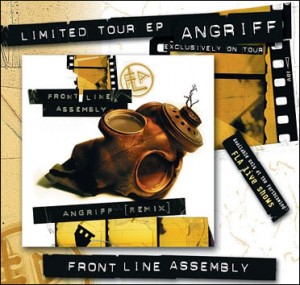
Front Line Assembly will have an exclusive tour EP, “Angriff” (Attack), taken from their album “Improvised Electronic Device “. This EP will only be available at the band’s concerts. This limited EP contains five new versions of “Angriff”, two previously unreleased new songs plus a radio edit. The remixers are Project Pithfork, Tim Skold (Marilyn Manson / KMFDM), Mindless Faith, tour colleagues mind.in.a.box and FLA themselves. You can check the song after the jump or order it at iTunes.
So what is sonic by the way?
SonicBirth is a free Mac OS X app for for creating AU plug-in instruments and sound processors for use in applications like Logic, GarageBand and others with Audio Unit support.
This tutorial will show you how to create a simple reverb unit.
Download SonicBirth at Sourceforge.net.
Into LoFi anyone?
Who doesn´t dig LoFi?
Buck is a circuit bender and multi-media artist in Chicago. He is also regular presence at Roth Mobot’s weekly Electronic Symposium meetups at Lizard’s Liquid Lounge and has recently been making some really interesting instruments and video work.
For the big guys – soon to be released Tonelux 1628 Mixing Board
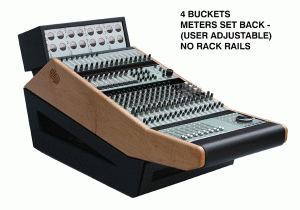
Here is a snapshot of the soon to be released Tonelux 1628 Mixing Board. It will have 16 Channels of the famous Tonelux Mic Pres. The EQs and Summing are arranged into a plug and play console format, ready to use, including a professional 192 point patchbay.
Features :
• 16 MX2 Mix Modules
• 16 EQ4P Equalizers
• 16 TR8 Bus Assign Modules
• 16 MP1a Mic Preamps with TILT
• 4 FX2+ Send Master/FX Returns
• 1 SM2 Stereo Master Module
• 1 CR2 Control Room Module
• 1 TB1 TalkBack Module
• 16 P&G Custom Manual Faders, the dB scale matches ShadowMix and ProTools fader scale
• 16 VU Meters in a Removable Bridge, all meters have Peak and VU modes
• 2 Large Stereo VU Meters, with Peak/VU modes
• Custom Designed Wood Sides/Top, made with Bamboo, a sustainable wood
• Leather Bolster
• Complete real TT Patch-bay/Dsub I/O Panel, removable and can swing around the side to mount
• Optional ShadowMix Automation
As shown above: $42,999.99, with ShadowMix Moving Fader Automation, $49,999.99. 8 or 16 channel expanders will be available.
GAIA Synthesizer Sound Designer Software for SH-01 Overview
More talk on the GAIA synth and its software pack
Take Full Control of the GAIA SH-01 GAIA Synthesizer Sound Designer is a specially designed PC/Mac software application for Roland’s award-winning GAIA SH-01 synthesizer. It inspires creativity by allowing GAIA users to conveniently explore every tone parameter on their large computer monitors.
The LEGO rythm machine
Lego Tinguely 2: a mechanical rhythm machine made of Lego. A great idea to use such simple building blocks to generate noise and rhythms. Its sounds could play a role in a musical setting as well, if used in moderation.
the video shows a full “choreography”.
Video Transmission and Electromagnets
Get ready for some serious noise
Video transmission feedback look that is being modulated by an electromagnet whose own energy is received from the audio produced by the system.
Acid 64 in a new version

New
- Added native support for JSidplay2 and JSidDevice
Improvements
- Faster startup time
- Emulation improvements
- Copy file/directory added to context menu
- Many small improvements
Fixes
- ACID64 couldn’t start on some Windows 7 64 bit machines
- Turning filter off and seek back turned filter on
- Switching device and then seeking could silent the tune
- Fast forward could freeze GUI in some cases
ACID 64 Player – Commodore 64 Music Player for all HardSID devices.
Experimenting with the obsolete LM8972 rhythm generator IC
Experimenting with the awesome and obsolete LM8972 rhythm generator IC. I have two LM8972s and a CD4024 clock divider wired up. I’m using the divider to send a 1/2 speed clock to the second LM8972 and a 1/8 speed pulse is activating different drum sequences. Adding a second rhythm IC and divider adds LOTS of variety to the output
First glimpse of the Mutable Instruments ShrutHI-1 digital/analog hybrid monosynth
A sneak preview of a new DIY synth project – the Mutable Instruments ShrutHI-1 digital/analog hybrid monosynth.
The video demonstrates some of the presets on ShrutHi-1 Kit #000.
Specs below. See the Mutable Instruments site for details.
2 digital oscillators
- band-limited sawtooth with adjustable phase
- band-limited square wave with adjustable pulse-width
- band-limited triangle wave with adjustable waveshapping
- phase-distortion emulation of a low-pass filtered sawtooth (casio CZ-101)
- phase-distortion emulation of a low-pass filtered sawtooth with high resonance (casio CZ-101)
- phase-distortion emulation of a low-pass filtered sawtooth in the Rocker Launcher’s world in which sine waves are turned into triangles (casio CZ-101)
- mysterious phase-distortion thing (could have been in the CZ-101 if the engineers at casio dared…)
- phase-distortion emulation of a Jew’s harp / Morsing (could have been in the casio CZ-101)
- stack of 4 detuned sawtooth waves (with aliasing)
- simplistic FM (1>2 configuration), with adjustable modulation index and frequency ratio
- wavetables, wavetables, wavetables!
- sweepable table of basic waveforms
- tampura transwave
- PPG harsh creature
- single cycle waveforms taken from D50 patches
- cello transwave
- slap bass transwave
- organ/drawbars single cycle waveforms
- male voice
- user wavetable, can be edited by SysEx messages
- 8bit-like harsh waveforms with wavetable scan
- sine wave with variable amount of bitcrushing
- poor man’s square with pulse-width modulation (plenty of aliasing but fat for basses)
- colored noise (sweep from low-pass filtered white noise -> white noise -> high-pass filtered white noise)
- lo-fi vowel synthesis (think “speak and spell”) with vowel morphing
Mixer
- adjustable oscillator balance
- mixing algorithms: simple sum, simple sum with synchronization, ring modulator, xor modulator, sum with post-mixing tanh fuzz
- extra sources: noise, sub-oscillator (triangle or square) or percussive attack generator (click, glitch, blow, metallic, pop)
Audio quality/resolution
- Internal digital audio signal processing chain: 39062 Hz, 8 bits.
- Internal digital control signals processing chain: 976 Hz, 8 bits.
- Digital outputs: 10 MHz, 1 bit.
Filter
- Exchangeable analog signal processing boards:
- CEM3379: based on the CEM3379, uses the same circuit as the original Shruti-1 with the “click filtering” mod
- SMR4: a 4-pole LPF (very SSM2044-like) and linear VCA built with the widely available LM13700 transconductance amplifier and TL074 op-amp
- SSM2044: SSM2044 4-pole LPF, SSM2164 2-poles HPF + linear VCA.
- (à suivre)
Modulation
- LFOs: 2, with square, sawtooth, triangle, sample & hold, and step sequencer shapes. Syncable to tempo. Adjustable “raise/attack” time. LFOs can be free-running, sync’ed to envelope retriggers, or retrigger envelopes.
- envelopes 2 ADSR
- modulation matrix: up to 12 source -> destination connections. Adjustable modulation amount in the -100% — 100% range
- modulation sources:
- LFO 1/2
- step sequencer
- first / second half of the step sequence
- arpeggiator gate
- mod. wheel
- aftertouch
- pitch bender
- DC offset
- CV inputs 1/2/3/4
- MIDI CC 16 to 19
- noise generator
- env 1/2
- random value resampled at each note on
- note velocity
- note number (eg for filter tracking)
- keyboard gate
- audio signal from the mixer output (decimated at 1kHz)
- modulation destinations:
- filter cutoff
- VCA gain
- pulse width/Parameter osc. 1/2
- wide pitch osc. 1/2
- pitch, applied to osc 1 & 2 simultaneously
- very fine pitch, applied to osc 1 & 2 simultaneously
- oscillator balance
- noise level
- subosc level
- resonance
- PWM CV output 1
- PWM CV output 2
- 2 bits digital value on CV output 1/2
- LFO1 FM
- LFO2 FM
Performance
Clock/tempo generator
- internal clock: 40-240 BPM, with some additional extra fast tempi for effects (270, 300, 360, 480, 600, 720, 960)
- external MIDI clock with divider
- 6 groove templates (swing, shuffle, push, lag, human, monkey) with adjustable amount
Arpeggiator
- 1-4 octave range
- up, down, up&down, random
- 15 preset rhythmic patterns + 1 programmable rhythmic pattern
- warp: creates complex rhythms by cyclical repetitions of steps (eg 1212343456567878 instead of 12345678)
- latch/hold
Sequencer
- 16 steps, with legato/slide, velocity, and modulation
- 4 modes corresponding to different interactions between the sequence and keyboard play: latch / transpose / loop recorder / override
Performance
- custom page in which 4 user-selectable parameters can be assigned to the 4 editing pots
- microtunings/key maps for arabic scales (1/4 tones) and a selection of hindustani ragas
- portamento, legato on/off
- master tune
System and memory
- complete MIDI implementation, including patch editing by CC or NRPNs, patch and sequencer data transfer, full memory backup, wavetable transfer
- MIDI out modes: off, thru, thru+knob movements sent as CC, sequencer/arpeggiator generated events only, polychaining, split (plays notes below split point, forwards the other notes)
- patch memory: 80 patches and 80 sequences stored in EEPROM (no backup battery required)
- firmware update by SysEx
Hardware and connectors
- power: 2.1mm connector, requires 7.5V-9V 300mA supply (can be unregulated). Center pin positive (+), outer collar negative (-)
- audio input/output: 6.35 Jack (Mono audio out), 6.35 Jack (External signal in)
- cv inputs: up to 4 CV inputs for easy experimentation with controllers ( might not be broken out on analog VCF/VCA board )
- cv outputs: up to 2 CV outputs ( might not be broken out on analog VCF/VCA board )
- MIDI: in, out
- serial: extra UART TX pin available on control panel board (might be used in future firmware updates to control extension boards)
- ISP connector for firmware development
- controllers:
- 8 facade LEDs (current page / modulation matrix visualization)
- 6 navigation switches
- 4 pots for patch editing
- clickable rotary encoder for fine parameter adjustment or navigationbacklit 2×16 LCD display
DATAMASKIN

