
Electro-pop: Cinemascape – Night Vision
This is the new official video for Cinemascape’s single “Night Vision”, from their debut album “The Falling Impossible” which is re-released on April 6. The video was directed by Cinemascape and Henrik Palm.
New concept for level independent dynamic processing
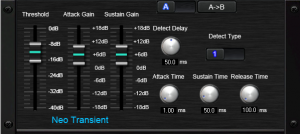
Sound Magic has introduced Neo Transient:
Unlike common compressors and limiters, Neo Transient reacts on Transients – those short peaks in the audio signal – rather than the overall signal loudness level. In this way, Neo Transient creates an entirely new way to process your tracks.
Neo Transient allows you to completely reshape the attack and sustain characteristics of a sound. You can shorten or lengthen the attack of all kinds of percussive signals, such as the bass drum, snare drums, toms, congas and so on, to give them more impact, change them to a punchier sound. Or go the other direction and make those sounds gentler than before.By boosting the attack period of a sound, such as a bass drum, the mix can be made to sound more transparent. Instruments can be mixed at lower volume while still maintaining their positions in the mix without costing needed headroom. By boosting the sustain stage of the sound, you can emphasize the ambiences and reverb-tails of the sound.
Neo Transient offers two entirely different sets of detection algorithms.These two algorithms have different sounds and will provide you more choices on the final sound it shapes. Parametric controls in Neo Transient are arranged in a easy to understand, musical manner. Neo Transient is a “must have” for processing your percussive signals while recording, mixing or mastering.
Features:
- Two Innovative algorithms, One for level independent dynamic processing , One for peak dependent processing.
- Parametric controls are arranged in a easy to understand, musical manner.
- Adjustable Delay for look forward processing
- Built-in A/B Compare function enables you to compare different settings
- Up to 32Bit/384KHz resolution
Neo Transient is available now for €49.00.
New Semi-Modular Synthesizer – The MEM PALette v2

Magic Echo Music has announced that it is taking ‘pre-orders’ for the PALette V2 – a semi-modular analog synthesizer that updates the original PALette.
Here’s what’s new:
The functions are mostly identical to the original PALette, the synth we love to make.
The changes in V2 are realized through the notable improvements in circuit board design and manufacturing.
We are proud of the improvements, as all PCB mounted hardware are quality parts and the build is durable and reliable for touring. We added internal compensation for room temperature, so that the voltage controlled oscillators are in tune wherever you are.
PALette V2 uses matched transistors so that you get improved tracking with external 1v/octave CV keyboards, and we moved the patch panel to the front, making an accessible interface with 1/4? cables.
The MEM PALette v2 is available for pre-order for US $785. See the MEM site for more information >>
Depeche Mode Studio Setup…
In The Studio 2012
http://www.facebook.com/depechemode
Project: INIT – #01 Vocal Formant Lead with Tone 2 Electrax
http://youtu.be/F-QoAbemLkQ
This video shows how to program a lead patch with vocal formant characteristics with lots of movement.
Here’s what Mark has to say about it:
Project: INIT is a new video series I’m kicking off today. In the videos I will offer real-time behind-the-patch footage taking you on sound design missions from INIT using a variety of sonic weapons. By simply coming along for the ride you’ll learn more about synthesis and how to make unique sounds for your productions.
Exploration and Discovery
A variety of synthesizers will be used focusing mainly on synths that offer interactive visual feedback making it easier for you to connect with the concepts. Don’t worry if you don’t own the exact synth – watch anyway – as concepts & techniques are most likely transferable to most synths and if nothing else I hope to spark some ideas for you.
So, for up-and-coming synthesists and producers the videos will help you grok the world of synthesis in less time. For seasoned synthesists and producers these videos will serve as inspiration for new ideas and help you learn your way around the featured synths more quickly.
Inspiration
I’ve been programming synths for over 20 years (did I just say that out loud?). I’ve been dabbling with behind-the-scenes videos to share my knowledge for quite a while but have always wanted to do a bigger series like this. Inspired by my good friend AfroDJMac (who I collaborated with on Live Packs #38 and #40 ) I’m going to attempt a video per week – zoiks! I’ll be publishing the videos to this playlist on YouTube.
Donations
While the videos are free, donations are most welcome and will encourage me to push on. You should know that early studies indicate that people who find these videos helpful and want more do donate to the cause to encourage work. Also, my wife would appreciate the boost to offset my synth addiction budget :^). I do like books and music so if you want to donate by giving me a copy of your art, contact me – although I do like money – quite a bit really. Did I mention my synth budget? You can also buy my albums.
New firmware and software update for the Continuum Fingerboard

Haken Audio has announced a new firmware and software update for the Continuum Fingerboard. The new version 5.01 includes additions to the innovative programmable synthesizer in the Continuum Fingerboard, the EaganMatrix.
The EaganMatrix design was inspired by classical modular matrix patching synthesizers such as the ARP 2500 and the EMS Synthi 100. However, unlike those analog predecessors, the EaganMatrix doesn’t use pins to make patch point connections. Instead, a dynamic formulaic equation can be placed inside a selected patch point, replacing that static pin, creating a simple to amazingly complex relationship between the Continuum playing surface and the flow of sound from patch point source to destination.
The EaganMatrix is a modular digital synthesizer, allowing the user to finely craft their musical sound by digitally connecting audio and control modules via a patching matrix. The EaganMatrix synthesizer is internal to the Continuum Fingerboard, utilizing the Continuum’s internal DSP engine. No external hardware is required. The synthesizer is edited by using an external cross platform editing program, the Continuum Editor. More information: http://www.hakenaudio.com/Continuum/eaganmatrixoverv.html .

Modules: There are a number of source and destination modules available, everything from oscillators and filters to direct formulas. Here is a listing of currently available modules:
* Three flexible summation oscillators, each with controls for frequency, phase, and spectral balance. The oscillators can also act as wave shapers, creating rich harmonic variations to the oscillator input.
* A smooth organic-sounding noise source.
* Two versatile multimode filters, with these inputs: audio to be filtered, frequency, and bandwidth. Possible filters are LowPass, HighPass, BandPass, LowShelf and HighShelf, as well as unity gain BandPass, Notch, and AllPass.
* Two powerful biquad filter banks, which are banks of 8 related but independent biquad filters, with controls for audio input, frequency, frequency spread, bandwidth, bandwidth spread, spectral centre, and spectral weighting. These biquads are the same technology that are used in the current Continuum to create the physical models like the winds and strings. This filters can also act as granular synthesis modules, and a vocal mouth shapes.
* A time delay, with controls for audio input and time. The time delay is suitable for creating chorus and flanging effects, and can be used for echo delays as well.
* Four independent LFOs, each with controls for cycle mode, frequency, and trigger. Available LFO shapes are RampUp, RampDown, Pulse, Triangle, Hann, Square, Sine, and SampleAndHold. The LFOs have been integrated into the EaganMatrix a unique way, allowing each LFO to influence a formula result directly.
* 8 CVC (Continuum Voltage Convertor) outputs. This requires that a CVC be connected to the Continuum to be active.
* 3 independent Midi controller streams for sending formulas to a connected Midi device.
* Output level via formulas.
Also, there are common controls for all voices:
* Reverb control via formulas.
* Convolution body control via formulas.
The output stage incorporates a soft saturation capability, allowing the creation of distortion and overloading effects.
The download for version 5.01 is available in the downloads section of the Haken Audio site: http://www.hakenaudio.com/Continuum/hakenaudiofirmwa.html .
Time machine: Sequential Circuits Prophet VS
A voyage into the heart of the SCI Prophet VS from the year 1986.
Exploration by Marko Ettlich

Here’s a very cool keyboard from Sequential. Notice the joystick for controlling your sound modeling. The Prophet VS uses Vector Synthesis as its revolutionary new means of sound creation. It uses a total of four oscillators per voice with 127 waveforms (32 user) and dynamic waveform crossfading via the joystick. This was Sequential’s first digital synth, and it was also their final synth unfortunately. But after Sequential was gone, Vector Synthesis technology went into the popular Korg Wavestation and Yamaha’s SY-22 and TG-33. The ProphetVS is still a very sought after instrument because it has an incredible range of sounds! Its only problem is that there’s practically nobody left that can fix it if something went wrong.
Start working for Native Instruments?

NI is hiring about 40 new people in all areas including hardware and software development, design, product management, sales and even Reaktor instrument developer.
Nintendo Emulation System on Reaktor

Salamanderanagram explains:
It contains 4 oscillators – 2 pulse oscillators, a triangle oscillator and a pseudo noise generator. I did not yet add a DMC channel as I was a bit unclear as to how it functioned or how to test my work. When I have some more time I may try to add that functionality to the next release. Other planned upgrades include a polyphonic version, and optimization by turning off unused channels.
I have made an attempt to be true to the character of the NES while discarding superfluous components such as length counters, which can be reasonably ignored since they are not exactly useful outside the context of text-based programming. If there is anything missing that you’d like to see, please let me know.
Download it here.
HyperSpace 3D Synth for iPhone
Synthesize music with sculpted waves; grok mesmerizing visuals.The Strange Agency has introduced a new software synth for iOS, HyperSpace.
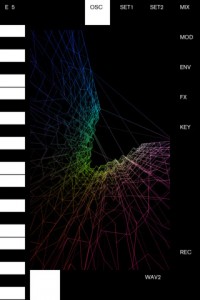
HyperSpace, a ‘waveform-sculpting 3-D oscilloscope synth’ is the latest edition of TSA’s Space series. HyperSpace uses a unique algorithm to generate images from sound. It works similarly to a harmonograph, but uses its 3 voice oscillators instead of pendulums to create images. Each oscillator is mapped to a dimension in 3-D space. Playing a single note creates a wave, like on an ordinary oscilloscope. Playing two notes at once creates a plane as with the harmonograph, and playing a three note chord creates a volume. There are two oscillators to crossfade between. These can be set to standard shapes as with older synths, but HyperSpace also lets you sculpt the waves with touch. Changing the wave shapes of course alters the sound, but it also alters the generated imagery.
DATAMASKIN

