
Mouse on Mars – Live set up with Ableton
For the tour supporting their latest album Parastrophics, Mouse on Mars’ three live members designed an interactive performance system around three laptops running Ableton Live. Learn more about their set-up in a new video feature.
Doepfer Sneak Peek
Not completely new, but we seemed to have missed it:
An interview with the great man himself, taken from the documentary ‘Totally Wired’. Dieter talks about the inspiration for the A100 series, his collaborations with Kraftwerk, and the future of modular. Unmissable!
‘Totally Wired’ is available on DVD from amazon.com
Time machine: Roland Jupiter 4
“This is a little demo i’ve made with the Jupiter 4. Since the first two albums from The Human League, this synth is well known. And i can say, this synth has a very special timbre. The Jup4 is not midified. All lines were played by hand. Only the bassdrum, snare and the HiHats are sampled from the Jupiter 4 and were played by a sampler. I’ve also used the internal JP4 arpeggio. As always a multitrack recording with some fx.”

The first Jupiter synth. It was among one of the first poly synthesizers (4 individual voices which could be synced together for one fat monophonic lead), it had a pitch wheel that could be assigned to the VCA, VCF, VCO or all together, there are 8 memory locations and a cool arpeggiator – the arpeggiator can in the Duran Duran classic, “Rio”. It also has a very slow LFO for those ever-so-long filter sweeps. Pretty good for 1978!
Not so cool however, are the 10 preset sounds which sound nothing like the piano, brass or strings they claim to be. The placement of all the preset buttons below the keyboard can be inconvenient, especially while playing it. And as with most old analog synths, the Jupiter 4’s tuning can go out often. Still it is a nice analog synth for creating weird trippy analog sounds.
ARTURIA – Introducing Wurlitzer V
The Wurlitzer V is a high end software recreation of the classic Wurlitzer 200A electric piano.
Unlike sample libraries, its physical modeling engine reproduces the very acoustic properties of reeds, key action and amplification, bringing you high realism while offering maximum flexibility on sound.
As most producers know, the legendary bright and overdriven Wurlitzer sound heard on classic records also comes from the use of fine amplifiers, micing and processing. This is why the Wurlitzer V goes further by putting you in command of a studio from the 70’s, filled with vintage stompboxes and classic tube amps… everything you need to get a true classic vibe!
If you are looking for a lively electric piano combined with inspiring studio tools, the Wurlitzer V is the ultimate package.
More details here : http://www.arturia.com/evolution/en/products/wurlitzer-v

One of the most cult proclaimed keyboard instruments in the history of music is the Wurlitzer Electric Piano. With its rough and phat sound, the Wurlitzer has left an immense mark on several classic recordings with a variety of performers such as Ray Charles, Steely Dan, the Doors, Sun Ra and Queen just to mention a few.
The Wurlitzer’s basic principles were developed in America in the middle of the 1930s by a man named Ben F. Meissner (b. 1890). In 1932 he patent and licensed several new revolutionary electrical ideas e.g. several TV-components, electron pipes and the Wurlitzer principles (the string less piano). Meissner came up with the idea to place electromagnetic pickups on each string inside an ordinary acoustic piano. In order to achieve a more powerful tone he added reeds inside the piano which he blew air into. His concept caused great interest from different piano manufactures around the country, and his ideas were sold to the Everett Piano Company who came to develop his original ideas. They started to work on the concept but what from the start was supposed to be an electric form of a piano, instead became a more electric organ under the supervising of the Everett Piano Company. But the idea had now reached the big jukebox and organ company, Wurlitzer who realized that the invention had a far greater potential. They took over the development of the piano and instead tried to come up with a electric version of a piano more similar to the Rhodes, than to an organ. To achieve their goals they designed a felt dressed hammer which was placed in the piano in order to stroke the metallic reeds. The vibrations from the stroke on the reeds produced a big fat and rich tone, which was picked up by a pickup system converting the tone into electric energy and leading the tone out of the built in speakers on the front of the piano. The Wurlitzer Electric Piano was born.
The Wurlitzer was in some ways relatively similar to the Rhodes regarding it’s construction and it’s design, but it was also in many ways different. The Wurlitzer was a lot lighter than the Rhodes (who weights at least twice as much) and therefore a lot easier to transport and to carry on the road. It also had built-in speakers with a separate monitor speaker, and a built-in tremolo which early Stage models of the Rhodes did not have.
Wurlitzer released their first electric piano in the beginning of the 1950s. The piano received great attention from the branch organizations and in 1956 the first Wurlitzer album was made by Sun Ra and Demons at Play. Another contributing fact which helped launch the piano was Ray Charles elegant Wurlitzer playing on his huge hit “What I’d Say” from 1959 which gave the Wurlitzer increasing attention. The most famous models are the Wurlitzer 100 and its improved version, the Wurlitzer 200 which replaced the 100 in 1969. The Wurlitzer quickly reached great successes, in particular during the 1960s and the 70s. The piano quickly became popular among touring bands who found it to be a lot lighter than the Rhodes and that the Wurlitzer’s sound more easily could fit into a guitar based band than a Rhodes. The Wurlitzer proved to be useful in more pop and rock oriented music were the Wurlitzer’s thicker and rougher tone easily could be used as a replacement to the guitar. As the popularity of the Wurlitzer grew, keyboardists seemed to become more and more divided into two camps, Rhodes or Wurlitzer. The Wurlitzer however, do work very well in soul/funk music as well as in pop and rock. A great example of that is the soul and funk music of legendary Donny Hathaway, who easily fits the Wurlitzer into his music.
Today it is quite hard to get a hold of a Wurlitzer in good condition. They are sadly not the most frequently used keyboard instrument in the music industry and are quite rare these days. However, if you are not into to much rush, got a fat wallet, and are a bit lucky there are some for sale.
Roland TR 808: All Hail The Beat
“The sounds of the Roland TR-808 drum machine inspire musicians around the world, even though the device hasn’t been made since 1984 and most of its avid users have never actually seen one.”

The TR-808 is a classic drum machine that used analog synthesis to create its sounds. The sounds have a very thin and pure quality and aren’t grungy like it’s successor the TR-909. In fact, the 808 has become the signature beatbox used in most R&B and hip-hop as well as a lot of dance and techno music. Booming bass kicks, crispy snares and that annoying cowbell sound made famous during the 80’s are all part of the 808 and its famous sound.
Its 16 drum sounds include the famous boomy low kick, snappy snares, low/mid/hi toms, low/mid/hi congas, rimshot, claves, hand clap, maracas, cowbell, cymbal, open hihat, closed hihat and accent. All of the sounds can be edited and/or tuned and have individual outputs. Unfortunately it is not MIDI equipped but it does use Roland’s DIN Sync.
The TR-808 was OK in its time. It just didn’t sound like real drums. When the Linn Drum machines appeared, the 808 seemed doomed. But its unique sound and analog allure have found it a long-lasting home in many forms of music. Clearly the 808 has been one of the more important and famous drum machines in the history of music, spawning imitators (ReBirth, DrumStation) and band names (808 State).
Skanner XT – unique and highly distinctive virtual instrument
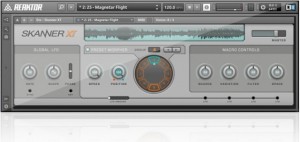
Native Instruments today introduced Skanner XT, a ‘unique and highly distinctive’ virtual instrument, designed by the team behind Reaktor:
With a strong focus on unconventional tone and genuine musical expression, SKANNER XT is both an exceptional library addition for REAKTOR 5 users as well as an excellent sound resource for the free REAKTOR 5 PLAYER. Part sampler, part synth, SKANNER XT utilizes a unique synthesizer architecture to create a wide variety of intense and cutting-edge sounds for contemporary electronic music production and sound design. Two oscillators ‘scan’ a sample, which at low frequencies deliver a scratch sound.
At higher frequencies the oscillators, shaped by the sample waveform, become the dominant force. In this way, Skanner XT provides a broad range of highly distinctive sounds – from heavy and dirty bass tones to morphing soundscapes and organic pads.
About Skanner XT
Developed together with NI synthmeister Stephan Schmitt, Skanner XT offers two interface views for different levels of interaction with the complex architecture under the hood. Besides a simplified page with a preset morpher and four macro controls, a second view provides access to more detailed parameters in order to further explore the sonic potential of the instrument. A morph control option allows for convenient switching between eight different snapshots – producing unpredictable, evolving sounds that range from the ethereal to the extreme.
Skanner XT is available at the NI Online Shop for $59 / 49 EUR. See the NI site for details.
Closer look at the iMoov – Motion controlled effects in Traktor
New video featuring the iMoov wireless MIDI controller:
After 2 years of research into sensor technology, we are proud to present the iMoov by TangibleFX. To celebrate this release, the app is free for the first 5000 users.
The iMoov is a fully customisable wireless MIDI controller that can be used to control multiple effect parameters within leading softwares like Logic Pro 9, Traktor, Ableton Live, etc, using your movement. The iMoov is also compatible with the Line6 MIDI Mobilizer II.
It’s useful for DJs, live musicians and producers alike. Hold it in your hand, or strap it to your guitar – the possibilities are limited only by your imagination.
We have also developed the TangibleFX School of Moovology to help you get the most out of your iMoov:
http://tangiblefx.com/moovology/
We hope you enjoy this app as much as we do! We’re very excited.
Available now on the App Store – FREE FOR A VERY LIMITED TIME!
Song used:
Royalston – Carnivore (Med School)
www.tangiblefx.com
Testing out the new Brain v2
Here are the background details from Livid Instruments:
Testing out the new Brain v2, I repurposed the Code Step Sequencer (as featured here: cycling74.com/2012/01/17/working-with-hardware-livids-code-part-two/) so it would work with these MIDI controller parts.
I hooked up a couple of the Livid Elements modules to the Brain, and hooked up my photosynth (an array of 16 photoresistors, described here: blog.lividinstruments.com/2011/04/22/photosynthesis/) to control the effects on one of the sounds (parameters on the reverb, delay, and filter). I use my crummy cellphone camera’s light to provide a source of photons to alter the effects in a dramatic fashion.
Audiovisual installation by Ryoji Ikeda
The glitch minimalist master mind Ryoji Ikeda displays his latest work “data.anatomy [civic]” at The Kraftwerk in Berlin, 19 April – 1st May.
Exhibited as a 3-screen video projection, data.anatomy [civic] immerses viewers in an intricate yet vast audiovisual composition derived from the entire data set of the car.
RapidComposer for OSX released
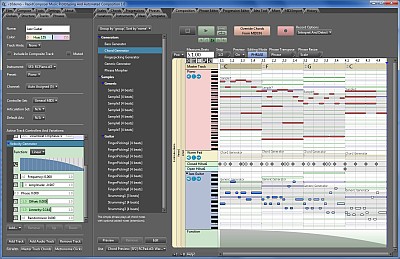
The sequencer designed puposly for the composing process, RapidComposer by Music Developments is now also available on OSX. Reduced price until end of April.
RapidComposer features:
– Advanced tools for phrase editing, phrase generation, phrase morphing, phrase grouping, motif development, chord progression editing,
– Timeline with chords which all phrases automatically conform to
– Piano roll with scale notes, visually editable chord notes, and smart arranging of overlapped notes in two styles.
– In-place non-destructive phrase-level and note-level editing
– 2D view of the composition with structure editor as opposed to 1D view of DAW applications
– Sophisticated MIDI CC editing and recording
– Articulations can be assigned to phrases or even individual notes
– Extensive scale, chord, guitar chord, chord progression databases,
– Taggable instrument database of all MIDI, VSTi and SF2 presets in one place
– IdeaTool that can generate a multitrack composition based on the provided parameters and rules
– Unlimited undo and the ability to make several versions of the same composition
– Fully customizable user interface with preset themes
– Virtual instruments (VSTi v2.4 plugins) support
– SoundFont (.SF2) support
– Standalone and VST (Windows only) version with 128-channel MIDI output
DATAMASKIN

