
Korg Radias – Step Sequencer Tutorial
“This is for the people that had asked me to do a tutorial on the Korg Radias Step Sequencer. This is the Low quality Version, I will upload the 720 Version soon. Please note – This is a Very Basic – I say again. Very Basic Tutorial on Step Sequencing and Creating a sound that has Velocity Sensitivity effected by the Step Sequencer causing the Filter (EG1) on the Radias to change the way the notes are played.”
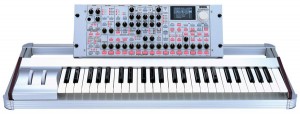
The Korg Radias is a Virtual Analog synthesizer that was released by Korg in 2006. It takes advantage of the MMT (Multiple Modeling Technology) that their flagship OASYS synthesizer module employs. The synthesizer itself is similar in design to the MS2000, but offers many more capabilities. It is capable of emulating older digital synthesizers and classic analog synthesizers like the MS-series without any noise or aliasing. The Radias also allows for various external sounds to be fed through its filters and envelopes. It also has the Korg DWGS (Digital Waveform Generator System) that the Korg DW-8000 employs.
The Radias also takes advantage of the KKS (Korg Komponent System) which allows it to be used with the 49-key keyboard or used as a standalone rack module, and the Radias-R unit can be connected to the M3 Music Workstation/Sampler along with its various keyboard models.
The Radias has two oscillators per timbre and a noise generator. Oscillator #1 has nine basic waveforms, with four types of modulation and PCM (64 synth sounds, 128 drum sounds) and Oscillator #2 has four basic waveforms with two types of modulation. The Radias has the ability to stack up to five types of waveforms in Oscillator #1, while using only one voice of polyphony. In Unison mode, you can stack five additional waveforms, while using more polyphony. With this function, you can create some awesome super waveforms-the overall result can contain up to 25 detuned waveforms. The Radias also has two Low-frequency Oscillators (LFO) that add more modulation to the two audio oscillators. These LFO’s provide six waveforms and their speeds can be set manually or by tempo.
The Radias itself has four timbres per program. With a timbre, you can assign one drum program, another can have a lead, a bass, and a vocoder as well; all in one program! Each timbre can contain one synthesizer/drum kit, equalizer, and two multi-effects.
The Radias has two filters that can be used side-by-side, individually, or in a series. They offer Low Pass, High Pass, Band Pass, and Combination modes. Each filter offers 24 or 12 dB modes for the low pass filter. The effects on this unit are remarkable as well. The Radias comes loaded with 33 different effects: Delays, Chorus, Flangers, Compressors, talking modulator, and even the good old Polysix Ensemble effect. You can assign one master effect to the program, while each timbre gets its own two effects, creating a whole world of possibilities. The Radias also offers a 16-band vocoder with a nice Formant Motion recording function that allows you to record up to 7.5 seconds of external audio which can then be triggered via the keyboard.
The Radias has a built in arpeggiator as well, providing six different patterns to choose from. Patterns can be up to 32 steps long and the gate/velocity can be set for each step to get that sound you want! It also has two 32-step sequencers (they can be combined for a 64-step on a single timbre). They can easily be assigned to a drum kit, for example, to use the Radias as a programmable drum machine. The step sequencer supports 8-voice polyphony per step.
Changeling Sequencer – Jupiter Mozart Variations
http://ios-music.homewoke.net/
This is really interesting sequencer. I tried changing from Mozart’s famous phrase. You can also play external synthesizers via MIDI.
Changeling is the super easy, flexible, diatonic chord sequencer. It’s purpose is to help people enjoy composing music by providing the basic tools to improvise! Improvisation is a skill that can normally only be obtained by investing a lot of discipline and time in to studying music theory and practice.

Changeling does not generate compositions for you, you remain in full creative control over your music. All recorded musical notes remain relative, and can be changed in various ways during playback.
Basic instructions:
1. Start by recording a simple melody-line with one finger.
2. Change the scale and root by sliding the ribbons.
3. Transform the melody to a chord progression by turning the chord knob.
4. Play around with the available voicings and transition modes that affect chord inversions.
5. Spread out the chord notes over time using the arpeggiator.
6. Switch to the next track by swiping down on the pattern area.
7. Change to playback mode, and start improvising a solo over the chord progresssion until you hear something that you really like!
8. Rinse and repeat!
Use Changeling’s 16 MIDI channels to record patterns to your DAW or other MIDI capable IOS apps. Or send an exported sequence via email to someone you are collaborating with.
Googlish from Japanese:
Had extra beat is so is not thought to try it with only the sound of four really (laughs) Mozart thoroughly until towards the end, try and. When the music becomes more and I think doing well.
Thought “w Taro or to produce large amounts of mock Satie” The truth is, why is not impressed that led to the purchase, this is so pretty can also be used for other things. Seems to play an instrument is designed with the intention originally external, can be transferred in the mail or there is a 16-channel MIDI track. Be played is the sound of the outside world via MIDI, of course.
Is
What I still like this, or will not it come alive on the piano?
A certain extent interesting phrase is simple phrase What if this is so that it can generate. something like that even ableton, but you can not do it we are ready troublesome dude before.
What is it good enough, if simple, do you know if you put Ne see how the upper-left corner of the video.
Will “DOR” What if there next “MAJ”?
Is minor or where you want to go and if Futsu.
I think quite interesting sequencer. I think, but seems to go only if the internal sound of the piano if there 16 tracks, and there is no way turnip ~Tsu What if, like so that the scale can be assigned to each track.
Ne Ssu interesting. I can not audiobus fast. What I thought interesting as possible does not it? Are buying. In a range not unreasonable.
Mr. Kaplin Official Release: Toob “Wavaphon” Music Video
Track: Wavaphon
Music: Toob // toob.org.uk/
‘Taken from Chromaphon EP on Process Recordings’
Some buy links – bleep.com/release/30552
Video Directed, Designed and Animated by: Mr Kaplin // mrkaplin.com
Albert Einstein is quoted to have said “It should be possible to explain the laws of physics to a barmaid.”
This video is our attempt at creating a graphical representation of the mathematization of motion, showing only a small amount of the different formulas used to define the chaos within our universe.
Visuals were influenced by: scienceworld.wolfram.com
Ableton Tutorial – Robot Drums Rack Emulating ‘Figure’
Propellerhead’s Figure app has been a big success and inspired many to similar type stuff:
In this tutorial Danny J Lewis shows you how to create a rack that emulates the mechanics behind the way the drum patterns switch in the recently released ‘Figure’ app.
Novation BassStation with modifications
This is a short video demo of the Novation BassStation analogue mono synth. A run through of the standard functionality followed by demonstrations of the modifications and then a quick Jam session using Ableton suite 8’s Looper to build a track from the Bass station’s sounds.
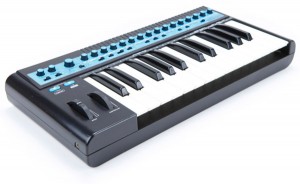
Before the famous Novation Bass Station Rack module came the small and portable Bass Station Keyboard! This synthesizer uses digitally synchronized analog oscillators (DCO’s) to reproduce the sounds of a monophonic dual-osc analog synthesizer with simple and intuitive controls via 17 knobs, 10 switches and 2 Moog-style pitch/mod wheels. Think EDP Wasp and ARP Odyssey.
The Bass Station can faithfully reproduce analog bass sounds similar to a TB-303, Micromoog or Pro One synthesizer. The small keyboard and monophonic architecture set this keyboard up for strict bassline, lead synth lines, and synth fx. It also transmits MIDI continuous controller data from its pitch/mod wheels, frequency cutoff, resonance, filter modulation depth, env1 attack, decay and env2 attack and decay.
New effects processor for Windows – HourGlass
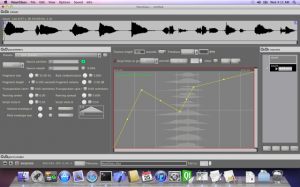
Xenakios has released a free granular effects processor for Windows, HourGlass:
HourGlass is a standalone application intended for radical sound processing by taking fragments (more commonly referred to as “grains” in other similar software) from sound recordings, to create sound textures. It is not intended for minor transparent corrections of playback speed or pitch, but is rather placed firmly in the sound mangling/glitch territory.
A Mac version is also in the works. Download HourGlass at the Xenakios blog.
Here’s a new interesting iPad App: Arpeggionome
“Demo of Arpeggionome, an amazing app for generating arpeggios. Lots of customisation. Lack of midi the only downside, which I hope the developers will be including in a future release.”
Listen to the new synth from MFB – Dominion 5
Here’s some early information on a new synthesizer, the MFB Dominion 5, that’s expected to be released this summer.
Features:
- 5 voices each with 3 VCOs, SED multimodefilter, 2 LFOs, 3 Envelopes, VCA.
- One main LFO, Mod Delay, Voice Panning, Arpeggiator/Seq(poly),
- Joystick, Ribbon Mod, Split Mode, Patch Memory,
- 4 Octave Aftertouch Halfweighted Action Keyboard,
- Big knobs and quality pots/sliders/Switches, Midi In/out/Thru, Some CV/Gate Connections,
- Steel Chassis with Wooden Walnut Panels.
The price is expected to be 1790 Euro, via MFB. You can preview the sound of the MFB Dominion 5 below.
Analog Drum ‘n Bass
Bakground data:
This is my imagining of what circa ’98 era minimal tech step drum ‘n bass may have sounded like had it been invented before modern samplers and digital synths / fx.
All the sound is being generated live, coming straight from the main mixer in the middle, with no multitracking. Sequenced by 3 vintage hardware sequencers, the Yamaha QX-1, Roland MC-4 and Roland MC-8 locked together by tape-sync.
List of the main gear used :
Sequencers : Roland MC-8, Roland MC-4, Yamaha QX-1
Modulars : Roland System 100 (Drums), Moog series 900 (pads), Roland System 700 (Basses), Arp 2500 system, Buchla 100 series.
Other Synths : Korg MS-20, Roland System 100 standalone synth.
FX : Roland Space Echo RE-501 (tape delay, chorus, spring reverb), Roland DC-30 (analog chorus-echo), Roland Dimension-D Analog Chorus.
Mixer : Tascam M308b
ANIMOOG – Timbres
Moog’s Chief Engineer Cyril Lance lifts the veil off timbres, the essential sound source of Animoog’s Anisotropic Synth Engine. ASE allows you to dynamically move through an X/Y space of unique timbres to create a constantly evolving and expressive soundscape. The constantly expanding library of timbres are the key to unlocking the limitless potential of Animoog’s 2D soundscapes.
Learn more about Animoog and its expansion packs here:
www.moogmusic.com/animoog
DATAMASKIN

