
Moogfest Audiotool competition
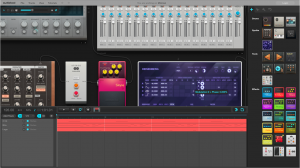
Moogfest has announced the Moogfest Audiotool competition, offering participants a chance to play at Moogfest and get released on a compilation.
Starting today, Moogfest is inviting anyone to produce a track – using the free cloud-based audio workstation Audiotool – and submit it to the Moogfest Competition. The winner gets to play a set at Moogfest in Asheville, North Carolina, taking place from the 23rd to the 27th of April 2014. The winner will also, along with 7 runners up, have their tracks included on a limited edition release which will go out to the artists, VIPs and press who will be attending Moogfest.
Participants will have until the 25th of March to submit a track to the competition. A select panel including some of the Moogfest artists will then judge the tracks, with the the winner being announced on 1 April 2014.
Moogfest is the annual festival that celebrates the innovative spirit of founder Dr. Robert Moog, an American pioneer of electronic music and inventor of the Moog synthesizer. Emmy Parker, Brand Director at Moog Music Inc commented: “Moogfest represents the synthesis of technology, music and art. Audiotool’s innovative platform empowers emerging artists to create on their own terms. We are excited to offer Audiotool’s rich community of musicmakers an opportunity to be a part of Moogfest 2014.”
Since the 50s Moog Music has pioneered and developed devices that offer artists endless possibilities when it comes to creating sound. Audiotool, which started in 2008, brings together a range of retro and new school synthesizer emulations running in the browser, allowing collaboration and free access for anyone. The browser-based audio workstation is all about democratising the process of music creation and collaboration in the cloud. This partnership offers a unique opportunity to combine forces and to capitalize on the natural strengths and alignment of the two brands.
Audiotool inventor André Michelle said: “this partnership is huge for us and our users will be super excited about the chance of winning a set at Moogfest, for one just because of the incredible line-up. It’s also a unique opportunity for Audiotool users to have their music critiqued by some of the Moogfest artists.”
The contest submission phase ends March 25th, 2014. The winners will be announced April 1st, 2014.
The grand prize is playing live set at Moogfest (flight, hotel and artist pass included), and 1st – 8th place winners will get their tracks on the Moogfest 2014 compilation.
Go here to record your song >>
Sliver – soundscape and texture tool
Apparently it is coming soon to the iPad, so stay tuned for this promising app
Hammond XK-3c demo 1 and 2
Hammond XK-3c demo 1 using its internal rotary emulation, reverb, and tube overdrive
Hammond XK-3c demo 2
(drums: XLN Audio Addictive Drums)
Product description:
The HAMMOND Xk-3c is recognized throughout the world for its sound, style and unmistakable dedication to the traditions created and maintained by HAMMOND for over 75 years. When a Hammond B-3 is not available, for whatever reason; serious musicians everywhere know only the Hammond Xk-3c can fit the bill. Many imitators have been brought forth, but one touch of their keys demonstrates you can’t clone soul, and you can’t clone feel. You don’t have to “break in” an Xk-3c, and you don’t have to “get used to it”. It feels right and sounds right, because it is right. Only a genuine HAMMOND can deliver this promise.
The Xk-3c is, for all practical purposes, the top manual of a Hammond B- 3, with two sets of Harmonic Drawbars™, Chorus-Vibrato, and Touch-Response Percussion™. The reverse-key presets function exactly as they do on a B-3, and the traditional waterfall keyboard fits like a glove. The Digital Leslie™ spins the sound just as you remember, and the entire package weighs only 35 pounds. If you desire, you can take the Xk-3c from its box and go straight to a gig-it’s that familiar-if you’ve ever played a B-3 you know how to play the Xk- 3c. Go ahead and mash the drawbars-they look, feel and respond just the way they are supposed to. Yes, there are a few more buttons on the panel than you’d find on a B-3, and you can ignore them if you want to.
But who would want to?
Like all modern Hammonds, the Xk-3c has deep editing capabilities, allowing voicing (volume/timbre/leakage/motor noise) for each of the 96 Digital Tonewheels, faithfully delivering any Hammond Organ’s individual personality, with the ability to save these profiles for instant recall. 12 Factory Digital Tonewheel profiles ranging from “showroom clean” to “road worn” are available for instant personalization. Every Facet of the Hammond’s sound like Chorus/Vibrato, Percussion, Key Click and Overdrive are widely adjustable with all settings saved with every preset. The customization doesn’t end there.
Entire industries have sprung up offering “hot rod mods” for vintage B- 3′s. Boutique engineers that do (expensive) surgery getting the old gals to do things that Laurens Hammond never intended. All of those Mods are included in the Parameter Menus of the Xk-3c as standard equipment. You can finally design and “build” the Hammond Organ of your dreams and store your creation in memory, and not only once, but as many times as you have room on the CF Compact Flash cards that save your setups.
The Xk-3c also may be expanded. You can add a lower manual to further your B-3 experience. The double manual Hammond you’ve always wanted is now within reach, with a 5 minute build/strike time and the ability to move the rig by one person, in a wide variety of vehicles. Or you can get a console cabinet in a variety of styles and finishes that allows you to have a 4- poster, two manual and 25 note pedalboard B-3 style organ in your music room during the week, and the versatility to slide the Xk-3c out in mere minutes to go and play a club gig on the weekend.
As far back as the Xk-3c reaches to insure the Vintage feel, soul and sound of the Hammond, we have not ignored the needs and desires of the Modern Keyboard player. The Xk-3c is also a powerful MIDI controller, with the ability to address 6 External Zones on two manuals and pedals, with dedicated and assignable switches and rotaries on the front panel. These zones may be used to augment the Hammond Voices with outboard MIDI gear, play those external voices solo, or use the MIDI controls to adjust lights, recording gear or anything that may be controlled by MIDI. A PitchBend Wheel and Mod Wheel live on the far side of the presets. A complete instrument, indeed.
In many ways, the Xk-3c has surpassed the legend
Bob Casale, founding member of DEVO, has left the planet
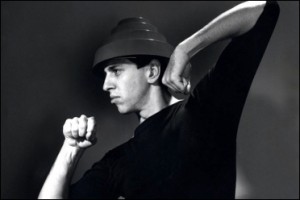
Bob Casale died on February 17th, from conditions that lead to heart failure according to Gerald Casale in a post on Facebook. Born July 14th, 1952 Bob was an original member of Devo. Says Gerald:“Bob Casale was there in the trenches with me from the beginning. He was my level-headed brother, a solid performer and talented audio engineer, always giving more than he got. He was excited about the possibility of Mark Mothersbaugh allowing Devo to play shows again.”
Robert Edward Casale Jr. aka Bob was the younger brother to Devo co-creator Gerald Casale. He played guitar, keyboards and bass guitar in the band, and was occasionally background singer in Devo. Trained as a medical radiation technologist, he left the job to join Devo. He was also part of Mutato Muzika, a music production company established in 1989 by Devo co-founder Mark Mothersbaugh.
Rest in peace Bob.
TB-Dither – new quantization and noise shaping plugin
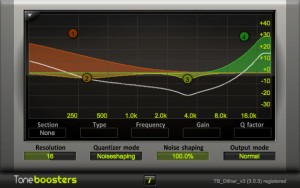
ToneBooster has announced the release of TB-Dither, a quantization and noise shaping plugin for Windows and Mac.
TB Dither is a plugin designed to modify the bit depth of audio signals, for example when authoring a CD or for archival purposes, with minimum quality degradation. Such process typically involves dithering, quantization, and noise shaping.
TB Dither supports industry-standard dithering noise types such as RPDF (rectangular probability density function, 1 LSB wide) and TPDF (triangular probability density function, 2 LSBs wide). A GPDF (Gaussian probability density function) is provided as well.
TB-Dither features
- Zero-latency processing.
- Support of all sampling rates from 44.1 to 192 kHz.
- Supports industry-standard RPDF and TPDF dithering noise.
- Unrivalled flexibility to shape dithering and quantization noise.
- Suports any bith depth between 8 and 24 bits.
- Dedicated modes to listen to quantization noise only.
- Advanced noise-shaping overload protection algorithm.
TB-Dither for Windows and Mac (VST/AU) is available to purchase for 9.95 EUR.
ToneBoosters has also updated it’s plug-in line to version 3.0.3.
Changes in v3.0.3
- All plugins
- Fixed a minor GUI memory leak.
- Dither
- First release.
- Barricade
- Improved accuracy of RMS output VU meter.
- Improved quantization and noise shaping algorithm (derived from TB Dither).
- EBULoudness
- Fixed an issue causing the loudness history graph not displaying correctly when closing and re-opening the GUI.
- Mitigated a crash due to a bug in Wavelab when using EBU Loudness on stereo tracks.
- Module
- Fixed a bug that could result in inresponsiveness of Module.
- ReelBus
- Added ‘legacy’ saturation mode to simulate v2.9 behavior.
- BusCompressor
- Added channel linking control and stereo gain meters.
- Improvement in transient detection/compression algorithm.
Deebox Chopra – new sample library in Native Instruments Kontakt
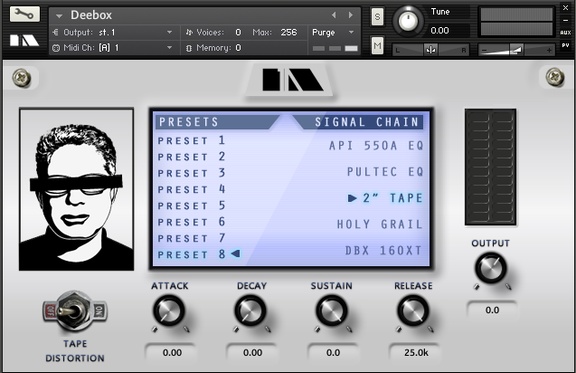
100 Akres has announced Deebox Chopra, a new sample library in Native Instruments Kontakt and Wav formats.
Deebox Chopra is a drum rompler which features drum sounds from an iconic 80s drum machine run through a series of high quality analog outboard gear to 2″ tape to add a bit of “hiss” and extra warmth.
The easy to use LCD interface allows you to choose between eight signal chains that were pre-tweaked by our engineer to bring out different tones of the recorded electronic drum kit. These presets range from clean with low hiss to gritty tape distortion with a flick of the tape distortion switch.
Deebox Chopra features
- 49 drum sounds, 8 different signal chains.
- Recording chain used includes: 2″ tape machine, DBX 160xt , API 550 eq, Pultec eq, and a Holy Grail pedal.
- Attack, Decay, Sustain, and Release knobs available for further drum tweaking (Kontakt version only).
- Tape distortion switch for extra crunch added to the drum sounds (Kontakt version only).
The library is available to purchase for $19 USD (Kontakt) / $14 USD (Wav).
Aalto synthesizer for Windows and Mac updated to version 1.5
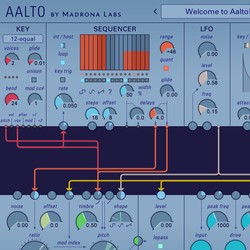
Madrona Labs has updated its Aaltosynthesizer for Windows and Mac to version 1.5.
Aalto is a semi-modular software synthesizer with an innovative, patchable UI, distinctive sounds, and a charming personality.
Changes in Aalto v1.5
- Fixed an issue that was slowing down Aalto dramatically on some Windows systems.
- Fixed an issue requiring a runtime support pack on some Windows systems.
- Improved latency through the patcher when running at large host buffer sizes.
- Aalto now draws at full resolution on Macintosh Retina Display, in compatible hosts.
- Aalto is now compatible with Soundplane version 1.0 and higher.
- Fix mousewheel direction on Mac OS 10.7 and higher.
- Accelerated drawing to the screen on Mac OS with OpenGL.
- Optimized drawing scheduling to avoid glitches, especially in Logic.
- User and factory presets now share the same location.
- Improved ergonomics of patcher with larger handles and smoother graphics.
- Fixed a drawing problem with bipolar dials.
- Improved drag ergonomics for dials.
Aalto for Windows and Mac (VST/AU) is available to purchase for $99 USD.
Soundsdivine releases Memorymoog synthesizer library for Kontakt
Preview of the presets from Soundsdivine’s MM+ synthesizer for Kontakt .
Based on the Moog Memorymoog Plus .
MM+ features
- 3 Oscillators.
- 31 Waveforms.
- 2 Filters.
- 2 Aux Envelopes.
- 1 Programmable Arpeggiator.
- 3 Monophonic Pitch Sequencers.
- 2 Additional Sequencers.
- 25 Custom Impulse Responses.
- 5 FX inc. Transient Shaper / Phaser / Delays & Reverb.
- 6.97GB (compressed) samples from the Moog MemoryMoog.
- 200+ Presets.
The sample library is available to purchase for 79 EUR incl. VAT.
Korg to develop a new ARP Odyssey

KORG INC. is proud to announce that a faithful recreation of the legendary 1970s analog synthesiser, the ARP Odyssey, is being developed by Korg for release later in 2014.
The ARP Odyssey was released in 1972 by ARP Instruments, Inc. and quickly became famous for its unique rich sound and innovative performance controls. It was a staple for many recording and performing musicians worldwide and was used on countless hit records over many years. The Odyssey was one of the highlights of the ARP company and became a long selling product. With slight updates and improvements it was sold through to 1981.
Korg is also proud to welcome Mr David Friend as our chief advisor on the Odyssey. David Friend established ARP Instruments, Inc. along with Alan Robert Pearlman and is a past president of ARP Instruments, Inc. He was also the lead designer of the original Odyssey in addition to designing or co-designing many other products.
After ARP, Mr Friend became a successful technology entrepreneur. In 2010, he was named Ernst & Young Entrepreneur of the Year in the Emerging Technology category for the New England Region, he has been a lecturer at MIT’s Sloan School of Management and is now Chairman & CEO of Carbonite, Inc. He has been a trustee of the New England Conservatory and Berklee College of Music.
In the last few years, KORG INC. has released several top selling analog synthesizers such as the monotrons series, the monotribe, the volca series and the hugely successful MS-20 mini, a faithful fully analog recreation of the 1978 MS-20. With Korg’s technology capabilities and planning ability for analog synthesizers, and in collaboration with David Friend, we believe the legendary ARP Odyssey will become a “must have” for an all new generation of music makers.
The ARP Odyssey is scheduled for release in September 2014. – See more at: http://www.korg.com/us/news/2014/0217/#sthash.E2XWNMxZ.dpuf
Texas Instruments Speak and Spell
The classic “toy” from the late 70s and 80s. Still sounds good after all these years.
Review:
The Speak & Spell is a handheld computer voice synthesizer by Texas Instruments. It consisted of a small display, membrane keyboard, a speaker and a cartridge slot for added expansion. It was marketed as a learning tool for children, coming out in 1978 and manufactured in various forms up until the early 90s.While the design is bright and ugly the great feature that has endeared it to millions of people, including musicians, is the voice synthesizer. The voice synthesizer chip, the TMC0280 is capable of emulating sounds into spoken words. The original Speak & Spell came with 200 words for several language versions (English, French, German and Italian) and contained minigames like Mystery Word, Secret Code, and Letter. To expand upon the words that the unit could use a number of cartridges were released. The sound is robotic and male. It’s no wonder musicians like Kraftwerk and OMD utilized the Speak & Spell in their songs. Depeche Mode named their first album after it.
While there were various versions of the Speak and Spell, including Speak & Math and Speak & Read, as well as software emulations, the original Speak & Spell is a neat little red box with a handle to carry around with. The voice synthesizer is wonderful, especially if you’re a musician and you want to dump a load of sounds into a sampler to use in something. As a toy for kids these days? Not much. A great retro box full of wonder and a bit of magic? Definitely. For someone wanting to buy one these days, they are getting harder and harder to find and their prices are becoming ridiculous.
DATAMASKIN

