
Korg Monotribe x2 – Berlin School style “How To”
‘thainmlh’ explores making Berlin School style synth music using a couple of Korg Monotribe synthesizers and a pair of Electro Harmonix Memory Toy analog delay pedals, background video description below:
A follow up to my video “Korg Monotribe x2 – Berlin School Example” which has had over 50,000 views at this point (much to my surprise…)
Again we use two Korg Monotribe Analog Synthesizers (with built in sequencers) slaved together for 1970’s style Berlin School sequences, This time, it is a “how to” in an attempt to answer the many questions posted to the original video. (This has higher audio quality)
KORG EPS-1 String Machine/E-Piano 1983
Korg EPS-1 with a delay effect from the Roland DEP-5.
EPS comes from “Electronic Piano & Strings”. The fully analog EPS-1 is one of the few touch sensitive string machines. It is a quite long keyboard. It has not only strings – it also has a piano section with several (non mixable) presets. On the piano section you can add a stereo effect (TREMOLO or CHORUS, both with parameters for SPEED and INTENSITY). Both sections have an equalizer.
The Contradiction of Silence
Inspired by the calm, tranquil beauty of the forests, lakes and wide skies of their Swedish homeland, world-renowned design company Bolon is proud to launch their new collection, ‘Silence’. Already known for their work with designers and architects such as Missoni, Paul Smith and Jean Nouvel, this launch features a creative collaboration of a different, yet equally exciting kind – with acclaimed choreographer Alexander Ekman. Famous for his modern interpretations of classic dance, his previous work includes projects with the Boston Ballet Company, Sydney Ballet Company, The Juiliard School and The Royal Swedish Ballet.
More here: bolon.com/silence
Nord Wave – Vintage Digitals (sample pack)
Nord Wave – Vintage Digitals Vol1, by Don Solaris.
Here’s what he has to say about the sound library:
Instead of going for the factory presets of various machines and sampling those, we went one step further. We went for the original ROM waveforms. And more importantly, their original loop points. The goal was high – to ensure 100% authentic sound. No cross-fade looping techniques here, everyone can do that nowadays and did we mention it totally kills the soul of the sample (due to the x-fade process itself).
Hence we used totally different approach and you bet these loops in here required a lot of screwdriver work to match original factory loop points. But the result is 1:1 original playback where you can no longer distinguish a copy from the source.
available at: http:///donsolaris.com/nord
This Nord Wave library is 99 multisamples made from the following machines:
- Roland U-20
- Roland JD-990
- Roland JV-1080
- Yamaha SY-22
- Yamaha SY-85
- Yamaha TX16W
- Ensoniq SQ-1
- Kawai K-1 rII
Roland AIRA TR8 vs TR808 – Listen
As an addition to the TR8 review I managed to get hold of an original TR808.
I must say that after using the TR8 – its not at all intuitive to use – hence the rather simple demo.
Giorgio Moroder and JM Jarre covered on classic gear
Giorgio Moroder / Riva Lima
Korg N364
EMU 1×1 USB MIDI
Chronologie 4
All sounds are made in Korg N364, not vstis, not samplers, only external daw sequencer
ABL3 Teaser – TB-303 clone
Audio Realism today announced ABL3 – the latest version of its software TB-303 clone and at the same time making some fun of the Aira 😀
More 303? We’re going to have it. From the release of ABL1 in 2003 to ABL2 in 2007 we’re still striving to raise the bar in analog modeling and more specifically 303 emulation. In 2014 we plan on raising this bar even further. Release date: TBA
More video captures of the Roland AIRA Series
System-1 synth will get its premiere (worldwide) at Dancefair on the 15th of february 2014. Yesterday we got a exclusive sneak peek from Roland CE.
The much hyped Roland AIRA is now live – packed with classic sounds and modern features
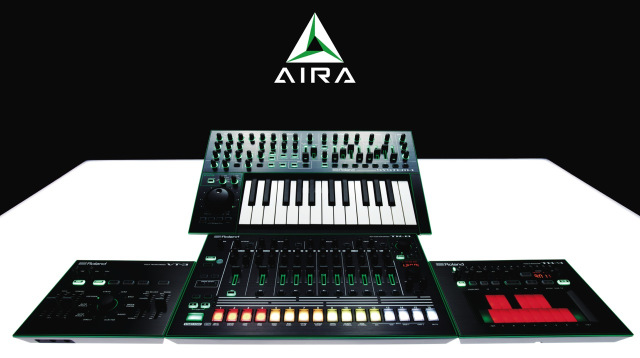
Roland has officially announced its new series of AIRA products:
- The AIRA TR-8 Rhythm Performer – a $499 drum machine;
- The AIRA TB-3 Touch Bassline – a $299 bassline synth;
- The AIRA VT-3 Voice Transformer – a $199 vocal effects processor and vocoder; and
- The AIRA System-1 Plug-Out Synthesizer – a $599 virtual analog synthesizer that can transform into a variety of classic synth, and act as a hardware controller for a new line of software synthesizers.
The AIRA series is based on Roland’s newly-developed Analog Circuit Behavior (ACB) which the company says faithfully captures the sound of some of Roland’s most revered classics. In developing the AIRA line, Roland modeled classic circuits, using original design specs, consultation with original product engineers, and a detailed part-by-part analysis of each analog circuit, using pristinely-archived Roland drum machines and synthesizers.
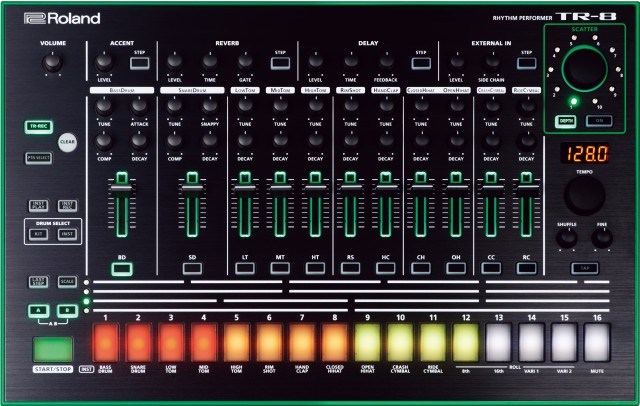
The TR-8 Rhythm Performer is a ‘performance rhythm machine’. It offers the sounds of Roland’s classic TR-808 and TR-909, 4 audio outputs and greater tweakability than the originals.
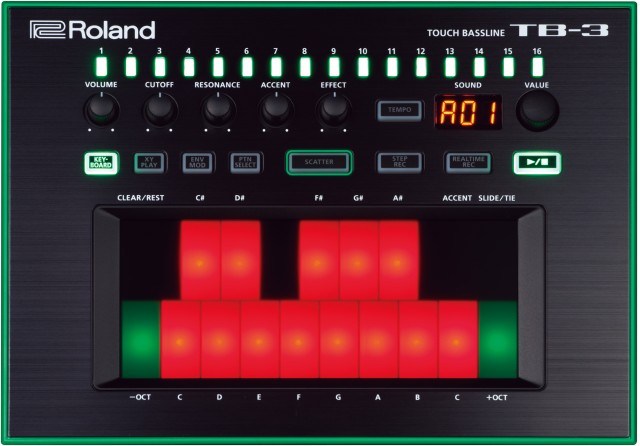
The TB-3 Touch Bassline is based on the classic Roland TB-303.
The new TB-3 Touch Bassline uses Roland’s ACB modeling to recreate the classic bassline sound and offers controls that will be familiar to users of the original. But the TB-3 also offers a large touch control surface that streamlines sequence programming and introduces new performance options.
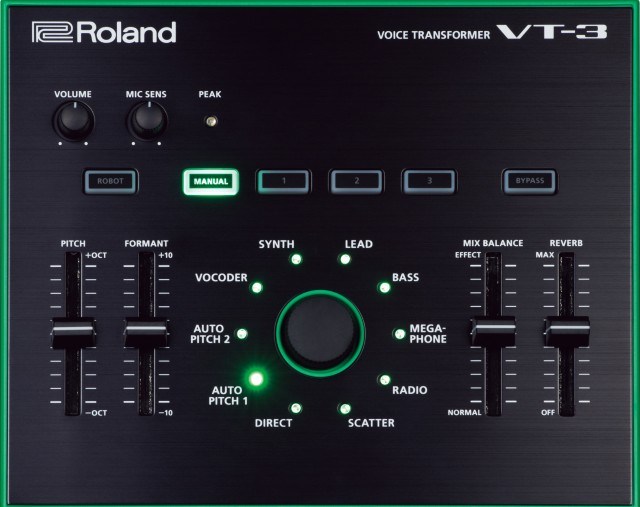
The VT-3 Voice Transformer is designed for creating heavily processed vocal sounds, with pitch and formant shifting, vocoder effects and more
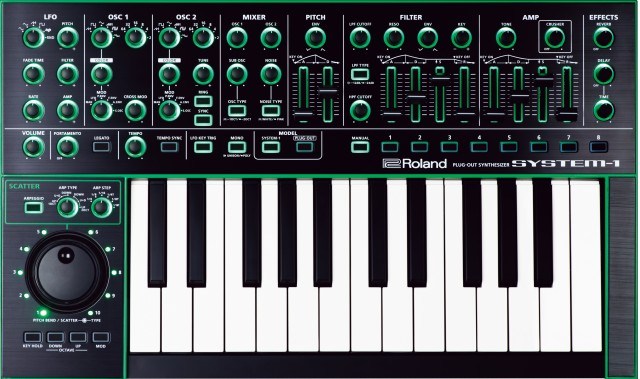
The System-1 Plug-Out Synthesizer is a new keyboard that can transform into a variety of types of synths.
It’s very hands-on and knobby, but the key feature is the synth’s Plug-Out technology, which lets the System-1 control – and even host – software recreations of classic Roland synths, with no computer connected.
Videos:
Pricing and Availability:
- The TR-8 Rhythm Transformer will retail for a street price of $499;
- the TB-3 Touch Bassline has a street price of $299;
- the VT-3 street price will be $199; and
- he System-1 Plug-Out Synthesizer will retail for $599.
Roland AIRA products will be shipping by the end of second quarter 2014
Monster Computation – HorriblerAlien2 – featuring the Hybrid Music 5000 software
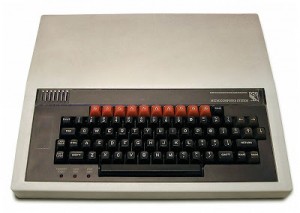
The BBC Microcomputer System, or BBC Micro, was a series of microcomputers and associated peripherals designed and built by the Acorn Computer company for the BBC Computer Literacy Project, operated by the British Broadcasting Corporation. Designed with an emphasis on education, it was notable for its ruggedness, expandability and the quality of its operating system…
Background video description:
In the late 80s I amused myself with my BBC model B and the Hybrid Music 5000 software. It was an amazing program at the time. I have not had as much fun with any computer music program since. It could be persuaded to do both interesting and silly things.
DATAMASKIN

