
Time machine: KORG POLYSIX Analog Synthesizer 1981
This video shows what someone can do with a Polysix who knows it very well. The audio signal was recorded straight from the Polysix’ output, without any additional effects or dynamics. The Korg Polysix is a classic analogue polyphonic synth. It was the best sold analog synthesizer. Roland answered one year later with the Juno-60.
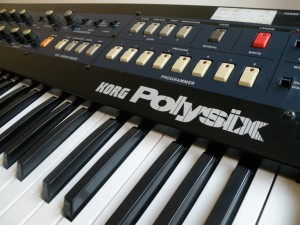
The Korg Polysix has per voice:
1 VCO + suboscillator (PWM possible), 24 dB lowpass filter, 1 ADSR envelope, 1 LFO (sine waveform only). It also has an very useful FX section, which lets you forget that you have 1 VCO per voice. ENSEMBLE, CHORUS and PHASE effects are possible. The Polysix has the same useful ARPEGGIATOR like the Mono/Poly. It is synchronisable with drum machines, sequencers,…
The Polysix has 32 RAM memories for your patches. With the tape interface, the whole RAM memory can be stored on tape/cassette. Of course you can save the memory data as WAV files as well. The Korg Polysix was inspired by the Sequential Circuits Prophet-5 – in fact, the Polysix has SSM chips like the early Prophets. For this reason, it has a warm, “american” analog sound…
The Polysix can produce fat pads with the “ensemble” effect, which reminds me on old string machines. It also can produce great bass and lead sounds in unisono mode. Weird sounds are possible with the arpeggiator in combination with filter resonance.
The hardware is solid, well made – except the original internal battery, which tends to leak. Especially when the Polysix is not turned on for a long time.
THE SOUND PROGRAMS IN THIS MOVIE:
Do you have a Polysix and want to play with the powerful sounds heard in the video? You can buy the “ANALOGAUDIO1 PATCH BANK” with 64 patches (2 banks with 32 patches) for 12,99 Euros. After payment through PayPal you will get a WAV file with sound data for the tape interface of your Polysix via email. You will also get a patch list with names of the patches (PDF), to find the right sounds quickly. The details about the functionality of the tape interface are described in the manual of the Polysix, which you can download for free.
The bank contains all the sounds you are hearing in this video and some more. The included patch list (PDF) is very useful to find the needed sounds quickly. As an experienced synth player / programmer I programmed these special sounds carefully to get the most out of the Polysix – these sounds are not available anywhere else!
If you want to buy the “ANALOGAUDIO1 PATCHBANK” for your Polysix, please drop me a mail:
ceramic-man@gmx.de
Video of Retronyms’ Drum Deranger for Miselu (Early Demo)
Background information:
We finally had a chance to sit down with John-Paul Walton (co-founder of Retronyms) to have him showcase the early version of the XOX Drum Deranger. This video doesn’t include all the final features and polish yet, but can provide you an idea of the final product that Retronyms is building for the neiro. It is only the first device they are bringing to the neiro with much more to come.
OP-X PRO-II vs. Oberheim OB-X
A very nice test of the real thing verus the digital version, and below you can read all about it:
http://www.sonicprojects.ch/opxpro2/description.html
A dry 1:1 comparison of the SonicProjects OP-X PRO-II virtual Oberheim VSTi software synth to an Oberheim OB-X Rev.2.
The lower manual in the video is an USB midi master keyboard (an Emu Xboard 61) which drives OP-X PRO-II hosted in Steinberg Cubase 5. No effects or any other treatments were involved, both OB-X and OP-X PRO-II were recorded directly to disk, OB-X over the line inputs of an RME HDSP 9632 which has very neutral sounding converters.
The exact detunings (deviating filter settings, warm up pitch drift, etc.) and the individual pan settings of the voices of OB-X have been copied in every detail before with the voice based tuning features of OP-X PRO-II for a perfect match to the real synth.
To copy the bright sound OP-X PRO-II uses the BRL (brilliant) filter setting (DMP button, second button above voice mutes) which is dedicated to copy the sound character of the early OB-X and allows the filter to open into the ultra sound area and adds some extra shine in the heights.
The used patches can be downloaded here:
http://www.sonicprojects.ch/opxpro2/userarea.html#Newest
The patches as used in the video:
00:02 Preset 04 B3 – Slow Upsweep
02:05 Preset 03 D8 – Resonance Pad
08:01 Preset 05 D2 – Sync Unison
08:26 Preset 01 D4 – Soft Brass
09:53 Preset 06 D6 – Soft Strings
10:44 Preset 02 C7 – Fullanalog Strings
The letter number combinations are the physical memory locations of the patches in the used original synth which were copied with OP-X PRO-II for the comparison.
Since all the original’s exact voice detunings have been copied in every detail too the patches sound almost 100% identical to the ones in the used device, which gives you the opportunity to have its unique characteristic sound at home too!
Some words about the OB-X:
The Oberheim OB-X was Oberheim’s first fully programmable polyphonic synth and is the direct follower to the SEM based 4/6/8-Voice models. Other than the later OB series models (OB-Xa, OB-8) the OB-X still uses the discrete wirings of the SEM for the oscillators and filters and only uses curtis chips for the envelopes.
This gives the synth a very bright and open sound, quite different from its followers OB-Xa and OB-8 which are fully curtis chip based and sound a bit darker and more behaved. The OB-X is the “enfant terrible” of the OB series.
Here’s some very useful info:
http://www.sonicstate.com/synth/oberheim_ob-x/
The featured OB-X is a six voice model (maximum was 8) and it has a lot of detunings going on because of all the wirings and dicreete voltage controlled components which gives the synth a very lively and organic sound.
The voices could be calibrated for a more “perfect” and even sound, but they were left as they are since it simply sounds more exciting like that, featuring some of the magic of the old SEM based 4/6/8-Voice where the never exactly even sounding voices (since they had to be programmed one by one manually) were part of the whole experience, and were the main inspirator for the Separate Voice Design (SVD) engine in OP-X PRO-II which allows to calibrate the voices for an individual sound too.
Time machine: KORG DW-8000 Digital Waveform Synthesizer
KORG DW-8000 Hybrid Synthesizer from the year 1985.
single sound demo
– 8 Voices
– 2 Oscillators per voice
– 16 digital waveforms
– analog lowpass VCF
– analog VCA
– Arpeggiator
– Digital-Delay

Take Korg’s first digitally controlled analog synth hybrid (DW-6000) two steps higher and you get the more popular DW-8000. Sound is digitally generated from the DWGS (Digital Waveform Generator System) and has been doubled from 8 sampled digital waveforms to 16 simple analog to complex digital waveforms. The DW-8000 has 8 voice polyphony in two modes, or one monophonic mode with all eight voices stacked. The analog VCF resonant filter and VCA both have independent ADBSSR envelopes. Parameters can be altered in real time via a single programmable slider. There are 64 presets that can be reprogrammed by the user.
When the DW-8000 succeeded the DW-6000, it expanded it to 8 notes polyphony, 16 sampled waveforms, a velocity sensitive keyboard with programmable aftertouch, auto-bend, a simple arpeggiator and a digital delay unit. The Digital Delay was an astonishing goody for the time, offering up to 512ms delay, phasing, flanging, chorusing and other time effects. Both the Arpeggiator, Auto-Bend and Digital Delay make this synth an inspiring and great sounding machine to use for great 303 basslines, techno and house bass and synth sounds and more! The EX-8000 (pictured above) is a rackmount version of the DW-8000. Several 3rd-party developers offered expansion boards for the DW-8000 providing up to 1024 presets, layered sounds, keyboard splits and Sample+Hold for the LFO.
Oberheim OBX-a: Unison lead demo
OBX-a Unison lead. 8-voice Unison. WFs- VCO-1 & 2: SW. LFO: Sine.

The OB-Xa is a massive analog synthesizer with a very familiar and classic Oberheim sound. Its sound, size and power are very similar to the Prophet 5 from Sequential. However this one has up to 8 voices which can be split, layered and stored!
The OB-Xa was available in four, six or eight voice polyphonic models. They all featured patch memories, also in varying degrees. A minimum of 32 patches were available on early models (4 banks of 8). The maximum amount of patch memory storage found on many OB-Xa’s is 120 patch memories. All models of OB-Xa, however, featured the new Curtis chips which offered great stability for an analog synth and they are attributed to its great filters and sounds.
The OB-X was very similar to the OB-Xa except that its voices could not be split or layered and, more significantly, the OB-X had a lowpass-only discrete SEM 12dB/oct state variable filter, which had a great and classic Oberheim sound. The OB-Xa changed that in an attempt to economize manufacturing and increase stability by switching to CEM3320 Curtis chips for its filters. The Xa offered two switchable filter modes: 12 dB/oct (2-pole) or 24 dB/oct (4-pole). This hardware change resulted in a more agressive sound, not quite as creamy as the OBX original, but what still became a “bread and butter” sound of the Oberheim line.
Splitting the keyboard mode separates the OB-Xa into two 4-voice synths with two available patches. The Layer mode plays the two patches simultaneously. There are also some added effect sources, perfect for any analog polysynth, including portamento, unison, sample & hold, chord memory and three LFO’s!
However none of the original OB-Xa’s have MIDI, unless otherwise having been modified. The OB-Xa is a classic and fat analog machine. It will give you thick analog pads and drones, punchy bass and cyclic analog effects.
Casio XW-P1 Tutorial: Basic Navigation
In this video we take you on a quick tour of the front panel of the Casio XW-P1 Performance Synthesizer. Selecting Performances and Tones, making quick edits, using the arpeggiator and phrase sequencer. This is the first in a series of videos on the XW-P1.
Daniel Fisher plays the XW-P1 using a preset that he created. A quick tribute to Shine On by Pink Floyd
Akai Pro MPC Software: Overview and Tutorial
Akai Pro Product Specialist, Andy Mac, takes you through the new MPC Software. This is the platform that will drive the MPC Renaissance and MPC Studio.
Features:
- 128-track sequencing capability
- Massive 6GB+ sound library, including all of the sounds of the classic MPC3000
- Instant mapping and real-time adjustment of VST plug-ins
- Record each track as an MPC drum program, Keygroup program or VST plug-in
- Works alone as your main DAW or works seamlessly with your current studio as a VST/AU/RTAS plugin
- Supports WAV, MP3, AIFF, REX and SND
- Supports samples and sequences from any MPC ever made
- Mac and PC-compatible
This is the platform that will drive the new MPC Renaissance and MPC Studio Music Production Controllers.
Moog Minitaur Demonstration by Asher Fulero (aka Halo Refuser)
Asher Fulero, aka Halo Refuser, demonstrates some of the sweet realtime performance capabilities of the Moog Minitaur bass synthesizer. Enjoy the demo, then learn more about the Moog Minitaur bass synth right here: http://bit.ly/sw_Minitaur
Zira Demonstration
A quick run through of Zira and it’s features.
A quick summary of it’s features;
- Two oscillators, each with 48 waveforms
- One Sub oscillator
- Hard Sync of oscillators
- Two ADSRs, one VCF, one VCA
- One LFO
- Multiple routing options
- 64 patch memories
- MIDI updatable firmware
Background info from Vaco Loco:
Zira came out of an idea I had to see how small I could build a synth and still get it to sound good. The prototype is based on the Korg NJM2069AD Filter/VCA chip, the reason for this being I had 8 lying around I bought a while back from Korg to build a polysynth with.
There are a small number of these being made, I will be selling these as fully assembled modules with a case.
However, I fully intend to try and replace the NJM2069AD with a discrete filter and VCA of some kind (currently a 2 pole State Variable Filter based VCF and simple VCA is looking good) and turn this into kits in much the same way as I did with GorF.
Arturia MiniBrute Synthesizer Demo
Sweetwater’s Daniel Fisher demos the new Arturia MiniBrute Analog Synthesizer with a thorough walkthrough of its parameters and features. You can control it with CV, MIDI, or USB-MIDI, and it’s even got an external audio input to run signals through the amazing multi-mode filter and amplifier sections. Enjoy the demo, then learn more about the Arturia MiniBrute here: http://bit.ly/sw_MiniBrute
DATAMASKIN

