
Time machine: YAMAHA CS-10 Analog Synthesizer 1977
The YAMAHA CS-10 came out 1977. It is a monophonic synthesizer equipped with 1 VCO, 1 multimode resonant filter (highpass, lowpass, bandpass, but self oscillating of the filter is not possible – why?), 1 LFO, 1 noise generator, 2 envelopes. It also has an external signal input. This is great for processing signals – a bit like Korg MS-20 (I did this with a Roland TR-606 in the video). The LFO is very fast. It has CV and trigger inputs/outputs.
A nice little synth with some nice sounds!
“I played the CS-10 along with a Roland DEP-5 (delay) and a Lexicon MPX-500 (reverb).”
Buchla 223e programming demo
Exploring programming different touchplates to different envelops in the 281e. Sound sources: Verbos 258v, 262v and Buchla 272e. Better audio at: soundcloud.com/user7621213/buchla-223e-touchplate
The 223e substitutes an innovative arpeggiator for the rings of the 222e
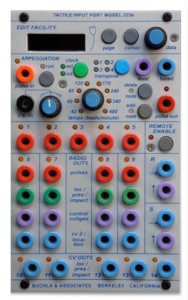
This three panel unit tactile sensor responds to a feather-weight touch, or to several pounds of pressure. An additional (1 panel unit) module houses the outputs, the arpeggiator controls, and the edit facility.
The tactile surface is normally mounted in the first row of a 201e-12 or 201e-18 cabinet: alternatively, it may be mounted in the recently announced 201e-3u frame, relieving spatial binds in crowded systems.
An ergonomic array of 27 keys sense pressure and velocity; fourteen respond to location in one or two dimensions. Arrayed into multiple user-defined groups ranging in size from 1 to 25 keys, they produce a variety of user-programmed control voltages.
Location, pressure, impact and tuned voltages, as well as pulses, are presented at a total of 30 outputs. The LCD based user interface is remarkably simple and flexible. The arpeggiator features multiple patterns, internal and external clocks, and many other sundry features.
All settings, including key programming, can be memorized and recalled by the 225e or 206e preset manager
Time Machine: Yamaha DX7 II + Roland VP330 “Choral”
(c) 2012 vintage synth demo track by RetroSound
lead sound, fx and female voice : Yamaha DX7 II FD
analog strings and human voice choir: Roland VP330 Vocoder Plus
recording: multi-track without midi
fx: a bit delay
drums: Roland TR-808
more info: http://www.retrosound.de and
http://www.facebook.com/pages/RetroSound-Marko-Ettlich/265713782347
Hands-On: Roland JUPITER-50 (JP-50) synth
Keyboard editor Stephen Fortner get an exclusive first-hand look at the new Roland Jupiter-50 synth. See a further look into the JP-50 at… http://www.keyboardmag.com/article/roland-jupiter-50-hands-on/148040
Features
With its unprecedented fusion of synthesis and acoustic instruments, the new-generation Roland JUPITER has changed the way we play, react to, and feel a keyboard. By combining the supreme expression of the JUPITER-80 with the travel friendliness of the JUNO series, the new JUPITER-50 brings SuperNATURAL sound and pro performance to every stage and studio.
- Stunning SuperNATURAL sounds powered by our most advanced sound engine
- Travel-friendly design; 76-note weighted keyboard
- Fast, friendly user interface with intuitive color-coded buttons and sliders
- Registration function for saving and selecting sounds instantly
- Pro-quality multi-effects and reverb
- Expressive performance controllers, including D BEAM, pitch/mod lever, and control input jacks
- USB Song Player/Recorder
- USB audio/MIDI functionality; bundled with SONAR LE and JUPITER-50 Control Surface plug-in for SONAR
Check out this modified KORG – FrankenKorg 800 Demo
This Korg Poly 800 keyboard is modified with the Moog Slayer mod, FM 800 mod, 12/24 db filter switch, VCF external audio in, an Alesis Nanoverb, and a Toshiba Libretto laptop computer. An Alesis Nanoverb and a Toshiba Libretto have never been built into a Korg Poly 800 synthesizer, until now. In this video I play the FrankenKorg to demonstrate most of its features and sound possibilities. Every sound is generated inside the FrankenKorg; no external effects were used. At some points during the video, I use a foot pedal I designed that connects to the synthesizer and controls the internal VCF cutoff. The video was recorded with a Sony DXC-327 and the audio was recorded with Pro Tools. A Toshiba Libretto 50CT laptop was designed to fit where the programming decal was on the original Poly 800. The Korg’s midi out is connected to the input of the MPU-401 controller in the Libretto and the audio output of the Libretto is switchable to either the VCF ext. in or the input of the Nanoverb. In this video, I used the software wavetable and OPL3 FM synthesis chip in the Libretto. The Alesis Nanoverb circuit board sits underneath the Libretto’s keyboard inside the FrankenKorg. Controlling the Nanoverb is accomplished through five of the eight added knobs on the Korg’s casing. The Nanoverb’s audio out can be routed through its original 1/4 inch outputs as well as the headphone output of the Korg. The Nanoverb provides reverb, delay, flange, rotary and chorus effects.
Casio XW-P1 Synth Workshop at Musikmesse 2012
CASIO demonstrator Ralph Maten explains the features of the CASIO Perfomance Synthesizer XW-P1
Roland Model 101 + VM Superdelay = Old meets New
Little improv of the model 101 going through the superdelay on “tape” mode.
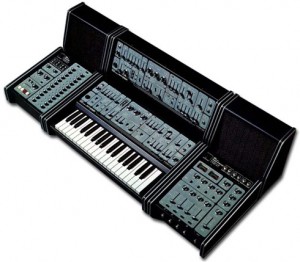
The System 100 is a great and classic analog synth! It’s a beautiful semi-modular monophonic synth consisting of 5 module components: the Synthesizer 101, Expander 102, Mixer 103, Sequencer 104, and Monitor Speakers 109. The Synthesizer 101 section is the heart of the system, from which you could add-on any of the other modules of your choice. Different combinations of these components can be used to create systems of varying potential.
The Synthesizer 101 section is a fully self-contained analog mono-synth. It features a 37-note keyboard (with no performance controls, velocity or aftertouch), and lots of sliders to tweak. Its design is similar to the SH-series analog synths. Controls for the VCO, LFO, VCF lowpass/highpass filters, VCA with ADSR, Noise, and Portamento/Glide effects are all within hands reach. There’s also a handy A-440Hz tuning oscillator, like on the Minimoog.
Hardware:
Roland System 100 Model 101
Empress Effects Vintage Modified Superdelay
Software:
Valhalla Room
Time machine: Roland Juno-60 “March1982”
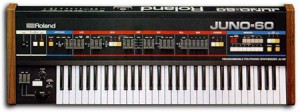
30 years back – March 1982 – one of the greatest analog synths was born – the Roland Juno-60
Among the first in Roland’s amazing JUNO family! Six analog voices of polyphony and patch memory storage!! The JUNO-60 sounds great, however, like the JUNO-6 it lacks MIDI control. The JUNO-60 includes 56 patches of memory storage. The JUNO-60 is still popular due in part to opinions that it sounds better (punchier) than the JUNO-106. The JUNO-6 and 60 are very rich sounding synthesizers and are great analog machines as long as you can withstand the absence of MIDI control. The JSQ-60 sequencer is an external sequencer controller for the JUNO-60 and is usually worth acquiring. Of course nobody can deny that the wooden side panel look is a true sign of Vintage status!
all sounds: Roland Juno-60
arpeggiator triggered by the TR-808
recording: multi-track without midi
fx: a bit delay
drums: Roland TR-808
Checking out StudioLogic’s Sledge Polysynth
Here’s a new video featuring the Sledge at MusikMesse:
For many synthesizer enthusiasts, it is the particular interaction of the sound engine and user interface that makes a great instrument. A quick look at Sledge shows you the generous set of controls available to interact directly with the sound engine. When you touch the knobs and switches of the front panel, you will instantly be aware of the meticulous attention to detail our engineers have refined, during many decades building the best electronic keyboards.
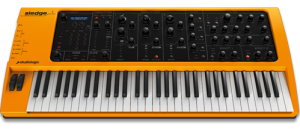
You will experience the logical set-up of the synthesizer modules, mirroring the signal flow of a classic analogue synthesizer. But what really distinguishes any synthesizer is its sound. Fortunately, our friends at Waldorf Music have happily shared their experience and know-how on this crucial part of the Sledge Synthesizer.
Read more about the new Sledge Synthesizer
CASIO XW-P1 – Directly from the MusikMesse 2012
CASIO XW-P1 Musik Messe 2012 by Rock oN Report
The XW-P1 is a synthesizer particularly designed for creating sounds and playing expressively in live performances. This model features 620 preset tones, including Solo Synthesizer presets that reproduce vintage analog synthesizer sounds, Hex Layer ensemble sounds that comprise as many as six tones, and Drawbar Organ presets that can be controlled using nine sliders functioning as drawbars. A wide array of sounds can be created using the preset tones and a wide range of internal waves. Moreover, the XW-P1 is loaded with various functions to give discerning performers more power of expression, including the Performance function that allows performance setups to be independently assigned for up to four designated keyboard zones.
DATAMASKIN

