
Cascadr 2.04 Demo
This video shows off the new feature of Cascadr which is the ability to save sequences to one of eight slots. It’s possible to switch slots and tweak ‘on the fly’ while Cascadr is playing music. This now means it’s pretty easy to make a simple song with Cascadr now, albeit with some live dodging about!
I’ll be exploring this slot idea further for sure!
Yamaha SY85 Realtime Control
Quick demo on using the faders in real time to effect the sound while you’re playing.
About the Yamaha SY85:
In the early 1990’s most synth manufacturer’s quest to use digital forms of synthesis to re-create acoustic sounds (as well as analog sounds) led to an onslaught of rather boring instruments. Among the mob of digital synths some stood out such as Korg’s M1, Roland’s D-50, and Yamaha’s SY-85. Fading away were the days of Yamaha’s FM-synthesis, replaced by Advanced Wave Memory (AWM2). Throughout the 1990’s Yamaha used AWM2 in many of their successful products because of its high sonic quality and advanced synth-like editing features. The SY-85 was a powerful workstation keyboard capable of some great sounds and full arrangements.
It’s a 16-part multitimbral MIDI synth with a nicely weighted 61-note keyboard designed to be the main keyboard in your MIDI studio, with tons of sounds and sequencing features built-in. It has a long but narrow 40 character x 2 line LCD display and a 5×5 mode selection matrix which enhances operation by allowing fast easy access to any of the SY-85’s modes. In addition to pitch & modulation wheels and dual output level controls, the SY-85 has eight slide controls that can be used to control a range of parameters while performing for expressive real-time power. Best of all it’s got multi-mode filters and a dual-effects processor with chorus, flange, reverb, delay, exciter, parametric EQ, echo, ring modulation, leslie, distortion, etc. The effects can be used in series or parallel, and there are 4 busses to route sounds through them. Other features include a 3.5″ floppy disk drive, external memory card slots and two assignable stereo outputs.
The Arturia MiniBrute – Introduction
Here is the introduction to a series of videos that demonstrate the sound and functionality of the Arturia MiniBrute.
MiniBrute is a revolutionary new analog synthesizer from Arturia. Featuring a pure analog signal path and a host of unique features, it sets a new standard for what a hardware synthesizer should be.
Its 100% analog audio signal path features a VCO wave mixer, the classic Steiner-Parker multimode filter, as well as numerous analog innovations such as the Metalizer, Ultrasaw, and the Brute Factor™. Boasting a complete MIDI, CV and USB connectivity, MiniBrute is right at home with your computer or your vintage synths, making it the ideal companion to deliver a pure analog blast anywhere you go.
Korg SQ-10 Demo feat. SQ-10, MS-50, and KR-55
Demonstration video of the Korg SQ-10 sequencer.
KR-55 triggering SQ-10. SQ-10 controlling MS-50 oscillator, filter, and envelope generator.

A very good old-school sequencer from Korg. Designed for the MS series synthesizers and using Korg’s CV / Gate control the SQ-10 sequencer can really surprise you with some groovy basslines. Three channel output allows pitch, tone color and timing variation. Use the knobs to adjust and build up a sequence. Sure it’s limited to 12 steps (with a max of 24) but when you hook that up to your MS-10, MS-20 or MS-50 you can get some pretty cool TB-303 like stuff happening. Because the SQ-10 outputs CV (Control Voltage) it can also be connected to the Oscillators, VCF filters or LFO’s of your MS synths for even cooler tricks. Using a CV / Gate converter allows you to use the SQ-10 with other Roland, Moog, Sequential and even MIDI synthesizers.
FL Studio Alpha Testing | Performance Mode Options
Discuss here – http://forum.image-line.com/viewtopic.php?f=100&t=89582
FL Studio Performance Mode Alpha Testing
Taking a closer look at the Casio XW-P1 Performance Synthesizer
Mike Martin from Casio visited Sweetwater Sound to give a deep overview of the XW-P1 Performance Synthesizer. Mike shows off a lot of sounds, the ability to mix oscillators on the fly, and some awesome sequencing and arpeggiation capabilities. Enjoy the demo, then learn even more about the Casio XW-P1 Performance Synthesizer right here: http://bit.ly/sw_XWP1
The Casio XW-P1 is a powerful six oscillator monophonic solo synth that is ready to gig. You can combine all six oscillators to make a single tone. You get two virtual analog style oscillators, two PCM oscillators, one noise oscillator, and one external oscillator for use with line and mic inputs. Each oscillator has their own filter, portamento, envelopes, key tracking, a master resonant filter, and two LFOs. The XW-P1 is an extremely powerful synth that lets you really edit and tweak each setting. You also have access to the original CZ synthesizer’s waveforms.
Introduction to Stochastik Drum Programming
This is a brief introduction to Stochastik Drum Programming using the Stochastik Drum Machine for iPad. It shows you how you can use probability to enhance your step sequencing so you won’t have any boring loops in your drum tracks.
Stochastik is a full-featured Drum Machine with one outstanding difference. And many killer features. Unlike any other drum machine, Stochastik lets you set a probability that a note will trigger for each of the steps in your pattern.
Once you add chance into the mix, you can generate thousands of unique variations automatically, in the time it takes to sequence two bars. It’s as easy as programming a loop but it generates a dynamic track: no more boring loops! Hundreds of high-quality samples are included, from classic analog drum machines of the past to pristine acoustic jazz and rock kits. Plus, you can import your own samples through iTunes File Sharing, Dropbox or email.
Create an awesome kit, pattern or song and you can easily share and collaborate with your friends through email, iTunes File Sharing or the Dropbox iPad app.
Roland Jupiter-6 Signature Sounds
The Jupiter 6 is an incredible analog synth. All of the Jupiters have a sound that was unlike any other synthesizer and the Jup 6 is no exception. This sound is due in part to classic analog Roland technology in its filters, modulation capabilities and a thick cluster of 12 analog oscillators at 2 per voice. Easy and intuitive programming via front panel sliders, knobs and buttons for all your tweaking needs.
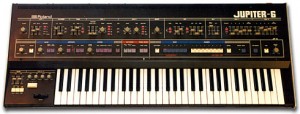
The Jup 6 is a scaled down version of the Jup 8 in terms of programming and polyphony. However the Jup 6 has some major improvements of its own such as newly added MIDI control and better tuning stability! While the Jup 6 does have MIDI, the implementation is very rudimentary and hard to control. The Jup 6 was one of the very first (along with the Sequential Prophet 600) synths to use the then new MIDI protocol, and the implementation on the Jup 6 is far from complete.
http://gstormelectronica.blogspot.com/
A quick demonstration of the Roland Jupiter-6 vintage analog synthesizer. Showing some of the signature sounds that are its claim to fame, and some sounds that may be not so familiar.
Not since 1983 has Roland produced anything quite like it. What sorts of things set the Jupiter-6 apart from its peers?
– Its wild multimode filter capable of Lowpass, Highpass, and Bandpass
– Like a handful of other synths, compound waveform selections are possible for each of the oscillators.
– A feature called Cross Mod: it’s like a third ‘virtual oscillator’ which is a frequency modulator for affecting OSC1. The beauty is that you still have OSC2 to do as you wish.
– Very stable oscillators, and the autotune routine takes about a second to execute! Memorymoog takes around 8 seconds.
– Envelopes: the attack transients are most unique. They aren’t extremely fast, nor syrupy, but I haven’t been able to get any other synth attack to sound the same.
What are these signature sounds the Jupiter-6 does well?
– Buzzy things
– Creamy Sawtooth, silky pad sounds
– Ambient Drones
– Gritty, Dirty, Raw, Nasty, Edgy sounds
– Blippy arpeggios
– Aggressive stabs/leads
– and very rude filter sweeps
Elektron Machinedrum + Octatrack = OT FX
Quick demo showing how octatrack effects can greatly alter a simple drum beat.
The drum beat comes from the machinedrum and is unchanged the whole time. The machinedrum is fed into the octatrack and goes through a “thru” machine and “neighbor” machine to achieve 4 effects: Lo-Fi, Plate Reverb, Filter, Compressor.
No other effects applied.
Hardware:
Elektron Octatrack
Elektron Machinedrum MK 2 UW+
Time machine: ARP Odyssey “Early 70s”
ARP Odyssey mk3 Analog Synthesizer from the 70s
recording: multi-track
fx: a bit delay
background sound: Roland Juno-60
more info: http://www.retrosound.de

While the Minimoog proved to be a runaway success as the first compact studio synthesizer, ARP responded with a compact and user-friendly studio synthesizer of their own with the Odyssey in 1972. An almost equally legendary machine itself, the Odyssey was ARP’s highest selling synth back then, and still is to this day in the second-hand market.
The Odyssey essentially gives you a simplified hard-wired ARP 2600 in a much smaller and affordable package. The Odyssey is a 2-oscillator analog synth (with duo-phonic capability) and it sounds really nice; the Minimoog has three oscillators and is capable of thicker sounds. The Odyssey comes well equipped with all the tweakable features and analog goodness you’d expect: a resonant low pass filter, ADSR envelopes, sine or square wave LFO, and a sample-and-hold function.
The Odyssey also added a few new features such as a high pass filter that could be used in series with the low pass, oscillator-sync capability, and pulse-width modulation. It is a very professional and expressive machine that can create nice analog basses, interesting leads, great effects and sweeping sounds straight out of a Tangerine Dream album!
There were many versions of the Odyssey over the years, each a little different. They can be broken down into 8 models spanning 3 Mark “Mk” version
DATAMASKIN

