
Roland RS-202 demo
“The wonderful string chorus ensemble sound of the Roland RS-202, a classic string synth of the 1970s.”
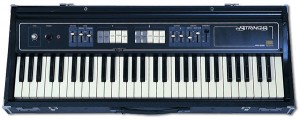
The RS-202 is a string and brass synthesizer released in 1976 that followed the lackluster RS-101. Oddly the RS-202 wasn’t much different than its 101 predecessor. The RS-202 had two new features: a user-controlled delay for the vibrato, and an Ensemble/Chorus effect (that would be seen on dozens of future Roland analog synths for years, including the Junos and Jupiters). It makes the ultimate “disco” string sound.
The RS-202 is fully polyphonic (all 61 keys can play simultaneously). Basically three sound presets are in the RS-202: Strings I, Strings II and Brass. Forget the brass, however, because this machine is all about the strings, and for a time it was considered Roland’s finest string machine. Strings I covers low cello & bass type sounds and Strings II is thinner and in the higher registers for Viola and Violin type sounds.
The keyboard is permanently split into two separate sections, the lower 2 octaves and the upper 3 octaves. Each section has it’s own set of identical controls. These include three white On/Off buttons for each of the three sound presets. This means you can assign any sound to each section, and any combination; For example, set the lower section to Strings II and set the upper section to Strings I+II+Brass if you like. There are also two grey buttons in each section for “Slow Attack” and “Volume Soft”. Each section also has its own sustain slider and there are global brilliance sliders for the brass and string sections independently.
Basic effects included the Ensemble (chorus) effect and Vibrato. A switching-slider is used to select Ensemble I, Ensemble II or Off. The Vibrato effect section had just two sliders: Delay and Speed (depth could not be changed). The Ensemble section did wonders for the sound of this machine; the ‘Ensemble II’ setting introduced a rich chorus, whereas the ‘Ensemble I’ produced the faster, deeper ensemble effect that became an instant classic. Sadly, like most vintage synthesizers the RS-202 is mono (high/low output jacks on back) and provides only a trigger output for an external synthesizer. It’s built-in to a suit-case style housing which made it easily portable.
The RS-202 is a truly vintage and classic machine. Historically, it launched Roland’s signature Ensemble effect. It also sounded fantastic – with or without the ensemble effect engaged. It easily stood up against many competing synths of its time such as the Arp Solina.
Vortex VSTi Introduction
Vortex is a Multitimbral Sequencer from Homegrown Sounds, features 12 independent sophisticated step sequencers, 12 internal synths (or use with external midi), and FX engine, real time rhythm and pitch re-scaling triggers and much more. See hgsounds.com for full details and demo.
Roland Jupiter 50 In Depth Look
Sonic State gives us a good run through of the Jupiter 50:
Roland UK visited us with a Jupiter 50 so we could explore exactly what you get with the little brother of their flagship Jupiter 80. We looked at the synthesis capabilities, the Supernatural voices, performance capabilities and how it works in a DAW setup.
Teenage Engineering OP-1 Demo
Demonstration video of the Teenage Engineering OP-1 portable synthesizer by Nigel Mullaney & Ray Sherwin from Mazmoneth.
Getting to know KORG Kaossilator 2
This is the first in KORG’s series of four “How-To” videos for Kaossilator 2, the next generation dynamic phrase synthesizer! This video covers basic operation and will help you get around the Kaossilator 2 quickly and easily.
For more information on Kaossilator 2, check out http://www.korg.com/kaossilator2
The Trinity – A Korg Trinity Demo
THE TRINITY
Korg Trinity Pro-X 88 Keys Music/Video Demo by Ares Kalogeropoulos. Korg Trinity is a commercially successful synthesizer music workstation released by Korg in 1995. It was also the first workstation to offer modular expansion for not only sounds, but also studio-grade feature such as SCSI, ADAT, various sound engine processors, audio recording capability, and more. It was considered one of the most comprehensive music workstations, in term of features, at the time. It is affectionately referred to as the silver beast by many of its owners.
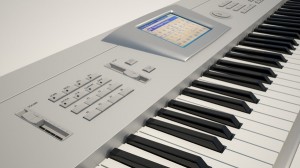
The Trinity workstation features a massive set of effects (100 Insert effects & 14 Master effects), a large graphic touchscreen (320×240) and a complete 16-track sequencer, as well as double sound generation system:
- ACCESS (Advanced Control Combined Synthesis System). A PCM-based sound synthesis with 16 bit – 48 kHz PCM playback on a 24Mbyte ROM. However, since 2:1 data compression has been used, these are equivalent to 48Mbyte of samples held in conventional RAM. The PCM data includes well over 1,000 individual samples comprising 374 multisamples.
- MOSS (Multi-Oscilator Synthesis System). The sound generation system of the Korg Prophecy and Z1 with: analogue modelling, VPM (Korg’s version of FM synthesis) and physical modelling (brass, reed, plucked string, bowed string, organ, electric piano modelling)
Along with the Korg Prophecy, the Korg Trinity synthesizer was a descendant of the original OASYS synthesizer, an acronym for Open Architecture Synthesis System, which was a mega-synth prototype that the company previewed in 1994 but never marketed. The foundation of the system was an open concept DSP system where the OS could load various unrelated models of different synthesis and physical modelling sound generators. It was a multiple digital signal processor (DSP) architecture, with the entire system clocking in at over 900 million instructions per second. Korg later adapted some of the core technologies and released three initial products: Trinity, Prophecy and Wavedrum.
All Sounds/patches made with Korg Trinity.
Multitrack Recording on a DAW.
Software Reverb and Delay added.
Time machine: CRUMAR TRILOGY Analog Synthesizer 1981
This is a short HQ sound demo of the Crumar Trilogy. I played it dry without any additional effects.
The Crumar Trilogy is a multi keyboard instrument / string machine from 1981. It has 3 polyphonic sections: ORGAN, SYNTHESIZER and STRING ENSEMBLE. The best about the Trilogy is the polyphonic synth section, which has 2 VCOs per voice, 24 dB filters which employ the famous SSM chips… The STRING ENSEMBLE and ORGAN sections sound somewhat cheesy, but hey, sometimes you need some vintage cheesy sounds 😉
Very impressive looking. It has no patch memory like you might think. The Oberheim-type led buttons just recall presets.
On a Vangelis record (I don’t remember the title) you see a picture of the Trilogy.
HackMe Rockit Synthesizer Demo
A close up look at the HackMe Rockit synth:
This is a demonstration of some of the sounds and features of this HackMe Rockit synthesizer, designed by Matthew Heinz, which I built from kit a little while back. This demo is less about music and more about the technology and functions of the machine so if you are not into synths you will probably find it boring. You can find out all about the synth or order your own kit from this site http://hackmeopen.com/?page_id=474&fb_source=message.
The Rockit is a dual oscillator monophonic synthesizer. The oscillators are 8 bit and each have 16 different waveforms. It has a VCA with full ADSR as well as a multi-mode 2 pole VCF again with full ADSR. Add to this a pair of LFOs with complex routeing options, Full MIDI support and 16 patch memories and you have a nice little package.
Because of the 8 bit wave table oscillators this thing can do a plethora of Atari sound with the VCA and VCF wide open but once you start get them involved then it moves over to more traditional analogue mono sounds.
Just so you are aware I built the little box case for my Rockit from scratch, the designer does have a case for sale from his site but I am planning to rack mount this thing at some point so I built my own cheap case as a temporary method of keeping it dust free.
DSI Poly Evolver Keyboard Demo
Background information:
Only using a single PEK voice. Oscillators turned on/off for variation parts, using Output Pan for stereo affects. Sequenced/recorded live, from the PEK. Tiny amount of compressions and EQ (bass rolloff). No external effects – delay is from the PEK. All drums from Jomox 888 / 999.

The Poly Evolver Keyboard is DSI’s flagship synthesizer, a nearly-knob-per-function knockout that sounds unlike any other synth out there—except another Evolver, of course! Don’t like a high-end hardware synth that requires wading through endless menus to program? Not an issue with the Poly Evolver’s 78 knobs—60 of them potentiometers—and 58 buttons, incuding a keypad for direct access of programs.
An analog/digital hybrid, the four-voice Poly Evolver features four oscillators per voice—two analog and two digital—in a unique stereo voice architecture with a real Curtis analog low-pass filter per channel. The digital processing does not simply add effects at the end of the signal chain, but is tightly integrated with the analog electronics for tuned feedback, distortion, bit crushing, and synced delays. It can also process external audio and has separate stereo outputs for each voice.
The Poly Evolver is capable of producing sounds ranging from classic analog to more brash and edgy digital sounds. It is also multitimbral, with the ability to play up to four parts simultaneously through separate stereo outputs. And it can process external audio.
The Poly Evolver is not a generic “slab” workstation. If you’re looking for realistic pianos and strings, keep looking. But if you want a truly unique, inspirational, real instrument, look no further.
- Each voice is a complete Evolver with four oscillators per voice, two analog and two digital.
- True stereo signal path with separate Curtis analog low-pass filters in each channel for each voice. Each voice has its own independent effects (feedback, delay, distortion, high-pass filter, etc.).
- Highly accessible sound control for easy, intuitive operation: 78 knobs and 58 switches.
- Clocked, pulsing blue LEDs and hardwood end-panels.
- Each voice has an independent 16 x 4 step sequencer. Everything (sequencer, LFOs, and delay) syncs perfectly to MIDI.
- In Program mode, all four voices play the same sound. In Combo mode, voices can be allocated however desired: stack all 4 for a huge unison sound, split or layer the keyboard in any configuration, and/or play one or all sequences at the same time. Each voice can respond to a different MIDI channel.
- Each voice has its own stereo output in addition to the mix and headphones outputs.
- Stereo audio input that can be routed to any or all of the voices, enabling parallel audio processing of external stereo or mono signals. The output of one voice can be routed to the input of another for interesting double-processing effects.
Closer look at the Roland Juno 6 synth
Background info:
The Juno 6/60 is a popular synth that is the subject of a lot of discussion, and much of it is negative. I am a huge fan of the Juno 6/60 and think it gets and unfair amount of criticism, primarily behind the veil of the internet. This demo showcases its amazing sound and some of it’s capabilities.
Below is the link to the original uncompressed demo:
http://soundcloud.com/briancastro/roland-juno-6
DATAMASKIN

