
DSI Dave Smith Instruments Evolver Keyboard
What a little beauty this synth is – lots of knobs, spacey blue colors and LEDs – nice, too bad DSI’s keyboards normally has a pretty hefty price tag
The Poly Evolver Keyboard is DSI’s flagship synthesizer, a nearly-knob-per-function knockout that sounds unlike any other synth out there—except another Evolver, of course! Don’t like a high-end hardware synth that requires wading through endless menus to program? Not an issue with the Poly Evolver’s 78 knobs—60 of them potentiometers—and 58 buttons, incuding a keypad for direct access of programs.
An analog/digital hybrid, the four-voice Poly Evolver features four oscillators per voice—two analog and two digital—in a unique stereo voice architecture with a real Curtis analog low-pass filter per channel. The digital processing does not simply add effects at the end of the signal chain, but is tightly integrated with the analog electronics for tuned feedback, distortion, bit crushing, and synced delays. It can also process external audio and has separate stereo outputs for each voice.
The Poly Evolver is capable of producing sounds ranging from classic analog to more brash and edgy digital sounds. It is also multitimbral, with the ability to play up to four parts simultaneously through separate stereo outputs. And it can process external audio.
The Poly Evolver is not a generic “slab” workstation. If you’re looking for realistic pianos and strings, keep looking. But if you want a truly unique, inspirational, real instrument, look no further.
- Each voice is a complete Evolver with four oscillators per voice, two analog and two digital.
- True stereo signal path with separate Curtis analog low-pass filters in each channel for each voice. Each voice has its own independent effects (feedback, delay, distortion, high-pass filter, etc.).
- Highly accessible sound control for easy, intuitive operation: 78 knobs and 58 switches.
- Clocked, pulsing blue LEDs and hardwood end-panels.
- Each voice has an independent 16 x 4 step sequencer. Everything (sequencer, LFOs, and delay) syncs perfectly to MIDI.
- In Program mode, all four voices play the same sound. In Combo mode, voices can be allocated however desired: stack all 4 for a huge unison sound, split or layer the keyboard in any configuration, and/or play one or all sequences at the same time. Each voice can respond to a different MIDI channel.
- Each voice has its own stereo output in addition to the mix and headphones outputs.
- Stereo audio input that can be routed to any or all of the voices, enabling parallel audio processing of external stereo or mono signals. The output of one voice can be routed to the input of another for interesting double-processing effects.
Close encounters with MFB Dominion-X
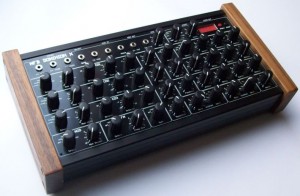
DOMINION X is MFB’s latest synthesizer. It combines analogue synthesis, programmability and modular patching. With advanced circuits, increased functionality and a new design, DOMINION X is the first of MFB’s next generation musical instruments.
DOMINION X offers three oscillators for maximum flexibility. Each waveform can be varied in symmetry. Besides altering the pulse width of a rectangle, you may also continuously turn a saw tooth into a triangle and a triangle into a sine. All oscillators also offer ring modulation. In addition, VCO 2 and VCO 3 can be synced to VCO1. Finally, VCO3 can modulate the frequency of VCO 1 and VCO 2. The analogue oscillator circuit is processor-controlled for stable tuning. To complete the available sound sources, noise or an external audio input can be added to the VCOs in DOMINION X’s mixer section.
The filter offers six operation modes. Available are three low pass variations with 12, 18 and 24 dB/oct. slopes. Also available are high pass-, band pass and a notch filter with slopes of 12 dB/oct. respectively 6 dB/oct. Variable filter modulations are possible via an invertible envelope, keyboard tracking, LFO, VCO, different MIDI controllers as well as by the use o the CV-input.
The two ADSR-type envelops are internally routed to the VCF- and VCA-sections. In addition, envelope 1 can also modulate the VCO section. LFOs 1 and 2 offer six waveform shapes including sample & hold. They may be switched to one-shot-modes to emulation simple envelopes. A third sine-LFO works in combination with a keyboard’s modulation wheel and can dynamically address the VCO, VCF and VCA sections.
Modulations are assigned by the use of selector switches, located at the destinations. This allows easily setting and re-routing internal modulation paths – ideally for your live-performance.
To integrate external modulators, control- and audio sources, DOMINION X offers nine inputs. Therefore, oscillators, filter, VCA, CV/Gate and mixer can be easily combined with other analogue synthesizers such as MFB’s MEGAZWERG, analogue sequencers such as MFB’s URZWERG PRO or modular synthesizer systems.
An additional selector switch allows assignment of velocity for up to eleven modulation destinations.
DOMINION X offers 128 programmable patches for your personal sound creations. To support sound programming without an attached keyboard, different demo sequences are available. To use DOMINION X as a filter box for external audio sources, the VCA can be opened permanently. Finally, there is an insert available to integrate an effect or distortion unit into the signal path.
A very very very short run on the patches memorized in the RAM-B bank of the small, but very effective, MFB Dominion-X Synthesizer
The small, but highly effective, MFB Dominion-X synth under CV/Gate control from Synthesizers.com 960 Step Sequencer. Out of sight, a plain MIDI keyboard for (occasional) key changes. Row 1 of seq goes on VCO 1, Row 2 goes on VCO 2&3, Row 3 goes on VCF.
Fiddling with control panel while playing the MFB Dominion-X synthesizer
The MFB Dominion-X synthesizer has some interesting capabilities of waveform shaping and its filter (developed by Carstein Schippmann) has some great modes
Time machine: YAMAHA AN1x
all sounds: YAMAHA AN1x virtual analog synthesizer (1997)
recording: multi-track without midi
fx: a little bit delay and reverb
I use the internal step-sequencer for the bass sequence.
more info: http://www.retrosound.de and
http://www.facebook.com/pages/RetroSound-Marko-Ettlich/265713782347
About the synth:
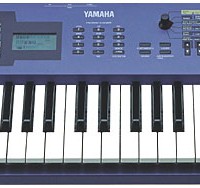
The AN1x is a powerful retro-analog synth with a really cool new feature that lets you record real-time editing and filtering and be able to store it as part of the sound! A major contender in the new wave of analog-digital synths using DSP modeling of analog waveforms to recreate the coveted sounds of analog synths with modern digital specifications. It offers truly traditional yet modern methods of analog synthesizing, 10 notes of polyphony, 8 knobs for tweaking, and an arpeggiator with dozens of inspiring patterns!
Although the AN1x is not a follow-up to the CS1x (which has since been followed by the CS2x and the CS6x) it has borrowed many functions and technologies from the CS1x synth. First, it’s built in an almost identical case with the same layout of buttons and knobs as the CS1x. However the function of every knob and button has been greatly expanded. The AN1x also has 2 Scene memories for instant recall of any envelope and filter settings and the mod-wheel can be used to morph between the two scenes. On-board effects and a state-of-the-art arpeggiator section also are on-board for giving your sounds life and motion.
The AN1x adds a new Ribbon controller for increased real-time control. It also includes pulse width modulation, ring modulation and oscillator syncing. The AN1x may not be the next evolution of the CS1x but it is basically a more advanced synth capable of increased sound potential and quality. It has a better feeling keyboard than the CS1x as well assuming that the AN1x is for those looking for something more professional than the CS1x.
Time machine: Yamaha DX7 II FD
A voyage into the heart of the Yamaha DX7 II FD from the year 1987.
Exploration by Marko Ettlich
FM Synthesizer
16 Voice Polyphonic
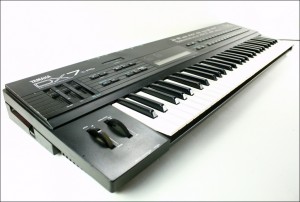
It has been used by Human League, a-ha, Depeche Mode, Tony Banks, Toto and many more.
The DX7 was an amazing digital FM synth. The DX7s carries on the torch once held by the DX7. It offers the same great FM synthesis method and can also create sounds just as unique and wild as the DX7. However, they can be just as difficult to program and understand for most users. Some general improvements include enhanced MIDI support, micro-tuning, aftertouch controlled pitch bending, and multiple LFOs. Although many improvements have been made to the DX7 in this upgrade there still could have been room for improvement, which is where the DX7IID and DX7IIFD come in.
These next models allowed for keyboard split and layering capabilities. The DX7IID (pictured above) and DX7IIFD hold 64 voices in internal memory, as well as an additional 64 voices in a RAM/ROM cartridge that can be accessed. These voices can be layered in dual mode providing very rich sounds or a nice combination of sounds that would be impossible on the original DX7. They can also be split, for a two voice multi-timbral capability. Again, impossible on the original DX.
They have wonderfully clean sound and are stereo, providing pans and chorus and a few other nice effects. There are two real time sliders on these instruments, allowing control of user-programmable items in real time. Micro-tuning, as well as fractional tunings for eastern music etc. is possible. The FD includes a floppy drive for storage of patches, performance presets and sysex information.
Modulatus Maximus
Liz Lang of Auracene demonstrates some of the many modular capabilities in the Minimoog Voyager XL while used in conjunction with Ableton Live.

“Designed in celebration of the 40th anniversary of the Minimoog, the Minimoog Voyager XL is a sonic powerhouse that pays homage to important milestones in the Moog synthesizer legacy. It starts with the heart of a Minimoog Model D. Fat oscillators and warm Moog filters give it that unmistakable Moog sound and the rugged construction and intuitive user interface design immediately tells you that you’re playing a high-quality musical instrument. From the current Voyager lineage, the XL inherits a 100% analog signal path with stable oscillators, patch storage, touch surface, pot mapping and extensive MIDI control functionality. To all this, add a ribbon controller and 61 note keyboard and you have a monster analog monosynth built on a 40 year legacy of sonic exploration.”
Learn more about the Minimoog Voyager XL at:
www.moogmusic.com/products/minimoog-voyagers/minimoog-voyager-xl
Geo Synth and the Talking Machine
First experiments with the Electro-Harmonix Talking Machine.
Synth demos: Oberheim Matrix12 and Arturia Wurlitzer V
Oberheim’s Matrix 12 is a legendary analog synthesizer from the mid-eighties that is still the king of analog sounds. One of the fattest, roundest, pleasantly analog synthesizers around! It’s long been known for creating some of the thickest and best analog pads, sweeps, buzzes, basses and textures. It features Matrix Modulation for extremely wild virtual patching for almost unlimited range of sounds and modulation capabilities!
The Matrix 12 is similar to the Xpander and the lighter Matrix 6. But the Matrix 12 is much fatter and more programmable than either. Every control can have an effect on some other parameter thanks to Oberheim’s flexible design. For example, there are 15 types of LFOs and VCAs per voice! And there’s plenty of diagrams drawn out on the front panel of the synth to help you figure out some signal routing.
The Wurlitzer V is a high end software recreation of the classic Wurlitzer 200A electric piano.
Unlike sample libraries, its physical modeling engine reproduces the very acoustic properties of reeds, key action and amplification, bringing you high realism while offering maximum flexibility on sound.
As most producers know, the legendary bright and overdriven Wurlitzer sound heard on classic records also comes from the use of fine amplifiers, micing and processing. This is why the Wurlitzer V goes further by putting you in command of a studio from the 70’s, filled with vintage stompboxes and classic tube amps… everything you need to get a true classic vibe!
If you are looking for a lively electric piano combined with inspiring studio tools, the Wurlitzer V is the ultimate package.
Moog Micromoog demo
A demo of the Moog Micromoog, the “baby” Minimoog with one oscillator and sub oscillator. Plenty of routing capabilities can create standard Moog bass/lead, but also incredibly crazy FX. Micromoog is a single-oscillator mono-synth, designed as a budget performance Moog. But it’s an inexpensive alternative to the Minimoog. In fact, it is often used as just a stand-alone filter processor since it has a filter that is virtually identical to the one found in the Minimoog, and it accepts external sounds for processing through itself (all at a fraction of the price for a Mini)! It also employs a ribbon controller (which was a cool new feature) for pitch bending. Notice that there are still plenty of knobs to give you access to the shape of your sounds! Unfortunately the construction feels kind of cheap.
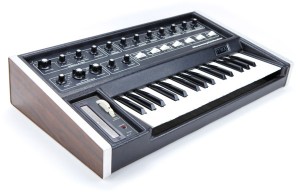
Synth Magic Polychrome basic demo of some of the sounds
Instrument based on the Farfisa Polychrome-Lots of extra features added such as LFO’s on all sections, full effects section,autopanners, velocity to vibrato,filter, tremolo etc.
Available at www.synthmagic.co.uk
Instrument based on the rare Farfisa Polychrome analogue synthesiser for Native Instruments kontakt 4.2.4 or higher(including Kontakt 5). Custom designed GUI to allow for easy tweeking of sounds. Over 200 presets included and thanks to the custom designed user interface it is childs play to design your own sounds. Many existing users say our instruments sound and feel like your playing with real hardware. Easily create the fantastic sounds of this beautiful classic synthesiser. Lots of extra features added such as extra LFO’s,independent autopanners for each synth section,lots of effects and a master effects plus lots of expression controls for aftertouch,modwheel etc.
Reason 6.5 – Pulsar audio demo
http://youtu.be/n1ZX5XphTSI
“Here’s a short audio demo that I did using the Beta version of the new pulsar Rack Extension that will be available in Propellerheads Reason 6.5”
DATAMASKIN

