
Roland Jupiter 4 Self Oscillating Filter and Strymon TimeLine ICE mode
Nice video featuring the first Jupiter synth from Roland.
All sounds from Jupiter 4 are produced by its self oscillating filter with VCO waveforem set to “OFF”. Modulating filter with ENV-1 and LFO and adding a little noise from time to time. Strymon TimeLine is being used in ICE mode with 1.5 octave interval.
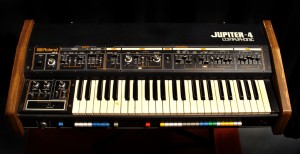
The first Jupiter synth. It was among one of the first poly synthesizers (4 individual voices which could be synced together for one fat monophonic lead), it had a pitch wheel that could be assigned to the VCA, VCF, VCO or all together, there are 8 memory locations and a cool arpeggiator – the arpeggiator can in the Duran Duran classic, “Rio”. It also has a very slow LFO for those ever-so-long filter sweeps. Pretty good for 1978!
Not so cool however, are the 10 preset sounds which sound nothing like the piano, brass or strings they claim to be. The placement of all the preset buttons below the keyboard can be inconvenient, especially while playing it. And as with most old analog synths, the Jupiter-4’s tuning can go out often. Still it is a nice analog synth for creating weird trippy analog sounds.
Demo Alesis Fusion 8hd : vocoder “Human Choir” (VP330-style) simulated
For this short improvised demo, the author has used internal programs and mixes from preset and Hollow Sun banks.
Here are the details:
8 tracks recorded in audio live in Presonus Studio One Artist v 1.6.5:
– mix “DANGER” (rythmics)
– Pea PG Vox (relatively close to the “human choir” of the Roland VP330 with no strings)
– imported sample : PolyMoog Vox Humana for bass and lead parts
– mix “high pass heaven”
– mix “trancin” with arpeggiator
– ambiance + chorus
– Sounds Fx 1 and 2
Experimental Giant Pinata MIDI Controller
Here’s a quick demonstration of the giant pinata MIDI controller that has been built. The demo shows how the sensors work. There is also some footage from its showing in the Children’s Museum.
See more at:
http://seaweedfactory.blogspot.com/2011/11/building-trojan-chorus.html
Demo of the Akai MPC-60, MFB Synth II, and EMW WCS-1
Background information:
Here is a demo of the Akai MPC-60 Sampler/Sequencer, MFB Synth II Analog Synth, and EMW WCS-1 Analog Synth. The drums/sequencing were done by my MPC-60; the drums were sampled on the MPC using my Roland TR-808 as a sound source. The bassline is the EMW WCS-1 and the MFB Synth II is the sequenced melody. Both are sequenced by the MPC-60. The delay/echo effect is a really old Washburn analog delay. The mixer is an Alto AMX-220.
There is lots of cross-talk/hiss/noise in this recording. I personally like this, and I fully understand how I would go about eliminating this. But I would never want to.
Roland Jupiter 80 Sound Demo
Some scapes made with the Jupiter 80. It’s the first synthesizer designed completely around SuperNATURAL® sound modeling technology, delivering expressive instrumental realism far beyond anything previously possible.
Since the launch of the JUPITER-80, many professional keyboard players and producers have praised its expressive SuperNATURAL sounds and live-performance capability. With the Version 2 software update, the JUPITER-80 offers new features that enhance its synthesis power, and provides more flexibility and creativity for musicians designing their own sounds.
“In my opinion a very warm and good sounding instrument with plenty of usable sounds and a good synth engine. I tried to put almost everything to this demo, but it`s hard and this demo should have one hour :)”
Roland Juno 2 iPad controller with Arduino Ethernet demo
Demo of a custom device build around Arduino in order to control the Roland Alpha Juno 2 via Wifi.
The Arduino connects the Juno2 to the Wifi network of the iPad via an Airport router, an Arduino Ethernet shield and a midi shield.
I used Touch OSC to design the controller.
Touch OSC sends OSC messages (e.g /jun/DCO_Range 2.000) which are translated by the Arduino into Midi SysEx messages.
But the Arduino also translates Midi sysex messages from the Juno 2 into OSC messages (sort of loopback) so that when you change the patch on the Juno2, faders automatically move to the right position !
The code and detailled instructions will soon be published on http://4colors.free.fr
The control design mimics Roland PG300, but better !
Checking out the new filters and envelopes in Access Virus TI TIOS5
In this video, we take a closer look at the new filters in OS5 for the Access Virus TI synthesizer
In this tutorial, we take a closer look at the new additional envelopes in OS5 for the Access Virus TI synthesizer
Moog Realistic Concertmate MG-1 Sound Demonstration
A brief demo of some sounds that the Concertmate can make.
This is the very source of cheap Moog bass! It is a lot like the strap-on Moog Liberation in its design and architecture and also looks and sounds very much like the Moog Rogue. The MG-1 was built by Moog for Realistic (Radio Shack), and was designed specifically for the home market. Very basic and easy to use, this is a nice cheap way to get your hands on Moog sounds!

The MG-1 is a 2-VCO monophonic/polyphonic analog synth with a genuine 24dB/oct Moog filter, however the overall sound is thin. On the MG-1, the VCOs are referred to as ‘Tone Generators’. It can produce sawtooth, square and pulse waveforms, and the oscillators are detunable and syncable. A simple ASR (attack, sustain, release) envelope called ‘Contour’ can be applied to both the amp and the filter. The LFO section provides triangle or square wave patterns as well as Sample-and-Hold. Additionally there is a simple Ring-Mod effect called ‘Bell’.
Unique to the MG-1 is a slider on the far right side of the keyboard which controls the volume of a simple divide-down polyphonic organ sound. This feature makes it at least a little more versatile than the Rogue. There are RCA inputs and outputs (the input is routed straight to the output for playing along with music from your stereo system) but no external speakers as in most other home marketed synthesizers. There is also no sign of Midi or patch memory on the MG-1.
“Sorry about the video quality. It was shot using my computer’s webcam (terrible resolution). While it might not look great I made sure to try and keep the audio quality up. I figured sound was the most important part anyway.”
How to use Propellerhead Pulsar as a playable synth
Learn more about the new Pulsar synth from Propellerheads:
Given Reason 6.5’s recent unveiling, the new Rack Extensions were, inevitably, a big topic for the event.
In the first of a series of tutorial videos from the event, resident Reason expert James Bernard shows us how to use one of those Rack Extensions – Propellerhead’s own dual-LFO unit Pulsar – as a playable synth. See how he uses it to make a classic Reese-style bass sound above.
Incidentally, Pulsar is free to all Reason 6.5 and Reason Essentials 1.5 owners until 1 October – so go download it from the Rack Extensions store now.
MacBeth – touch keyboard testing
This is a demo of the touch keyboard that MacBeth is working on.
Gone is the physical stylus- now a finger with a small piece of foil is acting as the actuator! It’s fun and it works. The touch keyboard is playing the MacBeth micromac desktop unit via it’s CV inputs. I’m using a fair bit of sample and hold- LFO1 S&H is sampling the LFO2 Triangle wave- is sounds a little bit like sequences or arpeggios. I’m also usin the CV from the touch keyboard to control the speed of LFO1- at the very bottom of the keyboard- it’s 0 Volts- at the top it’s about 3 and half volts- so the LFO speeds up and slows down accordinly. I hope that you enjoy the product development!
DATAMASKIN

