
Checking out THE DARK ZEBRA synth presets
A walk through some of THE DARK ZEBRA synth presets – a Zebra2 soundbank created by Hans Zimmer and Howard Scarr. A few of the clips reveal extra “ZebraHZ” features that are not present in the regular Zebra2.
Available from July 23rd, 2012 at www.u-he.com
(running the HZ version of this plugin requires a license for Zebra2)
Time machine: KORG Polysix
The Korg Polysix’ main features are six-voice polyphony (with unison and chord memory voice assignment modes), 32 memory slots for patches and cassette port for backing up patches, and an arpeggiator.
On its release it was, along with the Roland Juno 6 released around the same time, one of the first times a polyphonic analog synthesizer was available at a cost effective price ‘for the masses’. It cost about twice as much as the competing Juno 6 but had far more features and ‘real’ VCOs in place of the Juno’s DCOs. It also had on-board patch storage and back up which the cheaper Juno lacked until the upgraded Juno 60 model.
Korg developed the Polysix with an eye on the Sequential Circuits Prophet 5, trying to provide some of the features found on the more expensive synth in a compact, reliable and much cheaper design. While not as powerful, it used SSM2044 4-pole voltage-controlled, giving the Polysix a warm, rounded and organic sound.
Although the Polysix only had one oscillator per voice, it also featured built chorus, phaser and ‘ensemble’ effects (using a ‘bucket brigade’ analog delay line design), to provide a fuller sound.
Background info:
(c) 2012 vintage synthesizer track by RetroSound
“Rainy Days”
all sounds (self-programmed): KORG Polysix (1982)
I use the Arpeggiator for the line and the internal effects Ensemble and Chorus.
recording: multi-track without midi
fx: a little bit delay and reverb
more info: http://www.retrosound.de and
http://www.facebook.com/pages/RetroSound-Marko-Ettlich/265713782347
CASSINI Synth for iPhone – Waveforms
A closer look at the Cassini synth, below you can find the details of this polyphonic iPhone instrument
Polyphonic Synthesizer for iPhone/iPod touch
3 OSCs + 2 Filters + AMP + 9 EGs + 6 LFOs + 3band EQ + Saturators + 2 Delays + Arpeggiator
* 3 Oscillators plus 1 Sub-Osc
– Sawtooth, Pulse(PWM), Triangle, Sine, Noise, FM
– Waveshape Modulation
– Oscillator Sync
– Ring Modulation
* 2 Filters
– LP24, LP18, LP12, LP6, BP, HP
* AMP
– Overdrive
– 3 Band EQ
– Auto Pan
* 9 Envelope Generators
– DAHDSR (Delay, Attack, Hold, Decay, Sustain, Release)
– Velocity, Keyboard Tracking
* 6 LFOs
– Sawtooth, Pulse, Triangle, Random, 16 Step Sequence
– Waveshape Modulation
– Envelope(AD/AR)
* Modulation Delay
– Delay Time: 1-2000ms / Tempo Sync
– Delay Time Modulation
* Filtered Stereo Delay
– Resonant Filter (LP, BP, HP)
– Filter Modulation
* Programable Polyphonic Arpeggiator
* Scale/Chord Remapper
* CoreMIDI (input)
* Virtual MIDI-IN & Background Audio
* Scrollable keyboard (Horizontal scrolling at the bottom edge of the keyboard)
* Recorder
– Audio Copy (Compatible with INTUA BeatMaker, Apple GarageBand and so on.)
– Export wav file via iTunes File Sharing
– The recording time is limited to 3 minutes.
Further information at http://iphone.icegear.net/cassini/
Demo time: Dual AtomoSynth Koe modular
http://www.atomosynth.com/
Just a quick demo using the AtomoSynth dual Koe modular for the acid bass and lead, a bit of reverb and delay added with a lexicon, drums from the motif, all sequenced by midi with Cubase.
Time machine: Roland Juno-106
Time for a new trip with the time machine. A voyage into the heart of the Roland Juno-106 from the year 1984.
Exploration by Marko Ettlich
1 Osc per Voice + Sub osc
6 Voice Polyphonic
LFO – 1 LFO
Filter – analog lowpass with ADSR envelope
Chorus
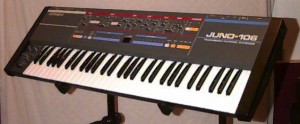
The Juno-106 is a very common and widely used analog polysynth. It continues to be one of the most popular analog synths due to its great sound and easy programmability. It was the next major incarnation of the Juno-series, following the Juno-60. While it has virtually the same synth engine as the Juno-60, the 106 added extensive MIDI control making it one of Roland’s first MIDI-equipped synthesizers. There was also increased patch memory storage, up to 128 patches instead of the 56 patches available in the Juno-60. However, the Juno-60 is often said to have a slight sonic edge over the more advanced 106. The 60 had the ability to modulate oscillator pulse from its envelope and has a “punchier” sound quality.
The Juno-106 is a six-voice polyphonic and programable analog synth with one digitally controlled oscillator (DCO) per voice. While classic monophonic synths used two or three oscillators to create a fatter sound, the Juno-106 uses built-in Chorus to fatten up its sound to dramatic effect. The nature of its DCO meant it was stable and always in perfect tune but still warm and analog. There is an excellent 24dB/oct analog lowpass filter with plenty of resonance and self-oscillating possibilities and a non-resonant highpass filter. The programable pitch/mod bender can be assigned to control the DCO pitch, VCF cutoff, and LFO amount all at once or individually.
The Juno-106 was the first MIDI equipped Juno and its implementation is quite good. There are 16 MIDI channels available and MIDI SysEx data can be transmitted/received from all the sliders and buttons for total remote control and sequencing capability. A switch on the back of the keyboard, next to the MIDI ports allows the user to switch between three types of MIDI modes: Keyboard and Hold data only; Keyboard, Hold, Bender, Patch selection data; or All data (including SysEx). Most users simply set it to MIDI Function mode 3 and forget it.
This synth is incredibly straightforward and very powerful. It’s SH-series derived panel layout is easy to understand and very hands-on. Use it to generate lush pads, filter sweeps, and funky bass lines and leads. The Juno-106 is an awesome learning tool for anyone new to analog synthesis, as well as an electronic musician’s dream for its warm analog sounds coupled with modern features like MIDI and memory – all at a very reasonable price. And still the Juno-106 has an even cheaper alter-ego in the form of the HS-60 – a hobbyist version with built-in speakers.
Mutable instruments Shrutih-1 SMR-4 mega demo
The SMR-4 board comprises a 4-pole VCF (a jumper can be moved to provide a 2-pole output) with voltage-controlled resonance, a linear VCA, and a +/- 5V regulated power supply powering all those (and the digital section upstairs).
00:00 start ov transmisison, 1 osc, wav forms
03:20 2 osc
04:20 duophonic mode
05:19 drone
07:00 arpgiator, sequencer, sound
16:55 playing
23:23 starting a new sequence
27:34 drone, modulations explorations
42:00 end ov transmission
shruthi sound + reverb & sometimes delay
Demonstration and mods – NovationMods MKII
This is a demonstration of the MK II modifications for the Novation Bass station. These include external audio through filter. DCO 2 as source for filter modulation and an analogue ringmodulator which can process external signals using the bass station as the carrier source or it can process the Novation’s own signal. For a more geniral run though of the Novation’s standard features please look at my other video. The speech recording in used to demonstrate the ring modulator in this video was used with kind permission of Afrotechmods check out there channel for some great videos. http://www.youtube.com/user/Afrotechmods
DSI MEK / Mono Evolver – demo
Demo of Dave Smith Instruments Mono Evolver Keyboard. All sounds programmed by WC Olo Garb. Video editing by WC Olo Garb.
Synth exploration: POLIVOKS Filter Demo
Here’s a new video focusing on filters appearing on the Russian Polivoks synth:
It’s a strange synth. But what great filter …. can be switched from low pass to bandpass in an instant. It also posesses two envelopes that can be looped over the attack-decay sections.
I understand that Rammstein use this synth as does Franz Ferdinand.
This is the first of two videos comparing an original Polivoks Filter to one of its many clones.
In this demo, its Blue Lantern’s LM4250 VCF.
http://youtu.be/6RM2HqfXOwg
Im starting with an open filter… Cutoff at max – level 6, resonance at 0.
I’ll update this later with a more detailed explanation of the controls (for those who cant read Russian).
Modulation is via an LFO on the extreme left and an ADSR envelope.
Two Moogs and five oscillators
A short video showing the powerful sound of 5 analog oscillators and actually being able to play more than one note. Simply adding another Moog via a MIDI cable, using last note priority on the Moog SP, you get to play 2 notes without having to go into the menu and setup a chain (both Moogs have this ability in the menu – Voyager 1, Voyager2 etc and the same deal with the SP).
A rather quick and dirty video – but you get the benefit of having your ear drums pummeled by the 5 osc’s
Best with Headphones
DATAMASKIN

