
Korg Radias “Reso Synth Experiment”
Nice demo featuring the KORG Radias – a description of the synth can be found below:
The Korg Radias is a Virtual Analog synthesizer that was released by Korg in 2006. It takes advantage of the MMT (Multiple Modeling Technology) that their flagship OASYS synthesizer module employs. The synthesizer itself is similar in design to the MS2000, but offers many more capabilities. It is capable of emulating older digital synthesizers and classic analog synthesizers like the MS-series without any noise or aliasing. The Radias also allows for various external sounds to be fed through its filters and envelopes. It also has the Korg DWGS (Digital Waveform Generator System) that the Korg DW-8000 employs.
The Radias also takes advantage of the KKS (Korg Komponent System) which allows it to be used with the 49-key keyboard or used as a standalone rack module, and the Radias-R unit can be connected to the M3 Music Workstation/Sampler along with its various keyboard models.
The Radias has two oscillators per timbre and a noise generator. Oscillator #1 has nine basic waveforms, with four types of modulation and PCM (64 synth sounds, 128 drum sounds) and Oscillator #2 has four basic waveforms with two types of modulation. The Radias has the ability to stack up to five types of waveforms in Oscillator #1, while using only one voice of polyphony. In Unison mode, you can stack five additional waveforms, while using more polyphony. With this function, you can create some awesome super waveforms-the overall result can contain up to 25 detuned waveforms. The Radias also has two Low-frequency Oscillators (LFO) that add more modulation to the two audio oscillators. These LFO’s provide six waveforms and their speeds can be set manually or by tempo.
The Radias itself has four timbres per program. With a timbre, you can assign one drum program, another can have a lead, a bass, and a vocoder as well; all in one program! Each timbre can contain one synthesizer/drum kit, equalizer, and two multi-effects.
The Radias has two filters that can be used side-by-side, individually, or in a series. They offer Low Pass, High Pass, Band Pass, and Combination modes. Each filter offers 24 or 12 dB modes for the low pass filter. The effects on this unit are remarkable as well. The Radias comes loaded with 33 different effects: Delays, Chorus, Flangers, Compressors, talking modulator, and even the good old Polysix Ensemble effect. You can assign one master effect to the program, while each timbre gets its own two effects, creating a whole world of possibilities. The Radias also offers a 16-band vocoder with a nice Formant Motion recording function that allows you to record up to 7.5 seconds of external audio which can then be triggered via the keyboard.
The Radias has a built in arpeggiator as well, providing six different patterns to choose from. Patterns can be up to 32 steps long and the gate/velocity can be set for each step to get that sound you want! It also has two 32-step sequencers (they can be combined for a 64-step on a single timbre). They can easily be assigned to a drum kit, for example, to use the Radias as a programmable drum machine. The step sequencer supports 8-voice polyphony per step.
Mopho x4 Synth Demo – Dave Smith Instruments
Carson Day demonstrates some factory sounds on the new Mopho x4 polyphonic analog synthesizer. Except for the programs that are obviously played on the keyboard, the x4 is receiving MIDI data from an external sequencer in this demo.
Studiologic Sledge Synthesizer Test / Demo / Sounds
Here’s a nice demo of the Sledge synth by a German music store, here’s what they have to say about it (Googlish from German):
“At this year’s Musikmesse, he was presented to the enthusiastic fans of synth: The Studio Logic Sledge synthesizer is finally here! As a fanatic of electronic soundscapes, Manfred has made available a copy of the first shipment stolen and extensively tested. Rumor has it he spent the whole night with the Sledge  The full test as a video with a lot of sound samples – now for you at Music Store TV!”
About the synth:
For many synthesizer enthusiasts, it is the particular interaction of the sound engine and user interface that makes a great instrument. A quick look at Sledge shows you the generous set of controls available to interact directly with the sound engine. When you touch the knobs and switches of the front panel, you will instantly be aware of the meticulous attention to detail our engineers have refined, during many decades building the best electronic keyboards.
You will experience the logical set-up of the synthesizer modules, mirroring the signal flow of a classic analogue synthesizer. But what really distinguishes any synthesizer is its sound. Fortunately, our friends at Waldorf Music have happily shared their experience and know-how on this crucial part of the Sledge Synthesizer.
MFOS Noise Toaster Presentation
Noise Toaster details can be found below:
The MFOS Noise Toaster is the latest LO-FI project we’ve come up with deep in the MFOS underground lab. I really think people who attend noise fests, noise battles, synth-diy meets, the symphony (alright maybe not the symphony…) are going to consider this standard equipment (symphony during intermission may be OK). I have to say that in some places having this much fun with a single nine volt battery might just be totally illegal so be careful where you bring it! The Noise Toaster has: One wide range VCO, a WHITE NOISE GENERATOR, a simple but fun VCF, a simple but effective VCA, an AR envelope generator, an LFO with several waveforms, a line out jack, and a nicely normalized switching scheme. But wait… there’s more! Last but not least we’ve put a 1W amp and speaker right into the unit. I want to emphasize that this device is LO-FI. It is not a temperature compensated, V/Octave trackin, needs calibratin’, must have highest quality components – kind of thing. This thing is just a freakin’ blast to goof with. Prepare to create a limitless cadre of amazing and unusual sounds. And of course there will be mods in the future. How about connecting your WSG to the Noise Toaster’s filter and VCA… I already put some pads on the PC board to facilitate it. You could even modulate the Noise Toaster with the WSG (pads for that too)! I plan to offer kits and PC boards as well as complete units. I’ll put a blurb on the MFOS home page when the project is posted.
Why is it called the “Noise Toaster” you ask? Well, what would you call something that has a bunch of knobs and switches that, when twiddled, cause unusual sounds and noises to pop out? Right… Then… On to the next project.
Time machine: YAMAHA AN1x
All sounds: Yamaha AN1x Virtual Analog Synthesizer from the year 1997
recording: multi-track without midi
I use the internal step-sequencer for the bass sequence
fx: a little bit delay and reverb
About the synth:
The AN1x is a powerful retro-analog synth with a really cool new feature that lets you record real-time editing and filtering and be able to store it as part of the sound! A major contender in the new wave of analog-digital synths using DSP modeling of analog waveforms to recreate the coveted sounds of analog synths with modern digital specifications. It offers truly traditional yet modern methods of analog synthesizing, 10 notes of polyphony, 8 knobs for tweaking, and an arpeggiator with dozens of inspiring patterns!
Although the AN1x is not a follow-up to the CS1x (which has since been followed by the CS2x and the CS6x) it has borrowed many functions and technologies from the CS1x synth. First, it’s built in an almost identical case with the same layout of buttons and knobs as the CS1x. However the function of every knob and button has been greatly expanded. The AN1x also has 2 Scene memories for instant recall of any envelope and filter settings and the mod-wheel can be used to morph between the two scenes. On-board effects and a state-of-the-art arpeggiator section also are on-board for giving your sounds life and motion.
The AN1x adds a new Ribbon controller for increased real-time control. It also includes pulse width modulation, ring modulation and oscillator syncing. The AN1x may not be the next evolution of the CS1x but it is basically a more advanced synth capable of increased sound potential and quality. It has a better feeling keyboard than the CS1x as well assuming that the AN1x is for those looking for something more professional than the CS1x.
Closer look at the Drone FX for the iPad
Music iOS app demo of Drone FX. A great app for making ambient music and atmospheric sounds.
“This is my first go at it and still working out a few things, such as ending a sound. A few of the sliders don’t seem to do much but perhaps they do! I like though. You can get it through the app store, with a link below, for $2.99. ”
http://itunes.apple.com/us/app/drone-fx/id499500746?mt=8
Drone FX has the following modes of operation:
– Auto (Generative music in all it’s glory)
– Manual (For the musician in you)
– Hybrid (Auto + Manual)
Users can play along with soundscapes generated in auto mode, or create ambient music without automation using the built-in keyboard(s).
Time machine: Crumar Performer “1979”
Crumar Performer Analog Stringmachine/Synth from the year 1979
recording: multi-track without midi
fx: a little bit delay and reverb
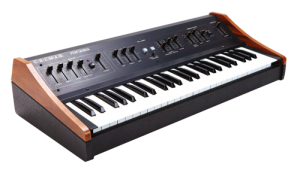
The Performer is a polyphonic analog Strings and Brass machine produced at the end of the 1970’s by the Italian synth company. It is slightly compact with just 49 keys. But it is fully polyphonic – you can play all 49 notes simultaneously! Programming is simple and clearly laid-out with just 15 sliders and a few buttons. A solid black chassis and wood end-cheeks round out this classic and often overlooked string machine.
The Performer is best remembered for its Strings. A simple 3-band equalizer with high, mid and low sliders can be used to give the strings shimmering sparkle or moody dark timbres. The Strings section uses two oscillators per voice with 8′ and 16′ settings. Simple Attack and Sustain sliders give you some control of your string’s envelope settings.
The Brass section is less exciting. It uses a single oscillator with just a square wave to generate a weak Brass sound. It has a low-pass VCF filter with resonance, but it too is pretty weak. Simple Attack and Decay sliders control its limited envelope settings too.
The LFO is pretty nice, with delay length, rate and depth control. It can modulate both Brass and String sections and can be routed either to the VCF or pitch. There are three outputs on the back: main output, brass output and signal output (for external processing) as well as CV and Gate connections.
WerkBench Ambient Experiment **First look at 1.1.0!**
WerkBench is available in the app store: http://bit.ly/L6jhd9
http://www.facebook.com/werkbench
Here is some ambient music generated from a single sample in real-time. The combination of pitch shifting and feedback makes for giant percolating pads. Enjoy! All of the sounds are being sampled with the internal mic and speaker. I live in a noisy place so there is a lot of texture added with each level of feedback. This video features WerkBench 1.1.0 which should be out in the first few weeks of August. I am making use of panning, high-pass filters, and decay settings for each step. These will be available soon!
Mutable Instruments showcases their new Anushri synth
This is a teaser of the Mutable Instruments Anushri synthesizer, currently in development.
Features not demoed in this video:
- Arpeggiator
- VCA envelope and envelope modulation of VCO / PWM
- The 8 LFO shapes and LFO > tempo synchronization
Here are the details on the Anushri synthesizer:
Analog synthesis
- Analog VCO with saw and pulse waveforms, freely mixable.
- Optional automatic VCO calibration in software for those who don’t like messing with trimmers.
- -1 or -2 octaves sub-oscillator.
- Auxiliary square oscillator (DCO) with accurate digital tuning available as an FM modulator or as a sync master for theVCO (yes, it means “ewwwwwwiowwww” and “wongwong”).
- 12dB/octave multimode filter, with smooth self-oscillation.
- Post-filter overdrive/fuzz circuit.
- Linear VCA.
Modulation sources
- 1 main ADSR envelope routable to pitch, pulse width, cutoff frequency.
- 1 simple 1-parameter envelope (morphing through various stages, including the shape of the main ADSR, and a rigid “GATE” style envelope) routed to VCA.
- Velocity routed to either cutoff frequency or VCA gain.
- 1 LFO routable to pitch, pulse-width and cutoff frequency ; with 8 waveforms (triangle, square, ascending and descending ramps, S&H, bernouilli process, piecewise linear random process aka “autodubstep”, noise).
- 1 triangle LFO for vibrato and/or growl.
Arpeggiator and sequencer
- Arpeggiator with 4 modes (up, down, up&down, random) ; 1 to 2 octaves ; 6 patterns.
- SH-101-style note sequencer with step by step recording, up to 128 notes. Easy recording of pauses, ties, and glides.
- Tempo set by internal clock with shuffle, external MIDI clock or external 6/12/24 ppqn trigger.
Drum machine
- Algorithmic drum pattern generator using an innovative “pattern sculpting” approach – allowing a large combination of drum patterns to be sculpted from 5 knobs
- Digital sound generation of BD / SD / HH with tone control
- Drum sounds can be freely triggered from an external sequencer using MIDI channel 10
Interface
- 9 pots and 4 switches for hands-on access to synthesis parameters.
- 9 “soft-pots” for editing modulations / arpeggiator / drum machine settings.
- 3 dedicated navigation buttons (“modulations”, “arpeggiator / keyboard”, “drum machine”).
- 3 dedicated sequencer buttons (“record”, “play”, “hold / rest”).
In/out
- VCO CV in/out (Note: manual VCO calibration is required for accurate 1V/Oct I/O).
- VCF CV in/out (Note: manual VCF calibration is required for accurate 1V/Oct I/O).
- Gate signal in/out (5V level for output).
- 24, 12 or 6 ppqn clock signal in/out (5V level for output).
- External Audio in.
- Audio out.
- MIDI in/out (thru + arpeggiator and sequencer notes).
- CC control over modulations and some of the digitally controlled synthesis parameters. Some parameters like filter resonance cannot be CC-controlled.
“Eurorackable”
- Remove main audio in / out and solder corresponding minijacks on PCB
- Remove LT1054 and solder 2×5 power connector
- Route MIDI in/out to front panel (if you want…). And that’s it!
Availability
- DIY product (full kit)
- Price < 200€ / kit
- Available < October 2012
Vintage style improvisation featuring the EMW-200
http://youtu.be/BhkTveCkatI
An improvisation featuring the EMW-200 from Electronic Music Works. No external effects or processing was used. The main patch contains three sub-patches. The first is the S/H module controlling VCO2 and then fed to the delay module. The second has the triangle wave on the master oscillator and VCO 1 ring modulating in the wave shaper section. And finally the noise output is being low pass filtered and then being ring modulated by the dedicated LFO (which is also modulating the pitch of VCO 1). Each sub-patch is routed to the left and right channels of the six channel mixer.
“I am struck by the warm and organic tones that can be generated by this instrument, as well as the sometimes unexpected sounds that can result from very small changes in the controls. In an upcoming video I will be pairing the EMW-200 with some external effects.”
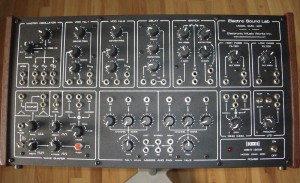
The EML-200 was designed primarily for electronic music courses at Universities. It had no keyboard and leaned in a more abstract direction from the start. The EMW-200 also has no keyboard and will not do 1 volt per octave. The only controls are knobs and one button that can trigger a simple envelope. Where the new version differs from the original is in size. The original was quite large, close to the size of an Arp 2600. The EMW-200 is 16 inches wide, a little over 8 inches tall and 6 inches deep. Nice and compact. The other two places where it differs is a delay unit where the original had a spring reverb, and an a dedicated LFO where once there was a microphone amp. It uses 3.5mm patch cables so if you own Euro Rack gear this will assimilate easily. With the right adaptors it was more than happy to take some modulation from various DotCom modules. This is an analog synth. It is sturdy, steel cased and the knobs do not wobble at all. Nice.
DATAMASKIN

