
Single-synth demo – U-He Diva, all sounds except vocal from Diva
Experimental track exploring the more analog-style sound of Diva
http://facebook.com/synthdemo
more audio demos at http://soundcloud.com/synthdemo
Grab Diva from http://www.u-he.com/cms/diva
Vocal from http://soundcloud.com/rain_and_sun
DIVA – Dinosaur Impersonating Virtual Analogue Synthesizer
The oscillators, filters and envelopes closely model components found in some of the great monophonic and polyphonic synthesizers of yesteryear. Modules can be mixed and matched so you can build hybrids, but what sets DIVA apart is the sheer authenticity of the analogue sound. This comes at the cost of quite a high CPU-hit, but we think it was worth it: Diva is the first native software synth that applies methods from industrial circuit simulators (e.g. PSpice) in realtime. The behaviour of zero-delay-feedback filters when pushed to the limit clearly demonstrates the advantages of this groundbreaking approach.
Check out more than 1200 presets. If your computer can handle it, try them in “Divine” mode.
http://youtu.be/cBKmE2hy5UA
The Diva Controller – An overview and function test
more infos: http://www.synth-project.de
Preview video: http://www.youtube.com/watch?v=m3J0f9G1T4w
An overview and function test of the Diva Controller. Nothing more, nothing less.
Raspberry Pi Synthesizer – live demo (Oscillators and Phase Distortion)
Background video information below:
You lot should be happy that it was a grim, wet, windy Bank Holiday as I got to plug in my Pi and make a video. Sorry the frame rate of the second half is low, it’s my Mac not being fast enough to capture everything.
So – here’s an indication of quite how rich a single-oscillator synth can be (as in, I left OSC B cranked down to zero throughout). OSC A is set to a ‘sin’ wave (which does actually have a *little* bit of harmonic content as it’s not really a sin, it’s a short power series), but all the amazing richness comes from manipulating the phase of the oscillator during each cycle of the waveform. An EG is used to stretch and squash the phase over the lifetime of each note, then the LFO is pulled in to add a warbly, squishy immenseness.
And no explicit frequency manipulation – everything here is being induced by messing with the phase within each cycle of the waveform, the fundamental is not being manipulated, at all. Things get beyond awesome when you add in pitch modulation at the same time as Phase Distortion.
Exploring Crumar Toccata
Founded in the late ’60s/early ’70s by Mario Crucianelli, Crumar was an Italian company that became very famous in its time mainly by their synths, keyboards and organs (both in compact or not so compact models). Mario was brother from Pierro Crucianelli, president of Elka – another very well known Italian company. Crumar existed until 1987 and the company’s golden age was in the second half of the ’70s, when they put on the market their “Pianoman” and “Stringman” models (1974) and later the model that combined the two machines in one, the “Multiman” model (1977). Even with this machines achieving a great reputation on the market, for me Crumar’s coolest instruments are the “Hammond organ clones” made from 1974 on which had a great sound, very close to Hammond organs, but much more compact and easier to carry than the originals.
The Crumar Toccata organ was released in 1981 as a more compact version of all previous models of these “Hammond clones”, more specifically the model T1/C (whose main difference was having one extra octave – higher than the Toccata’s four octaves – and drawbars, like that ones from Hammond organs). The Crumar Toccata organ was manufactured until 1986.
Quick Roland TR-808/Juno-60 Demo
New video from Jordan featuring the TR808 and a JUNO 60, description below:
Here is a quick demo of my Roland TR-808 and Roland Juno-60. No effects were used. They were both mixed on my mixing board and sent straight to my soundcard (Native Instruments Kore). The 808 is doing it’s thing and sending a pulse to the Juno’s Arp In jack. This video was done mostly to demo the Juno-60’s sound while in this mode (Youtube has a suspicious lack of videos demonstrating this). I consider this to be one of the best features of the Juno. It’s incredibly fast to build basslines and song structures this way. From start to about 3:40 I am kind of tweaking the 808 to get a drum pattern that feels right. From 3:40 on it is mostly improv lines on the Juno while the 808 rolls along.
Teenage Engineering – OP-1 Accessory Demo
The OP-1 world is continously evolving with new accessories and new OS updates adding more effects and functions for every release. Your OP-1 will always be the best and easiest to use portable wonder synthesizer. Visit http://www.teenageengineering.com/store for more info.
Single Synth Demo – KarmaFX Modular
All sounds including drums and vocal are from KarmaFX. No external FX used except light limiting on the master. KarmaFX Synth Modular is an advanced and highly flexible Simulated Analog Modular Synthesizer and Effect Unit. Its amazing visual- and highly intuitive user interface lets you modulate just about any knob or slider by any control signal – making the soundscape possibilities almost endless. The internal high-frequency digital simulation of analog voltage levels produces a sound quality that rivals even expensive hardware synthesizers. A comprehensive User’s Manual and tons of bundled patches make it easy to get started producing your own unique sounds.
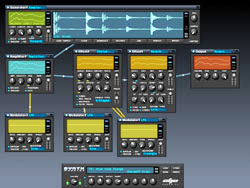
KarmaFX Synth Modular: Advanced Simulated Analog Modular Synthesizer and Effect Unit.
- Full Modular patching of synth Components and Controls.
- Internal high-frequency digital simulation of analog voltage levels.
- Oscillator with phase, Detune and Pulsewidth that generates standard synth waveforms.
- Dual Oscillator with Detune, Hardsync and Ring modulation.
- Sampler, 16/24/32 bit Mono/Stereo multi sample player that imports WAV/SF2/SFZ files.
- Multisample editing with Key/Velocity-ranges and Loop-Points.
- Additive and Pad module with waveform and Harmonic Magnitude/Phase editors.
- User defined waveforms and built-in presets of up to 1024 harmonics.
- 2/4 Pole Multimode Filters with Cutoff, Resonance (LP, HP, BP and BS filtertypes),
- SVF, Zolzer, Moog, 303like, Formant, Comb, Allpass, Parametric and Shelving Filters.
- 10-band digital and 31-band simulated analog Graphic Equalizers.
- Amplifier and Stereo module with Panning, Volume and Velocity control.
- Two channel Mixer with Ring modulation and Bit operations.
- Delay, Reverb, Phaser, Chorus/Flange, Pitchshift, BitShuffler and Distortion effects.
- Soft-knee Compressor with Peak/RMS detection and optional Sidechain.
- 10 Octave/12 Note Pitch control with Detune, Portamento and Pitchbend support.
- Controllers for Frequency Modulation (FM) and fast frequency sweeps.
- Up to 16 channel Unison controller with Detune and Stereo pan spread.
- 32 step, 4 octave Pattern controller with Hold, Loop, Legato and Arpeggiator.
- Bipolar/Unipolar LFO with Tempo Sync, HFO with FM option.
- ADSR and Multipoint Envelopes with Linear, Exponential, Hermite and Cubic curves.
- Step Sequencer, Envelope follower, Sample & Hold and Decay modules.
- Output module with Panning, DC removal, Volume and Clip control.
- Noise generator, filtered Pink, White and Brown Noise with Frequency Sync control.
- Input generator so synth can function as an Insert effect.
- Full stereo support (selected modules can run in mono to save CPU cycles).
- Patches are built up of Generators, Filters, Amplifiers, Controllers, Effects and Modulators.
- Up to 49 simultaneously running modules (8 modules per group and 1 output module).
- Instant visual feedback on all controls. Frequency, Time/Amplitude, Modulation, etc.
- Optionally see knobs and sliders animate as they are modulated.
- Choose between Mono, Legato, or up to 16-voice true Polyphony.
- MIDI modulator modules for MIDI Controller, Velocity, Aftertouch and Pitchbend input.
- 128 user-assignable Automation controls with MIDI Learn.
- Fully skinnable GUI: Optional skins are bundled with the installation.
- 7 banks of pre-made KarmaFX patches + userbanks. (More than 1300+ patches total).
Electrix Warpfactory – Vocoder
Josh Tallman demos the vocoder – Electrix Warpfactory:
Designed for both DJs and Musicians, the Warp Factory is possibly the ultimate stand-alone Vocoder. With those great big knobs, the Warp Factory is designed for straight-forward hands-on use. It has an XLR Mic input (conveniently located on the front) and a quarter-inch line input for use as the Formant or carrier signals. Then there are two quarter-inch line-inputs and two RCA phono inputs for your stereo source sounds, either drum loops, mixes, songs, synth pads, etc…
The way it works is whatever Formant signal you have, say your voice, will be warped into taking on the characteristic of the Source signal you have, say a buzzy synth sound. This would in effect give you that Robot voice effect.
The Warp section is where you’ll find most of the knobs and cool features of the Warp. There is a low- and high-pass filtering switch. A ‘Gender’ knob adjusts the pitch of the Formant. ‘Q’ adjusts the width of the filtering. An ‘Order’ adjusts the filter resolution for clear to abstract vocoding effects. There is also Noise and a built-in oscillator Source signal whose pitch is adjusted by ‘Robot Pitch’. Various Bypass and Freeze switches and complete MIDI implementation make this the ultimate Vocoder for DJs, musicians and producers.
EMW-200 & EMW-300 VIDEO
EMW-200 and EMW-300 demonstration. No external effects or processing of any kind on this video.
JUPITER-80 demonstration by Bernie Smith from Take That
Here’s a new demo of the Roland Jupiter 80; Bernie Smith is not your average session musician. Being the synth and piano man for acts like Annie Lennox and Take That need a special kind of musician. It’s a good job that his Jupiter 80 is not your average synth.
To find our more about the JUPITER-80 go to:
http://www.roland.co.uk/products/productdetails.aspx?p=1165#.UDVgudZmTYg
Doepfer A-106-5 Filter demo
Short Doepfer A-106-5 Demo by NetPierre
Starts with a sequenced bassline, generated by my Doepfer MAQ16/3 and Doepfer VCO A-110 (saw wave)
Bandpass Mode first, LP/HP later
A-118 Random voltages added to VC2 input somewhere in the middle.
Drums provided by an Elektron Machinedrum
More info on the A-100 and related stuff at http://PatchPierre.blogspot.com
DATAMASKIN

