
Ghazala Thereglyph
Radio interference, traditionally a problem in audio, can be used to our advantage. By means of the Thereglyph instrument I would like to introduce to circuit-bending a concept I call radiopool.
While Leon’s Theremin looks to onboard RF generation and sounds the same played anywhere, immersing a radiopool instrument to various depths within the RF field (the radiopool) yields changing results… similar to differing the length of the air column within a flute.
Here I’m playing the Thereglyph within the radiopool of a plasma globe – sometimes touched, sometimes not. For more info on this instrument and building one yourself, check-out my flickr gallery:
http://www.flickr.com/photos/moonbear3325/sets/72157626396557545/
TubeOhm Anti-Transpirant 8x,4x and no oversampling
TubeOhm has released the Anti-Transpirant 8000. Here’s what they have to say…
“After the VINTAGE prog stress we build a back to the roots’ synth.
Powerful VA sounds with 8 x OVERSAMPLING – thats new !!
It looks, feels and sounds like the old hardware synths. And A-T has its own character.”
Features
- 8 x,4 x, no oversampling. The FREE version with 8x oversampling
- audio frequency FILTER FM
- audio frequency PWM modulation
- filter 12 / 24 dB /envelope /VCA/VCF
- delay
- multi trigger ADSR with LFO
- maximum 6 voices ( sales version )
- A-T 8000 with 2 GUI’s
- 3 Instruments , A-T 8000 8x oversampling, A-T 4000 4x oversampling,
- A-T 6 no oversampling 8 reduce the CPU usage
Pricing and Availability:
29,00 €
More information:
Electric Dharma Wheels
First play of Electric Dharma Wheels app from stretta on monome arc 4
App is available here
post.monome.org/comments.php?DiscussionID=11552&page=1#Item_0
Altair-4 The SciFi Sounds Lab DemoVideo
Altair 4 – The SciFi Sounds Lab
is for spacey & wobbly stuff, drones and scapes i.e SciFi FX-sounds, and it is quite good at doing bell like sounds too.
The movie Forbidden Planet from 1956 being the first movie with a complete electronic soundtrack (by Louis and Bebe Barron) using sounds that could have been done with this plug.
“This instrument does do a lot of the things the Barron’s did with their circuitry albeit a lot easier”.
“It makes sciFi sounds & noises and everybody will reminiscent to a old soundlaboratory of the 50/60ties”.
Anyway Altair 4 puts it to a modern level.
Features:
- 2 oscillators with two soundsources with one (B) driving the other (A) to resonate; each oscillator with three mod inputs and extensive control options
- 3 LFO: L1 (7 waves) with key restart on first key pressed, L2 (8 waves) and phase modulation,- L3 (7 waves) with optional modulation by sub LFO;
- 2 hidden LFO: L12 = mix of L1 and L2, L13 = mix of L1 and L3;
- 1 Sample & Hold (6 modes);
- 1 VCA with AR EG (with pan for undelayed sound at Rev section);
- 1 Main Volume with level control: fixed, Velocity, and even Aftertouch, or Wheel;
- 1 Delay (bpm synced) and dedicated pan
- 1 Bass Boost
- 1 Reverb with predelay
- 1 Hold button to hold last played key
- 1 Joypad with 3 balls to control 6 destinations
Altair 4 will be available “soon” for 19 Euro, as introductionary offer until May, 15th 2011. The regular price will be 29 Euro. A demo version is now available.
Big Bang – Cinematic Percussion Virtual Instrument
Trailer for SONiVOX new electronic instrument:
SONiVOX Big Bang features over 12 Gigabytes of more than 200 instrument presets, designed to deliver “explosive sounding” drums and percussion, for use in a cinematic context.
Intelligent Rhythm Control
An integral part of Big Bang – Cinematic Percussion is a technology called Intelligent Rhythm Control, or IRC. Intelligent Rhythm Control intercepts and adjusts MIDI events as they occur, and is designed to help users make fluid percussion tracks with ease.
Features:
- Over 200 earth-quaking percussion patches.
- All programs are multi-velocity, and multi-take round robin for the utmost in realism.
- •SONiVOX’s Intelligent Rhythm Control (I.R.C.) technology
- MIDI Learn & Save Function – Big Bang – Cinematic Percussion is instantly compatible with any MIDI controller.
- Independent Zone (per-drum) Tempo-Synched Variable Resolution Roll/Retrigger Mode.
- 8 User-assignable stereo outputs and 8 User-assignable effects busses complete with onboard EQ, and tempo-sync delay.
- MAC Standalone, RTAS, VST, and AU compatible.
- PC Standalone, RTAS, and VST compatible.
Big Bang – Cinematic Percussion is available now for $299.99.
All the details on the Crystal synth
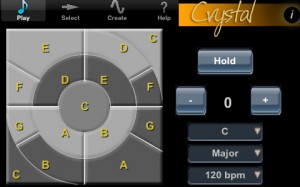
Crystal XT is a full featured semi-modular synthesizer, ideally suited to creating lush evolving soundscapes. Crystal VST has long been a popular synthesizer on the desktop. Crystal XT brings that same powerful synthesis engine to the iPad and iPhone. Crystal XT features MIDI keyboard input via the iPad’s camera adapter or the Line 6 MIDI Mobilizer and sharing of sounds with the desktop version of Crystal. Browse through the included sounds and use the 2 octave keypad to trigger notes to produce evolving, rhythmic, or melodic sounds. Create your own sounds with a single button press using the breed feature.
When using an iPad, you can delve into a tweaker’s dream by using the extensive editing features to sculpt sounds to your heart’s content (editing features are only available when used on an iPad). Crystal features both subtractive synthesis and frequency modulation (FM) synthesis. It offers abundant modulation control with over 90 parameters which may be modulated, multi-stage envelopes with graphical editors, extensive tempo sync of envelopes/lfo rates/delay times, built-in effects for chorus/flanging/comb filtering/echoes, and a band splitter for effects processing by frequency band. Not only that, Crystal has wave sequencing and granular synthesis. The musical applications for Crystal are literally boundless. With MIDI keyboard input, you can connect a MIDI keyboard to your iPad and play Crystal XT like a hardware synth. Or use the Line 6 MIDI Mobilizer and connect your MIDI keyboard to Crystal XT on an iPhone. With patch sharing you can create sounds on your iPad or iPhone while away from the studio, then transfer them to the desktop Crystal when you get back to the studio to use in recording projects. Or, create banks of sounds on the desktop Crystal, then transfer them to the iPad/iPhone Crystal to use in a live performance for a truly portable rig.
If you don’t need all the features of Crystal XT, try the basic version of Crystal, also available in the app store from Green Oak Software. With the basic version you can browse sounds, play notes, and create new sounds, taking advantage of its powerful semimodular synthesis engine. Crystal XT adds MIDI keyboard input via the iPad’s camera adapter and sharing of patches with the desktop version. Choose the app that is best for you! Important note for iPhone and iPodTouch users: Crystal XT runs on both the iPad and the iPhone/iPod Touch. Because of the limited screen space on the iPhone however, the editing pages, which contain the edit controls, are not available when running on that device. But on the iPhone you can still browse sounds, play notes from the keypad, create new sounds with the Breed feature, and share sounds with desktop Crystal VST. Note: MIDI input requires an iPad. Apple’s camera adapter is not supported on the iPhone/iPod Touch. I recommend www.iosmidi.com as a good place to go to learn whether specific keyboards will work with the camera adapter.
For videos and information about Crystal XT, visit: http://www.greenoak.com What’s New in Version 1.2 – New two octave keypad with selectable modes – Patch designer on iPhone for creating patches – Audio recording which may be copied to desktop – Audio copy/paste to copy recordings to other apps – Support for Line 6 MIDI Mobilizer to connect a MIDI keyboard to Crystal on an iPhone or iPad – Patch breeding can now include up to 20 user patches – High precision mode (drag vertically to get high precision after touching slider) for precise slider adjustments. Check out the Crystal Synth XT now on the iTunes App store at http://itunes.apple.com/app/crystal-synth-xt/id408288370?mt=8#
AlphaSphere IndieGoGo Campaign
What is the AlphaSphere?
The AlphaSphere is a brand new musical instrument. Consisting of 48 tactile pads, it combines iconic design and smart materials to create an audio-visual experience that is truly unique. The pads are touch sensitive and can be infinitely programed to trigger electronic sounds. The AlphaSphere will bring modern music production and performance off the computer screen and back into the hands of the musician. Know the feeling when you suspect the DJ is just checking his emails? You can say goodbye to that…
* A hands on way of producing music
* Sounds triggered by malleable pads
* Varying pressure applied to pad can control a number of parameters – volume, pitch, oscillations etc.
* Apply your own sounds or samples using Open Sound Control
* Integrated LEDs for full visual effect
* Can be easily used as a synth, a step sequencer, or a MIDI controller as well as being an instrument in its own right
The Technology
The brain of the AlphaSphere is based on an XMOS processor. The processing power and multi-core architecture allows for ultimate responsiveness and the possibility to expand the signal processing done on board. The prototype connects to the outside world using Open Sound Control which can interface with MIDI. Though there are plans for internal voices and sample-sets, we will always keep the AlphaSphere programmable, so any sound you conceive can be uploaded and shared. The Firmware and Software for the AlphaSphere are based on open source software and the code will be publicly hosted and documented. We are looking to foster a community around developing for the AlphaSphere, and hope that developers and producers alike can create and share new systems and sounds for the instrument.
There is also a speaker within the AlphaSphere itself, taking full-advantage of the inbuilt acoustics of the spherical resonant chamber. To play electronic music with the AlphaSphere, feels like you are literally holding the sounds in your hand, morphing and shaping them as you please.
Richard Hoadley – Gaggle, Generative Sound Interface 2010
The Gaggle prototype has been imagined, designed and developed in order to experiment personally with such interfaces, and primarily with the link between sensor (in this case ‘pings’), physical computing board (in this case Arduino) and SuperCollider audio language.
Gaggle provides an opportunity to investigate performance using Gaggle, including questions such as: * Does the number of sensors affect the nature of the interface? Does increasing the number of sensors to a point where they are difficult to control consciously affect performativity? * Does the relative position of the sensors affect the result. In particular these ultrasound sensors can interfere with each other, especially when designing for movement such as that created by dancers. * How does the type of movement to be used with the interface affect the use and design of the interface? For instance, in this case, how is the direction of the sensors affected and what difference does this make? * Interplay between physical implementation and software algorithms: for instance, does the physical nature of the interface need to be reflected in its performance results. Of course all the usual issues concerning algorithmic composition and structuring arise at this point.
More info: http://rhoadley.net/ music
grüvtron jam with iPad and iPhone
iPad and iPhone both running new grüvtron with their tempos locked wirelessly using BeatSync.
Want to create that thumping bass line to fill the dance floor or a heart-wrenching lead line? Want to jam along with your friends – any time, any place and sound superb? grüvtron lets you jam and create in a multitude of styles and in any key all on your iPhone, iPod touch or iPad – whether you’re a trained musician or not!
Just as easy as using loops but way more versatile. Just choose a Preset and jam! Change keys, scales, sounds and other musical parameters. The grid-based touch interface lets you create Bass, Lead, Chords, Pads and other musical Parts with control over note density and pitch. Bass part too busy? Too slow and plodding? YOU control the density of the part in real time! From slow whole-note soulful to fast and frenetic 16ths!
Kraftwerk Machine for the iPad

Kraftwerk has released something for the robot-lovin’ Apple fanbois – Kling Klang Machine for the iPhone & iPad.
Kling Klang Machine is an “interactive 24 hour music generator”. Here’s what the developer has to say about it:
It’s a novel system that creates music and sound based on realtime data depending on your location that are continuously feeded into the app, meaning the KLING KLANG MACHINE No1 can’t be compared with other generative music apps, which mostly utilize pre-programmed algorithms.
There are some nice ways to manipulate sound and store personal preferences.
For now the functionality is still kind of basic but the original concept will be more and more implemented in future updates and releases.
Unfortunately, there’s no video preview, at this point.
Kling Klang Machine No1 is $8.99
Here are the features:
1. WORLD TIME ZONE MAP
24 hours automated music
2. INTERACTIVE CONTROL
Bidirectional cross line: tempo and tune of sound
Zoom: room – sound – effect
Save: 2 memory locations for control settings
Reset: All settings back to default
3. MATRIX
Auto: Matrix sequence – variation after 16 steps
Loop: 16 step sequence in a loop
Clear: Clear matrix
Save: 2 memory locations for sequencer
4. MIXER
Direct access to all parameters through direct controls
Save: 2 memory locations for controller settings
Reset: All settings back to default
DATAMASKIN

