
Quick demo of the Solaris synth
John Bowen Synth Design started the process of developing the Soalris synth some 7 years ago:
The general concept behind the Solaris synthesizer is to implement something like a giant wall-sized modular system entirely in software where you can select among several completely different types of oscillators and filters, exquisitely modelled after the components culled from a variety of legendary vintage synthesizers of yesteryear and even some current virtual analog innovations of today. With up to four oscillators, four filters, four amplifiers, four four-input mixers, six envelope generators, one looping envelope generator, five LFOs, two vector mixers and still more of these software modules available in each program, the Solaris synthesizer becomes absolutely unrivalled in terms of versatility and programmability.

Solaris is a synthesizer designed to live up to the idea of ‘no compromises’:
- Flexible as a modular system, but easier to use – with five 2 x 40 character display sections, one 240 x 64 graphic display, and 40 knobs, the Solaris is capable of great depth in sound manipulation, but designed to be as easy to use as the vintage synths of the past for which John Bowen is known.
- Sound quality is paramount – newly created synthesis algorithms provide unparalleled quality; signal processing handled by SHARC floating-point processors. Internal processing is done at 96 kHz; audio rate modulation provided with sample-accurate precision.
- The Solaris is a purchase which will last for years, through new algorithm “expansion packs” and OS updates.
Modular MIDI Controller Prototype
Here’s a video featuring Livid’s soon to be released modular mid controller system. It’s based on the eurorack standard and will feature dozens of modules that can be arranged to create totally unique layouts. This will be our 4 modular skiff enclosure.
Teaser video of the Livid Modular Midi Controller
“Here’s a video I made of our soon to be released modular mid controller system. It’s based on the eurorack standard and will feature dozens of modules that can be arranged to create totally unique layouts. This will be our 4 modular skiff enclosure.”
Tabletop Demo: Sarah Nixey “The Homecoming (Microfilm Tabletop Remix)”
A re-creation of Microfilm’s tech house remix of Sarah Nixey’s single “The Homecoming” on Retronyms’ iPad app Tabletop. All music is played and sequenced by Microfilm using Tabletop on iPad 1. Ms. Nixey’s lead vocal has additional fx in the mp3 that’s playing on the SpinBack turntable. Also, there are 2 custom Gridlok samples (windchimes and backing vocal sample) which have external fx baked into them.

Retronyms has updated Tabletop, its virtual studio for the iPad.
New devices in Tabletop 1.1:
- Compressor
- Limiter
- Expander
- Bit Crusher
- Splitter
- High-pass Filter
Tabletop is a modular virtual studio that comes with a variety of devices, including a pad sampler, matrix synthesizer, mixer, turntable, low-pass filter and more. Additional devices are available as in-app purchases.
for more information on Tabletop visit: www.retronyms.com
The One – Teaser for a new DJ system
Here is what potentially may be a a new modular dj application, but nothing more is stated. However you may join their beta program here >>
Super secret for now 
Steinberg’s CMC modular controller system now released
The CMC series is the world’s first modular controller system for Cubase. Consisting of six unique USB controllers, CMC gives you all the control options you’re looking for — along with utmost flexibility and great ease of use.
From yesterday’s announcement:
Steinberg Media Technologies GmbH today released its new CMC controllers. Dedicated to Steinberg’s Cubase advanced music production system, the six USB-powered CMC units offer an integrated control solution that provides a desirable degree of flexibility and configurability.
The CMC controllers are equipped with a combination of control elements that provide tactile control over certain Cubase functions. Each unit can be used separately or hooked up together with the included joint plate, resulting in a control desk that leaves no wishes unfulfilled.
“The CMC controllers are ultra-portable and the design’s perfect, but more importantly, the units offer a mind-blowing array of control options. Without a doubt, the CMCs are the perfect complement to Cubase, and Nuendo too,” commented Stefan Schreiber, Steinberg’s product marketing manager for hardware.
The CMC-CH channel controller houses 16 illuminated rubber push-buttons, one rotary encoder and a touch fader. The multi-colored buttons provide access to VST instrument settings, solo and mute tracks, bypass EQs, sends and inserts and channel freeze. Eight of the 16 buttons can also be assigned to a second function. The Channel Select button browses through the entire Cubase mixer, while the rotary encoder is used for panning. The LED-based touch fader controls the volume level while displaying the fader position.
The CMC-FD fader controller features four high-precision touch faders with LED-based metering and solo/mute function. The touch faders offer simultaneous control over four channels in Cubase. With the Channel Select and Bank Select buttons, users can jump to individual channels or select entire channel groups in the Cubase mixer. Up to four FD units can be combined together for 16-channel control.
The CMC-QC quick controller boasts 13 illuminated buttons and eight rotary encoders in three different modes: EQ, Quick Control and MIDI. In EQ mode, the rotary encoders reflect the channel EQ controls in Cubase, while the QC mode maps Quick Control capability onto the encoders for controlling effects and other parameters. The MIDI mode turns the unit into a freely configurable MIDI controller. Eight of the 13 push-buttons can be assigned to random Cubase functions. The included CMC-QC editor allows users to adjust MIDI control change parameters through the computer.
The CMC-PD pad controller features 16 highly responsive backlit pads and one rotary encoder. The pads change their background color according to the pressure exerted. Depressing the pads triggers MIDI notes or selects volume response curves. In 4Velocity mode, the pads are used for easy step recording. The rotary encoder browses sounds and presets in Cubase. The included PD editor software is used to assign MIDI notes to each pad.
The CMC-TP transport controller houses 17 buttons and a touch slider. The slider allows users to jog or shuttle through the project, tap in the tempo, scroll, zoom and browse. All major transport functions, including play, stop, record, cycle, fast forward and rewind, are controlled via the CMC-TP. Other buttons are used, for example, to insert markers, set the locator range or insert new tracks. The top four buttons can each be assigned to a second function, for even more control in Cubase.
The CMC-AI controller highlights Steinberg’s universal AI Knob, together with its ten function buttons. The AI Knob allows users to control any control element in Cubase by simply moving the mouse cursor over it. In Volume mode, the AI Knob turns into a high-precision master volume control whereas in Jog mode, the AI Knob is used to jog through the project. The AI Knob also doubles as a browse button to search and select presets. The four function buttons can be assigned to further control parameters.
CMC accessories comprise the CMC Studio Frame 4 and the CMC CC121 Extension Frame. The CMC Studio Frame 4 is a durable construction for housing up to four CMC units. The CMC CC121 Extension Frame can hold up to two CMC units and one CC121 controller.
Availability:
The CMC controllers and accessories are available through the Steinberg Online Shop in October. Shipping of the CMC controllers and accessories to dealers in Europe begins in October; however, the exact time of availability at certified Steinberg dealers is subject to regional variations.
Improvised solos on the TouchContinuum
Background information:
The final release candidate version of the TouchContinuum!
I’m playing my Nord Modular G2X synth over MIDI.
The two solos were improvised over self made jamtracks.
Thanks to the new rounding algorithm, the intonation isn’t that bad this time
###################
HOW TO GET IT
###################
There is NO DOWNLOAD AVAILABLE so far, but I’m working on it! The source code will be released on github.com under the GPLv3 licence.
###################
For more Informations about the multitouch table hardware I refer to my other videos.
Short Dreamboat Sample and hold video
Dreamboat fed a sample a hold CV
The Dreamboat is a dual chaotic oscillator with 2x CV inputs, a Gate output with adjustable threshold, and two sets of X and Y outputs. There are two oscillator sections to the module, the top half is an audio rate chaotic oscillator and the lower half outputs LFO rate signals. With its five outputs, the Dreamboat allows you to connect to plenty of modules all at once, allowing all kinds of modulation and listening possibilities.When used with an oscilloscope or a scope program in X/Y mode, the Dreamboat allows you to view its chaotic attractors in realtime.
Allowing for unique rhythms through the use of the gate output, a typical setup might see the Dreamboat involved in a few feedback loops while controlling an ADSR and a VCA with its gate output. When used with TIP-TOP’s special dual cables, hearing AND viewing the Dreamboat at the same time is a snap.
The Dreamboat is easy to use, just turn the knobs until the Chaos starts, then add modulation, cross-couple the two sections, and bring in a VCO or Noise module. For even more far out sounds, we recommend the use of two or even three Dreamboats for a truly powerful setup. Though the Dreamboat is not an oscillator in a way you might be used to, it will push you into new musical directions.
From subtle to destructive, from scary to absurd, the Dreamboat is a strange bird.
Use the Dreamboat to create everything from strange fogs to banging pots and pans, use it to explore Chaos or simply to have a truly unique module in your setup.
Snazzy FX recommends Gleick’s classic book CHAOS for those who want to know a bit more about what is going on behind the scenes in this module.
Synthesis: Twisted KP Controls Doepfer Analogue Modular
Twisted KP converts OSC from Konkreet Labs Performer to control voltage which is then routed a Doepfer modular rack. Gate mode in KP allows for control voltage messages to be sent only sent on touch.
TWISTED KP:
http://twistedtools.com/shop/reaktor/twisted-kp/
KONKREET LABS PERFORMER FOR iPAD
http://konkreetlabs.com
THE FOLLOWING EURORACK MODULES WERE USED:
Livewire AFG, Doepfer A-105 VCF and A-188BBD and A-180 Mult
CV AUDIO INTERFACE:
Control voltage output made possible by using MOTU 828MKII interface. Please make sure that you have a similarly capable dc-coupled audio interface if you plan on using control voltage with TWISTED KP.
Geist Expander: Analogue Mayhem
Here’s a new expander we discovered yesterday, promises to give you a lot of organic electro sounds:
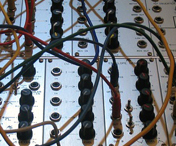
FXpansion is proud to present Analogue Mayhem, a Geist Expander featuring edgy, organic electronic sounds generated almost exclusively with a large analogue modular synthesizer. Its unique character and texture is ready to deploy in Geist’s fast and intuitive sample-sequencing environment – insane sequences, deranged SFX bursts, deep basses, lush chord stabs and multi-sampled synthetic drums which use Geist’s round-robin, velocity layering and FX treatments for expressive depth and sonic variation.
Geist Expander for electronic music
Over 800 WAV samples
Over 180 RX2 loops
5 Full song presets
6 Engine presets
30 Kit presets
71 Pad presets
Anything but vanilla, Analogue Mayhem defies genre categorization and is infused with a refreshing energy and attitude. Its versatile, tasteful material is universally relevant in any music requiring powerful, forward-looking sounds, and begs to be mangled further through Geist’s FX and filters or any device capable of loading 24-bit 44.1khz WAV and RX2 files. Producers of dubstep, techno, electro, hip-hop, ambient, drum & bass and other creative modern styles will find Analogue Mayhem a trip to use.
DATAMASKIN

