
New midi step polyphonic arpeggiator
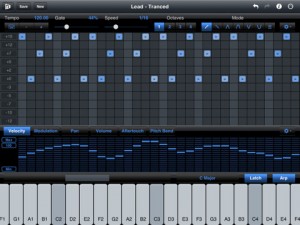
Laurent Colson’s StepPolyArp (App Store link) is a midi step polyphonic arpeggiator. The arpeggiator does not play any sound itself, it transmits midi notes to a Mac or a PC to be used in combination with any sequencer, virtual instrument (VSTi, Audio Unit) or midi synthesizer.
The arpeggiator can transform chords into sequences of notes played one after the other in several ways. A matrix polyphonic step modulate arpeggiated notes in time and pitch. The main controllers (velocity, modulation, panning, volume, aftertouch, and pitch bend) are also programmable through a step editor. The integrated keyboard automatically adapts to the selected musical scale.
StepPolyArp is available now for $11.99. See details below.
If you’ve used StepPolyArp, leave a comment!
Features:
- 32 steps programmable matrix
- 11 configurable transposition lines
- Features copy and paste
- 8 octaves virtual keyboard
- Velocity, modulation, pan, volume, aftertouch and pitch bend step controller
- The apeggiator and keyboard fit the selected scale
- 6 arpeggiator modes
- 1 chord mode
- Unlimited number of saves
- Random patterns creation
- Presets manager
- Presets shared between computer and iPad using iTunes 9.1 or later
- 128 Undo/Redo levels
- Lockable keyboard (latch mode)
Supported midi connections:
- DSMidiWifi (free)
Requirements:
- A computer running Mac OS X, Windows Vista or Windows 7
- DSMidiWifi server (free) installed on the computer for wireless midi connection
- A sequencer installed on the computer (Logic, GarageBand, Cubase, Ableton Live, Digital Performer, Reaper, ProTools, Sonar, Studio One, …)
- An iPad with iOS v3.2 or later
New free stand alone four voice synth

16tone’s Vogue Quattro is a free standalone four-voice synth for Intel Macs . It has microtonal capabilities and it comes with a library of 3,000+ tuning files.
Specifications:
- four-voice polyphonic PCM synthesizer
- three oscillators per voice, each endowed with square wave sub-oscillator (1 or 2 octaves lower)
- true monophonic mode (plays three voices at unison, nine oscillators in total)
- 88 raw waveforms including white noise
- single LFO with 6 waveforms
- ring modulator
- easy-access modulation matrix
- scale-relative pitch-bend (self-adapting to tuning scale steps with microtonal precision)
- 64 factory preset programs
- receives MIDI tuning standard SysEx messages
- compatible with Max Magic Microtuner mtx – tuning files
- includes library of 3,000+ tuning files
This is a standalone synth so you’ll need Cycling ’74 (free) Soundflower to re-route its output and be able to record it .
New synth from XILS-Lab

XILS-Lab has told me that the polyKB is a recreation of a very rare, very powerful polyphonic synthesizer released in the 80’s by a french company. And in there own words:
The polyKB is a polyphonic substractive synthesizer based on two waveform morphing, aliasing free oscillators and a self oscilating 4 poles low pass filter.
The oscillators take a large part of the sound of this synthesizer but the filter recreating a standard analog chip of the 80’s with the help of of very complete modulation section allow the polyKB to create incredible and warm sounds, from georgous bass to slow evoluting pad, through agressive lead and thin cristal keyboards, without fogoten a wide range of special effects.
The modulation section of the polyKB acts like a matrix with five dedicated sources (LFO, ADSR,VCO,NOISE,VELOCITY) and five dedicated destinations (VCO 1 and 2 pitch, VCO 1 and 2 waveform,VCF frequency).
To increase the sound design possibilities, six menus have being added, two for the sources, four for the destination, with which a wide range of modules can be choosen
(Velocity, sequencer ouputs, LFO freq, Filter res, VCO levels, to name but a few)
The polyKB brings also a very powerful polyphonic sequencer.
The sequencer can record and play 8 voices independently as well as the pitch than the velocity. To control the sequence, a 2 to 128 steps clock system allows a wide range of rythms and patterns.
Of course the sequencer outputs can be assigned as a source of modulation, opening the sound posibilities endless.
The polyKB offers:
- two aliasing-free morphing oscillators: from triangle to pulse, through saw.
- One 4 poles low pass self oscillating filter
- two envelope generators (ADSR)
- two MIDI synced LFO
- One MIDI synced Sample and Hold
- One 128 steps polyphonic sequencer
- One arpeggiator
- Chorus and delay effects
- Mono/Unison/Poly playing mode with up to 16 voices of polyphony
- All parameters are MIDI controllable
POLYPHONIC PATTERN BASED ARPEGGIATOR
[youtube=http://www.youtube.com/watch?v=09ixxQO5kVk&feature=player_embedded]
Usage
- Catanya is good for beginners. It allows them to combine preset patterns and quickly receive song basement.
- Catanya is ideal and recommended for the live musicians. It allows to design and create original riffs for them (but not only for them)
- Create compositionally rich traces to your songs.
- Create professional traces for the instruments which you are not familiar with.
- Compose songs at style which is not “yours” – for brass band fan it is not problem to make techno song when necessary.
- You don’t need to manufacture a trace. You need just your chord procedure (you have it mostly), then hang-up our plugin, join a syntesizer/sampler and the track is finished.
Features
- next generation pattern arpeggiator
- easy to use
- fully editable patterns
- multiple instances
- 9×32 note matrix
- 1100 presets (music phrazes)
- supports recording final output into DAW for additional editations
- presets browser with ability to choose genre, style, rhythm, instrument, tempo
- applicable with any VSTi plugin or external HW synthesizer (via DAW’s midi out)
- unique AI Random functions for making unique velocity Groove
- realtime velocity spread
- support Cubase, Ableton Live, Reaper, FL Studio, Mackie Tracktion, NI Kore 2, EnergyXT
Don't want to create your own patches – Check out L'il Poly-Ana
 L’il Poly-Ana 1.14 |
 |
L’il Poly-Ana offers all the same sound features as her big sister, all we’ve done is remove most of the voice editing controls to make her a preset player only. We have however left in all performance related controls, allowing you to customize your patches to your desired playing style. And we’ve also included the most popular controls for live sound tweaking, the filter cutoff and resonance controls. All fully automatable and MIDI CC controllable, just like with “big” Poly.
There’s also been an evaluation reset for both products, so even if you’ve tried them before, you can download and try them again. We offer a free, fully functional evaluation peroid for the first week, so go ahead and try them out, save and recall your work, sample the sounds, even make hit records with them — we don’t care! The 7 day free evaluation period is there for you to enjoy actually using our products in real-life production scenarios. We feel you should be able to “Try B4 Buy”, and we believe our products truly sell themselves. Our fully functional demos are there to prove it, so try ’em out!
L’il Poly-Ana contains all of the sound features and capabilities of Poly-Ana. What makes it L’il, however, is the restriction on your ability to design new patches. It almost works on the honor system, however, as Admiral Quality decided to leave in every performance control and the entire simulation control section which includes Quality (CPU), Saturator and the new Analog Drift Feature. What’s more, Admiral Quality left in the cutoff and resonance controls for both filters for live usage. L’il Poly-Ana is only available as a VST instrument. The full version includes an effect version of the plugin.
The intended L’il Poly-Ana customer is someone who does not want to create their own patches, possibly someone just beginning a venture into computer sound. However, even Poly-Ana users might find L’il Poly-Ana useful for recalling patches and saving screen space. That should be good news for Poly-Ana users because if you’re one of them, you get L’il Poly-Ana for free.
Oberheim Matrix-12
Spent an hour in one of my fav synthshops this week and played around with an old favorite of mine the Oberheim Matrix-12 – had almost forgotten how nice it sounds – can´t remember right now which group it was that was using it the most, could have been OMD but I am not sure. Below is a video clip featuring an Oberheim OBX (couldn´t find a clip of the M-12) paired with an TR 606 and an SH 101, me like 
[youtube=http://www.youtube.com/watch?v=Gl8hKDM5FA0]
About the Matrix-12
The Matrix-12, truly one of the “Monsters” of programmable analog synthesizers. It is basically two complete Oberheim Xpanders hooked up to a velocity-sensitive (including release velocity), pressure-sensitive (there were some early Matrix-12s that did not have pressure-sensitivity), 5-octave, 61-note (C-C) keyboard. With 24 oscillators (two VCOs per voice) it can be set up as a 12-part monophonic or a 6-part polyphonic multi-timbral synth. The front panel is exactly like the Xpander, except for one button that switches between voices 1-6 and 7-12.
DATAMASKIN

