
Reaktor Monolite 1.0.5
http://nonorder.wordpress.com/
Monolite is a new experimental noise/drone/fx Ensemble for Native Instruments Reaktor.
Technical info: 4 sine oscillators + tone cut filter + grainer unit (granular processing) + fx unit with 17 different effects + automizable X-Y controller for fx + high-quality reverb. Low CPU-usage
Note: The ensemble works best with Reaktor 5.6.2
Native Instruments 203: Reaktor: Revealed x 35 videos
Native Instruments 203: Reaktor: Revealed by Brian Cass
Video 2 of 35 for Native Instruments 203: Reaktor: Revealed
Imagine having all the tools you need to build your own synthesizer. Thats what Reaktors all about! Join sound design and synthesis maestro Brian Cass as he reveals the inner world of this amazing instrument from Native Instruments. And along the way youll learn everything you need to know to begin designing and building your own, unique virtual synths and sound modules.
This tutorial starts out with an intro section that gives you a deep understanding on how Reaktor is put together and how you iinteract with its interface. Next youll learn all about its amazing tone generators, filters, envelope generators and other modules that you can use to build you own custom synth.
Throughout this tutorial adventure Brian leads you on a synth design/sound design journey showing you all along the way how and why Reaktors programable objects are connected together giving you deep understanding of programming and synthesis all at the same time! By the time you get to end of this 35 video tutorial youll be ready to take on the synth world with your newfound Reaktor skills!
After watching this tutorial, checkout our ever-expanding library of Native Instruments tutorials below and forever-expand your NI sound experience!
More info on this title: http://j.mp/yTglM0
Enjoy
Musicrow Sound Pilot – Synthesized Effects for Reaktor
http://www.mcrow.net/ Will be released on March 2012
With Sound Pilot you are the pilot! Blurring the difference between an effect and a sound generator, Sound Pilot opens new sonic dimensions for the innovative music producer and sound designer. Sound Pilot is part of Musicrow Golden Ensembles pack for NI Reaktor.
NAMM teasers from Eowave – featuring the Domino Filter and Reaktor
Here is a quick look at the Eowave Domino, focusing on the sound of the filter, using the sawtooth oscillator
Eowave Domino’s LFO sync’d to MIDI clock. This video shows LFO waveforms: triangle, ramp up, ramp down, square and random. You can have fun manipulating the LFO speed setting while sync’d to MIDI clock. The LFO is modulating the 24db/oct filter and the pulse width of the square waveform oscillator in this video.
Using the audio input to route a drum beat from a Reaktor Ensemble Krypt, through the Domino’s 24 db/octave filter. Domino’s LFO is tempo sync’d to Reaktor’s MIDI clock, and is modulating the filter cutoff.
Nintendo NES chip sound simulation
There’s a beautiful synthesizer for chiptune music called Bitmaker in the Reaktor User Library which simulates the NES sound processor RP2A03. Made by Keisuke Ai.
MLR in Reaktor!
“The original MLR was written in Max/Msp by Brian Crabtree, inventor of the Monome. I have rebuilt his program in another language, Reaktor for many reasons: to best understand how a program works, bottom up; because I would like to see the program have more functionality, and I am more fond/capable of/with Reaktor over Max/Msp; and because Reaktor adds certain features that Max/Msp does not allow for. For one, the ability to use any program created in Reaktor as a VST, automatically in your favorite DAW.
After I am complete advancing the program the way I would like to in Reaktor, I will code it in C as a standalone program.”
opensource collaboration with no regard for national borders or trade agreements. this is grass roots interaction with the aid of the modern world.
mlrV is fundamentally based on brian crabtree’s mlr
it has been REFACTORED by trent gill with assistance from %
see: vimeo.com/2434050
GET IT > docs.monome.org/doku.php?id=mlr:mlrv
monome.org for the latest updates
A short demonstration of a selection of presets included in GRID
A short demonstration of a selection of presets included in GRID.
GRID is available now for £20
Visit icebreaker-audio.com/products/grid/ for more information
An example of how to make an analog style drum beat in GRID.
Holiday treat from Native – free synth – SKANNER
Xmas treat from Native Instruments 
SKANNER – our holiday gift for you: Stephan Schmitt’s raucous and exciting new synth is available for download now. SKANNER can be used either with the latest version (5.6.2) of the free REAKTOR 5 PLAYER, or REAKTOR 5.6.2.
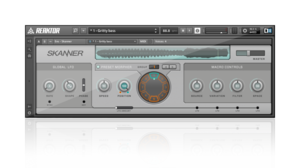
Play samples like a synth – SKANNER will rip through your holiday lethargy.
“Created by Stephan Schmitt, SKANNER is an innovative, unorthodox instrument with a unique raw edge. It takes samples as source material and generates breathtaking new sounds, ranging from simple sine waves to walls of noise. A must-have for adventurous producers and sound designers, SKANNER is also completely free. Runs in the latest version (5.6.2) of the free REAKTOR 5 PLAYER, or REAKTOR 5.6.2. Download it today!”
Despite the complex synthesis going on under the hood, SKANNER couldn’t be easier to use. Two views offer different levels of interaction: The ‘A’ view features four macro controls that are mapped to multiple parameters – even subtle tweaks can create dramatic changes.
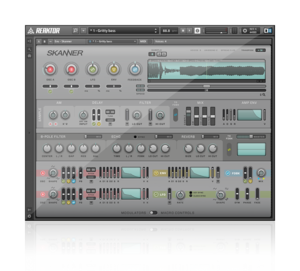
If you want to dig deeper into the architecture of SKANNER, the ‘B’ view (pictured here) provides access to more detailed parameters. Use SKANNER with REAKTOR 5.6 and you can replace the included samples with your own – discover their sonic potential when they get skanned. At the heart of SKANNER’s creative potential is the versatile Preset Morpher – morph between eight different snapshots for evolving sounds that are unworldly and unusual. The controls include morphing speed and LFO modulation – jam and morph from one extreme to another, and capture your performance in your DAW.*
Using Native Instruments’ Reaktor To Build Virtual Instruments
More info – http://bit.ly/vKrfPY
Dubspot Electronic Music Production and Sound Design Instructor Evan Sutton explains how to make basic connections and building a subtractive synthesizer using Native Instruments Reaktor’s Built In Modules in this new tutorial. There are many levels to Reaktor’s hierarchy. In the last tutorial, we spent most of our time on the Instrument level, making small changes and swapping out effects. If you missed the first tutorial, you can find it here: http://bit.ly/nxoNjs
In the second installment, we’ll go even deeper and build our own instrument from the ground up. We’ll be using Reaktor’s Built In Modules, which are tools that range from simple math to complex signal processors. Many of these modules are the basic tools used in modular synthesis. We’ll use these to build a simple synthesizer with one oscillator and an amplitude envelope. Remember to keep the volume down while you’re setting up your modules.
It’s important to explore basic signal flow in Reaktor. There are infinite possibilities for experimentation, but these concepts are the starting point for building larger and more complex ensembles.
Maschine and Reaktor manipulation
A simple groove along with some realtime manipulation with Reaktor
DATAMASKIN

