
Analog Drum ‘n Bass
Bakground data:
This is my imagining of what circa ’98 era minimal tech step drum ‘n bass may have sounded like had it been invented before modern samplers and digital synths / fx.
All the sound is being generated live, coming straight from the main mixer in the middle, with no multitracking. Sequenced by 3 vintage hardware sequencers, the Yamaha QX-1, Roland MC-4 and Roland MC-8 locked together by tape-sync.
List of the main gear used :
Sequencers : Roland MC-8, Roland MC-4, Yamaha QX-1
Modulars : Roland System 100 (Drums), Moog series 900 (pads), Roland System 700 (Basses), Arp 2500 system, Buchla 100 series.
Other Synths : Korg MS-20, Roland System 100 standalone synth.
FX : Roland Space Echo RE-501 (tape delay, chorus, spring reverb), Roland DC-30 (analog chorus-echo), Roland Dimension-D Analog Chorus.
Mixer : Tascam M308b
Time machine: Roland Jupiter 4
“This is a little demo i’ve made with the Jupiter 4. Since the first two albums from The Human League, this synth is well known. And i can say, this synth has a very special timbre. The Jup4 is not midified. All lines were played by hand. Only the bassdrum, snare and the HiHats are sampled from the Jupiter 4 and were played by a sampler. I’ve also used the internal JP4 arpeggio. As always a multitrack recording with some fx.”

The first Jupiter synth. It was among one of the first poly synthesizers (4 individual voices which could be synced together for one fat monophonic lead), it had a pitch wheel that could be assigned to the VCA, VCF, VCO or all together, there are 8 memory locations and a cool arpeggiator – the arpeggiator can in the Duran Duran classic, “Rio”. It also has a very slow LFO for those ever-so-long filter sweeps. Pretty good for 1978!
Not so cool however, are the 10 preset sounds which sound nothing like the piano, brass or strings they claim to be. The placement of all the preset buttons below the keyboard can be inconvenient, especially while playing it. And as with most old analog synths, the Jupiter 4’s tuning can go out often. Still it is a nice analog synth for creating weird trippy analog sounds.
Roland TR 808: All Hail The Beat
“The sounds of the Roland TR-808 drum machine inspire musicians around the world, even though the device hasn’t been made since 1984 and most of its avid users have never actually seen one.”

The TR-808 is a classic drum machine that used analog synthesis to create its sounds. The sounds have a very thin and pure quality and aren’t grungy like it’s successor the TR-909. In fact, the 808 has become the signature beatbox used in most R&B and hip-hop as well as a lot of dance and techno music. Booming bass kicks, crispy snares and that annoying cowbell sound made famous during the 80’s are all part of the 808 and its famous sound.
Its 16 drum sounds include the famous boomy low kick, snappy snares, low/mid/hi toms, low/mid/hi congas, rimshot, claves, hand clap, maracas, cowbell, cymbal, open hihat, closed hihat and accent. All of the sounds can be edited and/or tuned and have individual outputs. Unfortunately it is not MIDI equipped but it does use Roland’s DIN Sync.
The TR-808 was OK in its time. It just didn’t sound like real drums. When the Linn Drum machines appeared, the 808 seemed doomed. But its unique sound and analog allure have found it a long-lasting home in many forms of music. Clearly the 808 has been one of the more important and famous drum machines in the history of music, spawning imitators (ReBirth, DrumStation) and band names (808 State).
JP80 + JP8 + JP6 + Ion “3 Jupiters”
Here we have a Jupiter 80, Jupiter 8, Jupiter 6 and Alesis Ion. The Ion is being used for the Arpeggiator. The patch on the Ion is called “Infrastructure”. The patch on the Jupiter 80 is called “Big Mouth Pad” which is the first patch of the new 2.0 version.
“Roland Jupiter 80” Distorted Polysynth
Short description:
What’s even more apparent is that the Jupiter 80 is not based on any conventional synth architecture, because it eschews the conventional patch and performance structures that have dominated synth architectures for the past 20 years or so. The lowest level (or so Roland claims) is the ‘Tone’, and there are two distinct Tone generators: Supernatural Acoustic (which, confusingly, also contains the APS sounds) and Supernatural Synth. The next level up is the ‘Live Set’, which can comprise up to four Tones in ‘Layers’. The top level is the ‘Registration’, which comprises four ‘Parts’: a single Tone in the Perc Part, a Live Set in the Lower Part, another Live Set in the Upper Part, and another Tone in the Solo Part.
Modular research – Antikythera
Equipment used in this video:
Roland System 104 Sequencer to
Doepfer A 185-2 outs to
a.A 156 ionian Scale
b.Quantimator 1 phrygian scale
c.Quantimator 2 mixolydian scale
4ms Peg RCD VcaMatrix
Analogue Systems RS 110
Doepfer A 134 pan by Moog MP 201
Make Noise Maths QMMG
Malekko 4x Oscillator
SSL Modulation Orgy
Toppobrillo Quantimator Sportmodulator
Master Clock Logic via Kenton Pro 2000II and 2x 4ms RCD.
Drum Logic Ultrabeat 6/4
Roland RE201 Space Echo
The Roland RE-201 Space Echo is truly a Vintage (1973) piece of music technology with lots of appeal even today. It’s not a synth, but a Tape-Echo machine for creating true analog echo effects. The RE-201 is a simple system in which a small loop of tape records an incoming signal and immediately plays the recorded sound back over a couple playback heads before being erased over by new incoming audio. A real analog system with warm, gritty and almost noiseless operation, the Space Echo can provide warm, unpredictable and highly tweakable echo effects.
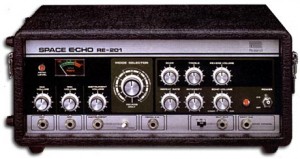
There are twelve settings to adjust various tape loop speeds, number of repeats, levels, intensity, etc… It can even generate some of its own feedback loops for instant sci-fi effects. It features a built in spring reverb for even more classic analog effects. The RE-201 not only has Vintage appeal but is still widely used to get those dubby, slightly unpredictable, musically analog echo effects.
Juno 106 Ableton Live Pack
Ableton Live Pack of 22 instruments created with the Roland Juno 106 Polyphonic Analog Synthesizer. Each instrument was sampled from a custom patch on the Juno 106 and contains 8 macro knobs with its own unique effects to further twist and manipulate this diverse collection of sounds.
Available at http://afrodjmac.spinshop.com
The JUNO-106 is a very common and widely used analog polysynth. It continues to be one of the most popular analog synths due to its great sound and easy programmability. It was the next major incarnation of the JUNO-series, following the JUNO-60. While it has virtually the same synth engine as the JUNO-60, the 106 added extensive MIDI control making it one of Roland’s first MIDI-equipped synthesizers. There was also increased patch memory storage, up to 128 patches instead of the 56 patches available in the JUNO-60. However, the JUNO-60 is often said to have a slight sonic edge over the more advanced 106. The 60 had the ability to modulate oscillator pulse from its envelope and has a “punchier” sound quality.
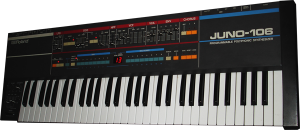
The JUNO-106 is a six-voice polyphonic and programable analog synth with one digitally controlled oscillator (DCO) per voice. While classic monophonic synths used two or three oscillators to create a fatter sound, the JUNO-106 uses built-in Chorus to fatten up its sound to dramatic effect. The nature of its DCO meant it was stable and always in perfect tune but still warm and analog. There is an excellent 24dB/oct analog lowpass filter with plenty of resonance and self-oscillating possibilities and a non-resonant highpass filter. The programable pitch/mod bender can be assigned to control the DCO pitch, VCF cutoff, and LFO amount all at once or individually.
The JUNO-106 was the first MIDI equipped JUNO and its implementation is quite good. There are 16 MIDI channels available and MIDI SysEx data can be transmitted/received from all the sliders and buttons for total remote control and sequencing capability. A switch on the back of the keyboard, next to the MIDI ports allows the user to switch between three types of MIDI modes: Keyboard and Hold data only; Keyboard, Hold, Bender, Patch selection data; or All data (including SysEx). Most users simply set it to MIDI Function mode 3 and forget it.
Closer looka at the “Roland Jupiter 6” – Fat Analog Synth
The Jupiter 6 is an incredible analog synth. All of the Jupiters have a sound that was unlike any other synthesizer and the Jup 6 is no exception. This sound is due in part to classic analog Roland technology in its filters, modulation capabilities and a thick cluster of 12 analog oscillators at 2 per voice. Easy and intuitive programming via front panel sliders, knobs and buttons for all your tweaking needs.
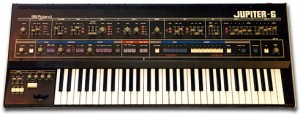
The Jup 6 is a scaled down version of the Jup 8 in terms of programming and polyphony. However the Jup 6 has some major improvements of its own such as newly added MIDI control and better tuning stability! While the Jup 6 does have MIDI, the implementation is very rudimentary and hard to control. The Jup 6 was one of the very first (along with the Sequential Prophet 600) synths to use the then new MIDI protocol, and the implementation on the Jup 6 is far from complete.
Synthcom Systems, Inc. offers the Europa firmware upgrade for the Jupiter 6 which gives it an up-to-date and comprehensive MIDI implementation. All parameters are controllable via Continuous Controller or SysEx. Europa also features an extensive arpeggiator which will sync to MIDI clock with programmable clock divisors and rhythms, and has about 50 more playback variations than the JP-6’s original Up, Down, Up/Down, and Down/Up. A Europacized Jupiter 6 is a thoroughly modern synth with a classic sound.
DW / New Recording (NightBirds Electronic from France) 2012
“Today, I remade a title that I had written in long ago. I kept notes in my archives of every parameter of my machines but also the programming of all the sequence on the ROLAND MC-4 sequencer. 4 hours of work to achieve this title and again 2 hours of rehearsal before recording in live.”
Recorded with : ARP Odyssey, RSF Polykobol, RSF Kobol, ROLAND System 101 & 102 (x2), ROLAND MC-202, ROLAND MC-4 Sequencer, ROLAND TR 707 (for synchronisation)… Two Mix Table… Effects pedals…
Video creation by NightBirds.
Publication & Copyright by NightBirds Electronic Music – 2012
http://fr-fr.facebook.com/people/NightBirds-Electronique/100000038001995
http://soundcloud.com/nightbirds-electronic
http://soundcloud.com/nightbirds-past-records
DATAMASKIN

