
Droner and Echo Pad via Audiobus for iPad
Droner is a nice little drone generator but put this through Echo Pad and some fantastic effects can be achieved
Microtape 17 Marimba Nirvana from Tronsonic
Featuring new tape echo sequencer and FX section.
For full version of NI’s Kontakt 4.2.4 or 5.1.0 or later
www.tronsonic.com
Sound Demo: Behringer Echo Machine EM 600 & Roland Juno 106
Download WAV : https://www.box.com/s/r7s4w491slkg81g…
Roland Juno 106 played through a Behringer Echo Machine EM 600 Delay Pedal.
“Just some Juno noodling, and rather extreme settings on the EM 600, but that’s the way I like my delays  “
“
Analogue Systems RS-390 Echo Demo
Background video description:
I seem to have acquired a lot of eurorack delays. So I thought, let’s make some demos. These are however a lot of work. I also note I have a lot of dust on my modular! But anyway: here is the first: a demo of the Analogue Systems RS-390 echo (digital delay). I got bored with filming the synth itself, so I added a few shots of the vegetable patch on my balcony … Probably next demo will be the Pittsburgh Analog Delay. But don’t hold you breath, this may take a while.
Any suggestions for other patches to try are welcome.
PSP Echo is available in AU, VST, RTAS and AAX formats

PSP Audioware let us know that PSP Echo is a high quality echo processor plug-in (AudioUnit, VST, RTAS AAX for Mac OSX (Universal Binary); VST, RTAS and AAX for Windows). They say that PSP Echo’s powerful and unusual features combined with its smooth operation makes it ideal for all kinds of creative uses from simple slap back and sustain effects through ping-pong delays and spacious echoes.
A spokesperson told SBC, “Use the delay sliders to add special tape echo effects for even more unique effects. The tape wow control and built in ducker further extend the creative potential of PSP Echo. Internally, the Echo is like a combination of four mono tape delays–two for the initial ping-pong pre-delay and two for the main stereo echo. PSP Echo includes a set of extremely useful factory presets that cover a wide range of this plug-in’s settings.”
Pricing and Availability:
Until 3rd September 2012 you can buy PSP Echo at the special introductory price of $69*
Until 17th September 2012 you can buy PSP Echo at the special introductory price of $79*
Starting from 18th September 2012 regular price $99* will be applied.
(*all prices exclude taxes)
More information:
DFRNT – Everyone Is Moving
DFRNT – Everyone Is Moving (Video) [taken from “Fading” – Echodub EDUBCD001]
DFRNT – Everyone Is Moving
Video by Alice Millar – vimeo.com/user765391
Track taken from the DFRNT album “Fading” – Released on Echodub – 3rd September 2012.
dfrnt.co.uk
echodub.co.uk
Two new effect plug-ins coming your way – echo and morph
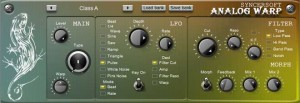
Syncersoft tells us that Analog Warp is a warp and morph effect designed to deliver the clear, penetrating sounds favoured by live musicians. They believe that it’s ideal for use in trance, dance, techno, dubstep, electronica, drum n bass, big beat, dub, reggae and all other styles. Syncersoft says that the LFO modulation section was designed specially for Dubstep genre but can be used in other styles too.
The plug-in contains:
- Main section.
- Filter section.
- LFO section.
- Morph section.
Pricing and Availability:
Free download.
More information:
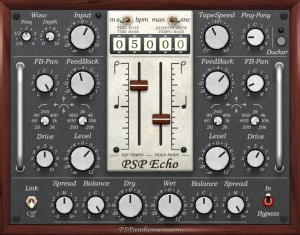
PSP Echo – the echo processor previously only available within Wave Machine Labs’ Auria 48-track DAW iPad app – is now available in standard plug-in form for use in your favorite DAW.
Echo’s powerful and unusual features combined with its smooth operation makes it ideal for all kinds of creative uses from simple slap back and sustain effects through ping-pong delays and spacious echoes. Use the delay sliders to add special tape echo effects for even more unique effects. The tape wow control and built in ducker further extend the creative potential of PSP Echo.
Internally, the Echo is like a combination of four mono tape delays — two for the initial ping-pong pre-delay and two for the main stereo echo. PSP Echo also comes with a set of useful factory presets that cover a wide range of the plug-in’s settings.
PSP Echo is available in AudioUnit, VST, RTAS AAX formats for Mac OSX (Universal Binary); and VST, RTAS and AAX for Windows.
Minimalistic 8-bit techno with Nanoloop & Echo
Minimalistic 8-bit techno with Nanoloop & Line6 EchoPark.
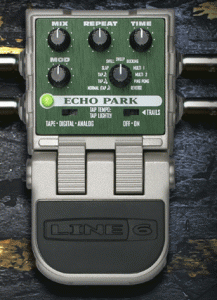
Based on the award-winning DL4™ Delay Modeler, Echo Park™ is loaded with unbelievable sounding models including Analog, Tape, and Digital Delay. Different delay patterns such as slap, ping pong, swell, and sweep can be adjusted with the twist of a knob, and the Mod dial can be tweaked for even more variations. Also features Tap Tempo and stereo ins and outs.
New version of a classic chorus echo device with tape-delay simulation
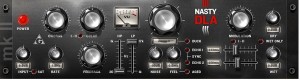
Variety Of Sound has released NastyDLA mkII, a new version of the classic chorus echo device with tape-delay simulation.
The mkII version of this plug-in is an overall technical redesign and features “stateful saturation” algorithms for an overall improved sound experience and changes several things under the hood. Basically, NastyDLA mkII remains feature-wise the very same but introduces the input stage modelled by this new technology and also redesigns the tape compression algorithm for an improved IM distortion performance. In general, the distortion generation appears to be more analog-like and the perception of width and depth has been improved significantly.
Improvements:
- The behaviour of the input stage has been changed. It acts output level compensated now and only is active if the SAT switch is engaged. It is modeled based upon a stateful saturation algorithm which sound wise turns in to a way better distortion performance as well as a more “3d” sound perception.
- The tape compressor has been improved for a better IM distortion performance and a less muddy sound.
- The level of noise which can be dialed in has been altered. The level itself is corrected and by moving the according knob to the left-most position the noise can be switched off.
The .dll name and the VST plug-in ID has been changed and so both, old and new version, can be used in parallel in any case. Nevertheless, the mkII version remains preset-compatible with version 1.x so one can transfer presets between them in both directions.
NastyDLA mkII is a Windows 32-bit freeware release for VST compatible applications and you can grab your copy via the download page.
Roland RE201 Space Echo
The Roland RE-201 Space Echo is truly a Vintage (1973) piece of music technology with lots of appeal even today. It’s not a synth, but a Tape-Echo machine for creating true analog echo effects. The RE-201 is a simple system in which a small loop of tape records an incoming signal and immediately plays the recorded sound back over a couple playback heads before being erased over by new incoming audio. A real analog system with warm, gritty and almost noiseless operation, the Space Echo can provide warm, unpredictable and highly tweakable echo effects.
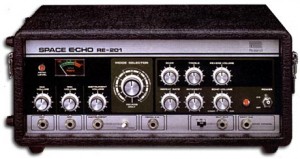
There are twelve settings to adjust various tape loop speeds, number of repeats, levels, intensity, etc… It can even generate some of its own feedback loops for instant sci-fi effects. It features a built in spring reverb for even more classic analog effects. The RE-201 not only has Vintage appeal but is still widely used to get those dubby, slightly unpredictable, musically analog echo effects.
DATAMASKIN

