
Experimental: Light sensing sequencer
A project I did for halfterms at HKU 15-12-2010
The entire project works with analog electronics. I used an overhead projector to project the images on an 3m x 1,50m screen. Behind the screen are 8 seperate piramids capturing the light and converting it into a pitch, the less light, the higher the pitch. The 8 step sequencer runs through the pattern and plays the corresponding pitch. I also added a filter and a control panel for the tempo, pitch and filtersettings.
Shared by JvGrieken
Doepfer Dark Time Sequencer Video
Just listen to the sounds of this video
Here’s a nice shot showcasing the recently released Doepfer Dark Time analog sequencer. Deopfer has probably the best resume when it comes to making analog sequencers.
The brandnew DARK TIME is a fantastic analog sequencer. It has MIDI, CV / Gate and also TRIGGER IN / OUT for vintage sequencers or rhythm machines.
In my opinion, it is much more comfortable than the Korg SQ-10, which I had. The steps run not just forwards – they also can run backwards or in random. Also a great feature is the quantizer – like on the ARP sequencer. In MIDI mode, the two rows can send at two different MIDI channels.
The DOEPFER DARK TIME was originally designed to be used with the DOEPFER DARK ENERGY synth, but you can use it with every synthesizer which has MIDI or CV/GATE. Sometimes (it depends on your synth) you will need a converter or a additional interface (for example: ARP needs +12 volts to trigger the envelopes instead of +5V; Also the Minimoog needs a switch trigger).
I always wanted a sequencer like this!
I played the Doepfer DARK TIME with ARP ODYSSEY, MINIMOOG, KORG MS-20, KORG MONO/POLY and YAMAHA TQ-5. There is also a sequence, where the Dark Time is synced with a Roland CR-78 (through trigger signals, not MIDI) and controls an ARP Odyssey at the same time.
Rhythm Core Alpha for Nintendo DSiWare
This is a quick demo of building a song from scratch using the new version of Rhythm Core Alpha, released in the Nintendo DSiWare Shop for 500 Nintendo Points in Europe, the UK, and Australia on January 21st, 2011.
Rhythm Core Alpha is the most advanced music creation system for the Nintendo DSi, It includes a loop sequencer, a pattern sequencer, and a unique solo mode that let’s you solo along with your sequences. You can even change the key of your sequences using the +Control Pad, or use the buttons to jump to different parts of the song. Not only is it the easiest sequencer on the Nintendo DSi, but it also is a powerful tool for live performance.
How to make a toy keyboard into a sequenced input device
Took a very basic cheap toy keyboard and turned it into a rad sequenced control voltage input device. Check it out and learn how to do it yourself!
Arduino sequencer further research
Got the LCD, potentiometer, and play/stop button working. This thing is an experiment for our techno improv band to help suggest phrasing. The idea is that once you’re queued up to come in with something, you’d wait for beat 1 instead of coming in on beat 6 or 13 or whatever.
Just starting to figure out some basics on step indicator lights with demultiplexers. So far so good. 
Metasonix TIp Top Audio Analogue Systems sequence
Playlist:
Metasonix TIp Top Audio Analogue Systems sequence
Tiptop Audio Z-DSP Any color you like
Metasonix modules Modular Synth
TIp Top Audio z8000 sequencer with Modular Synth
Tip Top Audio z8000 Modular Synthesizer
Metasonix modules Modular Synth
TipTop Audio Z3000 Z2040 Z8000 Modular Synth modules
Playlist:
Analogue Systems rs390 Echo rs100s Moog modular filter Eurorack
Analogue Systems EMS Synthi filter RS500E VCS3 on joystick with Sorcerer
Analogue Systems filters rs100 rs100s rs110 rs120 rs500e
Analogue Systems rs120 & rs440 Modular Synth filter and phaser
Analogue systems RS15 Modular Eurorack Modular Synth EMS Filter
Analogue Systems Reverb rs320 rs310
Analogue Systems modular synth rs95e, EMS Filter and EMS Trapezoid
Pink Floyd On the Run sequence with Analogue Systems Modular Synth
Synthesizer External Processor Analogue Systems RS35 Radiohead synth solo
Radiohead – How to disappear completely and never be found (cover)
A Fm drifting on French connection Ondea Analogue Systems
Flying saucer arrival at Equinoxoz, Six Tracks Analogue System RS15 synths
RS90 & RS100 Modular Synth modules
The Mad Scientist Analogue Lab
Analogue Systems percussion Modular Synthesizer
Analogue Systems rs40 Sample hold modular synth
Analogue Systems percussion test 2 Modular synth
Analogue systems rs230 rs100s Stereo pan modular synth
Analogue Systems rs95e VCO modular synth oscillator
Shruthilogy
Playing around with the nice playable build in sequencer in the lovely DIY Shruthi-1
The developer describes it as a “best of both worlds” design:
Digital…
An 8-bit microcontroller plays the role of the two main oscillators + sub-oscillator. This allows the generation of (aliasing-free) classic analog waveforms, but also wavetable/transwave synthesis and a trove of weird digital algorithms (sinewave bitcrushing, formant synthesis, phase distortion, bit toggling, XOR modulation).
… and Analog
Beyond this point, everything is analog. Most of the Shruthi-1s are built with the SMR-4 filter, a warm 4-poles “modern analogue” low-pass (no vintage IC). But you are in no way limited to this! The filter section of the Shruthi is on its own board and can be easily replaced. We currently offer 2 alternatives filter boards, one with the CEM3379 VCF/VCA chip of the Ensoniq/Waldorf fame ; and one with the classic SSM2044 VCF. More to come, based on vintage chips or modern OTAs and VCAs! From silky-smooth to squelchy or fat: pick the filter that matches your personal taste best.
The Shruthi-1 has an audio input: external signals can be processed by its analog section, under the control of the digital LFOs, sequencer and arpeggiator for crazy gating and re-enveloping effects. A perfect way of warming up the sound of your favorite VA or… cheesy organ!
The kit includes everything needed for building the Shruthi-1 synth, except for the enclosure:
- PCB for the digital section and the filter
- All electronic parts / ICs
- Pre-prgrammed ATMega644 and patches/sequences storage EEPROM
- Switches caps / knobs
- Blue backlight LCD display
- Connectors
- A pack of screws / spacers / nuts for holding the two boards together
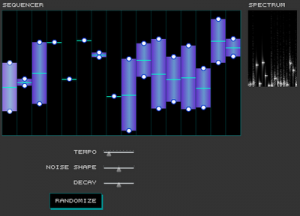
Flash based sequencer
This sequencer is not using expensive bandpass filters. The oscillators are sine waves, which are frequency modulated with white noise. It may not sound inherently musical, but you can produce great hihats, bass thuds, and airy pitched noises.”
Give it a go on the Zach Archer Blog
The making of an album
Joseph Raglani has shared a couple of videos covering his process towards a new album
Decided to chronicle the making of the follow up to Of Sirens Born. We’ll see if I can keep it up. I’m just in the demo stage and getting some ideas down. What you see here is all played live (well with a few sequencers). I’ve found that long hair and funny hats help with this process.
I’m playing a Dave Smith Mopho keybord with a Tetra in tow. Doepfer A-100, Synthi-R, Moog Voyager Old School (sequenced by the MFB Step64) and the Tip Top Audio Z8000 is doing some modulation sequencing. Left hand is playing the melodic part, right hand is tweaking. I only say that because it’s a little hard to see what’s going on from this angle. Recorded Dec 6th, 2010.
A couple of patches featuring my Synthi clone, A Doepfer A-100 Modular system and my first first two or three runs with the Tip Top Audio Z8000 sequencer. In the last clip, all three of the aforementioned are being triggered by an old Univox SR-55 drum machine via the Doepfer A-119. Headphones are a must here. There is a lot of V.C. panning going on.
Some of the modules featured here are the
Buchla clones –
A-149-1, A-101-2 and the Plan B Model 13.
Analogue Systems –
Rs95e, Rs95, EMS Synthi filter, Ems Trapezoid Filter, VCA and EG.
Tip Top Audio Z8000
Plan B Model 14 and plenty of multiples are functioning as substitutes for the EMS pin matrix.
The rest are standard Doepfer modules with a little bit of history behind them… (I bought them from Bill Leeb about 10 years ago)
The Oodmood: Kraftwerk-like groove
Analogue Solutions Telemark triggered by a Doepfer Analog/Trigger Sequencer A-155.
DATAMASKIN

