
Doepfer MAQ 16/3 Intro
This video, via killingthursby1, is a short intro to the Doepfer MAQ 16/3 Analog step-sequencer.
The Doepfer MAQ 16/3 Step Sequencer retails for Euro 659.00 (i.e. about US$ 650.00).
Details below.
Specifications:
- MIDI Sequencer featuring analog inputs
- designed in cooperation with the German band KRAFTWERK
- used by famous musicians like Kraftwerk, Human League, Jean-Michel Jarre
- 3 rows of 16 dials and LEDs each
- grey 19-inch rack-mount unit (4 height units), design fits withs A-100 and MS-404
- Assignable MIDI-Events and MIDI-Channels for the 3 rows:
- Note On/Off
- Velocity
- Controller 0-19, 64-74, 84, Pitchbend, Aftertouch mono and poly
- Program Change (for dynamic sound change)
- MIDI channel of another row (for dynamic sound change)
- Transposition of another row
- Gate time (length of time for this column)
- First/last step of each row can be limited by user
- MIDI channel of each row selectable
- Different modes for each row: Forward/Backwards/Pendulum/ Random
- Different timings for each row (synchronized by MIDI-Clock)
- Transposition via incoming note on events possible
- Muting of single steps and complete row possible via incoming MIDI-Program-change and note events
- External Synchronisation (via MIDI-Start/Stop/Clock-In) or
- Internal Synchronisation (sends MIDI-Start/Stop/Clock-Out)
- 32 Sequence memories (Presets) in of non-volatile memory
- full editing capabilty of all preset parameters
- Remote control of important parameters (first/last step, mode, event type, mute step, mute row and so on) via MIDI-Program-change and Note events (no Sy-Ex necessary)
- 3-digit, 7-segment display
- Operation via 8 buttons with LEDs
- Alpha-dial for rapid input of all parameters
- 3 CV and Gate outputs (3.5 mm jack sockets on rear panel):
- CV outputs: 1V/Octave (0…+5V)
- Gate outputs: 0/+10V (voltage trigger, not switched-trigger, modification for switched-trigger upon request)
- dimensions: 480 x 177 x 110 mm (19″ /4 HU), weight: 3 kg
- 230V power supply (external) included
- for other mains voltages the power supply must be purchased by the customer in his country (7…12V DC / 350mA required)
THE NEW MOON 568 IN ACTION
A video called the “THE TOWN OF SOUND”, this is a demo of the new 4 row 32 step sequencer
Using a checker board as a step sequencer
Josh Silverman has provided us with this interesting demo featuring a checkerboard sequencer
This is a demo video to demonstrate the use of a checker board as a step sequencer. This video should make obvious the relationship between the position of the checkers pieces and the noises they represent and trigger. It’s still a work in progress, but for now I won’t subject you to the cacophony that is the sound of an actual game of checkers.
Aside from the kick drum, which just keeps pace on every beat, all other drum samples are triggered off the board.
In this version, I’ve implemented a Mute Region that surrounds the board. When the application sees activity in the mute region, it disables the updating of the sequencer. This way, my hand doesn’t trigger a cacophony when I move the pieces.
More details at prettyextreme.com/?p=124
Built with openFrameworks and Ableton Live.
BLIP1000 – free matrix step sequencer instrument for Windows
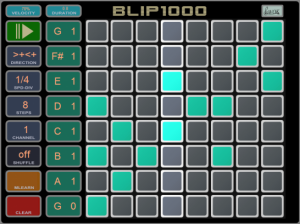
WOK has introduced Blip1000, a free matrix step sequencer instrument for Windows.
Blip1000 is inspired by matrix synths for the iPad and hardware like the Bliptronic 5000, which were derived from software like ToneMatrix, which was inspired by devices like the monome and the Tenori On and so forth
Here’s what the developer has to say about Blip1000:
Got a windows touchscreen computer and miss these cool apps like on the iPad?
Now you can generate MIDI sequences with a touch of your finger. Also great for controllers like Novations launchpad (together with Automap).
Blip1000 is a MIDI sequencer VST plugin. It plays mono- or polyphonic sequences depending on the selected notes and the enabled trigger buttons. Host sync with different speeds, swing, several play direction modes and MIDI controller learn – try it for free and start making music now!
Features:
- Clear and easy interface.
- Number of steps selectable (up to 8).
- Note per line selectable from 3 octaves with display.
- Several play modes (forward-backward, random etc.).
- Syncs to host – clock divider adjustable.
- Sequence transpose by MIDI input
- MIDI ouput channel selectable.
- Automatable in the DAW.
- Sequences can be saved as VST plugin presets.
- Random play.
- MIDI-ouput; any plugin or synthesizer can be used as sound source.
- Low on CPU.
Note: Blip1000 is nagware.
David Vorhaus and the MANIAC
That step sequencer looks really innovative even 30 years later!
Quote from YouTube via JeffreyPlaide
“In this historical video excerpt, David Vorhaus talks about two of his analogue inventions – the MANIAC analogue sequencer, and the Kaleidophon from 1979.
The MANIAC (Multiphasic Analog Inter-Active Chromataphonic (sequencer)) was an analogue sequencer having variable step lengths, and the ability to split sequences into several smaller groupings giving considerable sonic potentiality. Addition and subtraction of events was possible, as well as the possibility to chromatically correct the output during performance. David could program his MANIAC sequencer to play a background rhythm or combination of musical events, to then improvise over the top with another instrument or synthesizer.”
Step poly arp demo
First try using ipad running “Step Poly Arp” thru Wifi Midi and a Virus TI polar with no processing.
StepPolyArp for iPad controlling an Oberheim FVS
Just a quick demo to show this awesome iPad application. The StepPolyArp iPad application hooks up wirelessly to a Windows or OSX computer. I currently have the StepPolyArp app talking with Logic Pro that then drives a Doepfer MCV24 to go from midi to CV and Gate. The Oberheim is being triggered in Unison for all 4 Voices on every step. Each voice is being panned right/left to create a nice stereo effect with a total of 8 oscillators.
The perfect companion for any analogue synth.
Audio signal path is:
Oberheim FVS==>Eventide 2016==>Prism Orpheus AD
Website:
laurentcolson.com/steppolyarp.html
Nice sounding demo of the alphaPad
This is a demo of alphaPad – a free Windows step sequencer for the Novation Launchpad, created by Thibaut Labbé.
Features:
- 8 instruments working on distinct channels
- 8 patterns / instrument, 64 patterns in total
- 8 notes / pattern
- Pattern length from 8 to 32 steps
- Gate, velocity and pitch control
- 3 modes:
- Edit mode for creating patterns
- Launch mode for playing patterns (works as the session mode of Ableton Live)
- Select mode for choosing the pattern to edit
- Easy synchronization with host using midi notes
Can be downloaded for free from http://alphapadstepsequencer.blogspot…
(no MAX/MSP required)
Little MIDI Machine for the iPad
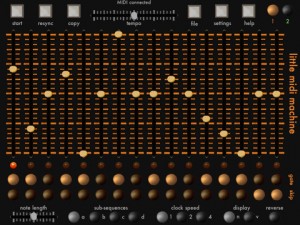
Little MIDI Machine (App Store link) is free app that turns an iPad into an MIDI step sequencer app.
The app requires the hardware Line 6 MIDI Mobilizer interface in order to connect to hardware MIDI synths.
Specs and demo video below.
Description:
Little MIDI Machine gives you the step sequencing power of a hardware analog sequencer on your iPad.
Program two independent sequencers that send note and velocity MIDI data out on two MIDI channels to control your hardware synthesizers. Little MIDI Machine includes many favorite hardware sequencer features ,such as mute and un-mute notes, skip steps, reverse the sequencer, adjustable clock speed, etc.
If you do not have a Line 6 Mobilizer, Little MM can generate very basic melodic sounds in place of sending MIDI. This will let you play around with the app and try it out, but it is not a feature that will be developed further and is not the primary purpose of the app. LittleMM is intended to be a MIDI step sequencer for driving external hardware.
Getting up to speed on step sequencers
A basic description of what the seq does.
I have been getting questions about what my pseudo random or fuzzy microcontroller sequencer does, and how it does it. You may remember about 6 months I talked about several kinds of sequencers including the microcontroller sequencer. The concept behind this sequencer is to let it do the work of composing and triggering whatever toys are connected to it. This allows focusing on tweaking the modifications on the toys, and to use a mixer to layer or enhance sounds. The toys have to be prepped with rca jacks to be connected to the sequencer. After this is done the sequencer acts as remote buttons for the toys. The microcontroller is programmed to trigger the buttons in randomly generated patterns. When powered on or reset the code randomly, as random as small digital can be hence pseudo and fuzzy, creates an array of numbers that correspond to the four channels of the sequencer. Then an increment or step size is randomly selected as well as a number of times to repeat moving through the array using that increment size. For example an array of 32 elements might looked like this:
1, 1, 4, 3, 1, 3, 2, 4, 2, 4, 1, 4, 4, 4, 3, 1, 1, 2, 3, 1, 2, 3, 1, 4, 4, 4, 2, 3, 2, 3, 1, 1
DATAMASKIN

