
New programs for the Roland JV-880
The JV-880 is the rack-mount version of the JV-80 keyboard and features powerful multi-timbral capabilities combined with impressive sound editing capability, all in a 1U rack space. The immediate forerunner to the immensely popular JV-1080/2080, the 880 provides the same high quality sounds for which the entire JV line has come to be respected. And like its descendants, the JV-880’s sampled waveform memory can be expanded (to 14 Mbytes) using Roland’s series of SR-JV80 expansion boards and SO-PCM1 cards.
Editing sounds is done via the rotary encoder that lets you select parameters and set values at the touch of a button. When editing you can audition sounds right from the front panel by pressing the preview button. There are TVF (filter), TVA (amp), micro-tuning, and multiple LFOs. An onboard effects processor with various types of chorus, reverb, and delays rounds out the package. It is used by K.O.
Hi!
Here are some of my new programs for the Roland JV-880!. Every patch was initialized, then saw waves/square waves are chosen then the programming is started from all zero-set parameters. The JV-880 (1992) is very similar to the Roland D-50 (1987) with 4 partials that can be turned on or off, individually programmed. Each of the partial’s parameters can be filtered in several ways. There isn’t a limit to what is sent through the TVF as there is with the D-50. JV-880 is tricky to program with just one knob and 7 buttons, but its so rewarding! Although the JV is digital, the JV can be very lush if programmed with some diligence and patience as all synths require.
DIY: Tymkrs Protosynth
Background details for this video; the Protosynth is designed to streamline experimenting with keyboard-controlled electronic music projects and the prototyping of new DIY synth projects. The video shows a lot of background on the creating of the Protosynth and follows that with a brief demo of how it can be used.
Keep http://tymkrs.com/ viewer supported, please donate!
Show Notes:
Power Supply:
http://store.tautic.com/Dual-Output-Breadboard-Power-Supply/dp/B007X5HN2I
Propeller ASC:
http://mghdesigns.com/propeller/mgh-designs/propeller-asc-arduino-shield-comp…
Chat with us live every day:
#tymkrs on irc.AfterNet.org https://tymkrs.com/chat
Help us continue to provide free educational videos, podcasts, and blogs! Your equipment and monetary donations are what make this possible. With just a few clicks you can make a one time donation or set up a monthly subscription, see http://tymkrs.com/ for details. If you would like to donate parts or equipment to the show, let us know at feedback@tymkrs.com.
Dave Smith Mopho analog synthesizer review
http://twitter.com/soundsandgear
http://soundsandgear.com/dave-smith-mopho-analog-synthesizer-review
In this video they are doing a review of the Mopho synthesizer from Dave Smith Instruments.
“It’s a monophonic analog synthesizer module that I’ve had for about a year. I love the aggressive analog sound it has, plus it doesn’t take up much space on my desktop. In this video I go through the front panel, go through some of the sounds, and show why I feel it’s definitely a great bargain for anyone looking to purchase an analog synthesizer.”
Magellan for iPad – What’s New in Version 1.1
Version 1.1 has arrived! They’ve added even MORE features to Magellan – the Professional Analog Modeling Synthesizer for the iPad! Our demo here shows off new 1.1 features including WIST capabilities, LFO BPM Sync, MIDI Out for the Arp and Sequencer, INIT preset, and more!
Check out our website for more info: http://www.yonac.com
Magellan on iTunes: http://itunes.apple.com/us/app/magellan/id544119998?mt=8
Raspberry Pi Synthesizer – live demo (Oscillators and Phase Distortion)
Background video information below:
You lot should be happy that it was a grim, wet, windy Bank Holiday as I got to plug in my Pi and make a video. Sorry the frame rate of the second half is low, it’s my Mac not being fast enough to capture everything.
So – here’s an indication of quite how rich a single-oscillator synth can be (as in, I left OSC B cranked down to zero throughout). OSC A is set to a ‘sin’ wave (which does actually have a *little* bit of harmonic content as it’s not really a sin, it’s a short power series), but all the amazing richness comes from manipulating the phase of the oscillator during each cycle of the waveform. An EG is used to stretch and squash the phase over the lifetime of each note, then the LFO is pulled in to add a warbly, squishy immenseness.
And no explicit frequency manipulation – everything here is being induced by messing with the phase within each cycle of the waveform, the fundamental is not being manipulated, at all. Things get beyond awesome when you add in pitch modulation at the same time as Phase Distortion.
SOUNDOR—Free open source FM Synthesizer for Max4Live & AudioCubes
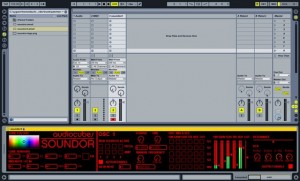
Percussa has announced the release of SOUNDOR, a free and open source FM Synthesizer for Max for Live, the visual programming environment in Ableton Live based on Cycling 74′s Max/MSP.
SOUNDOR features 4 oscillators each with their own waveform mixers, allowing the user to mix sine, square, sawtooth, triangle and noise waveforms to create totally new kinds of waveforms. Each oscillator section also features a state variable filter (SVF), and can modulate any other oscillator in pitch and/or amplitude. Each oscillator’s output can also be sent via its own ADSR to a master out, for lots of sound possibilities. Oscillators can overdrive each other through the built in waveform mixer, and can be controlled through the MIDI Keyboard as well as manual settings.
SOUNDOR integrates seamlessly with AudioCubes: rather than having to MIDI map the AudioCubes onto parameters in SOUNDOR, the moment an AudioCube is plugged in, it is automatically connected to any of the waveform mixer parameters and filter sections, through an easy to use connection matrix in the synthesizer. The 4 high speed low latency sensors of AudioCubes can control multiple parameters simultaneously and can even be inverted. A pedal input allows the user to keep the sensors values in place, while the hands are near the sensor, allowing exploration of the parameter space of the FM synthesizer while at the same time allowing rigid locking of parameters to keep the sound steady once an interesting combination of parameters has been found. SOUNDOR supports the well known preset system of Ableton Live and Max4Live, so presets can be saved and recalled just as for other Max4Live devices.
SOUNDOR is available as a free download from Percussa.
A quick demo of SOUNDOR, a free and open source Max4Live FM Synth for AudioCubes by Percussa, smart cubes for sound, music and visuals. In this video, you can see how you can easily create wind and bubbling water sounds using an AudioCube, the free SOUNDOR application and a simple foot pedal. Press the pedal down to enable control of the synthesizer using the AudioCube, and release the foot pedal if you want to “lock” the sound where it is or stop controlling the sound using the AudioCube. One AudioCube can control up to 4 parameters simultaneously, using your fingers and hands. The sensors are high speed and resolution (1kHz and 10 bit). Learn more at http://www.percussa.com/soundor/
Syntorial: The Ultimate Synthesizer Tutorial
Synthesizers are POWERFUL beasts. Indeed, no other musical instrument gives us so much control over our sound. But that control comes with a STEEP learning curve. For many of us, the wall of buttons, knobs and sliders is so intimidating that we resort to browsing through endless presets, or mindlessly tweaking parameters until we either stumble upon something interesting or quit in a flurry of curse words.
Enter SYNTORIAL, the synth-tutorial-to-end-all-synth-tutorials. I’m sure your brain is just brimming with questions.
Additional reading can be found here >>
Alesis Andromeda Tutorial – Oscillators
‘gstormelectro’ continues to provide us with good tutorials on the Alesis Andromeda, in this one he checks out the oscillators:
http://gstormelectronica.blogspot.com/
In this video I will examine the OSCILLATOR and PRE-FILTER MIX sound modules in more detail. I will introduce and explain topics for Oscillator FM, Filter FM, SYNC, Ring Modulation and Filter Feedback. And I will also show how to program a couple of basic patches along the way.
CONTENTS
0:10 Introduction
0:35 Tune Page
1:32 Wave Page
2:39 ENV1 Page
3:13 Patch: Classic Or Deviant Sync
4:56 OSC2FM Page
7:57 NZEXT Page
8:48 Modulations + Control Routes
9:49 Patch: Mod-Wheel PWM
11:23 Pre-Filter Mix: Ring Mod + Filter Feedback
12:14 Closing
Join me for my next video which will cover the Filters in more depth, including examples of Filter FM and Filter Feedback. Thanks for watching!
Molecule Synth meets MK-4902 MIDI Keyboard
The MOLECULE SYNTH is a unique musical instrument. It is like a traditional keyboard synthesizer that has been broken into its elements: speaker/amp, sound generator, and pitch control. With the MOLECULE SYNTH SET you decide how to put those elements back together using simple, color-coded, interchangeable hexagons. The MOLECULE SYNTH combines LEGO-interchangeability with Synthesizers with Physical Electronics.
I was inspired to create the MOLECULE SYNTH by experiences circuit bending toys and building my own electronic instruments, and I wanted to make something with sounds that were more wild and less predictable than what comes from traditional keyboards. I wanted an instrument that was more interesting than just pushing buttons, but I also wanted to get away from the “black box” pre-fab technologies that makes us all passive “consumers” using someone else’s designs. So I made the MOLECULE SYNTH to be an open ended, hardware-based, stand-alone musical instrument that is easy to hack & modify, that is DIY to the core, that totally rocks, sounds amazing, and is guaranteed super fun to play!
EMW-200 & EMW-300 VIDEO
EMW-200 and EMW-300 demonstration. No external effects or processing of any kind on this video.
DATAMASKIN

