
JUPITER-80 demonstration by Bernie Smith from Take That
Here’s a new demo of the Roland Jupiter 80; Bernie Smith is not your average session musician. Being the synth and piano man for acts like Annie Lennox and Take That need a special kind of musician. It’s a good job that his Jupiter 80 is not your average synth.
To find our more about the JUPITER-80 go to:
http://www.roland.co.uk/products/productdetails.aspx?p=1165#.UDVgudZmTYg
Authorized DEVO Synthesizer and Robot Maker App – DEVOBOTS
This is the first ever DEVO App utilizing one of the most influential bands of the last 40 years. The App includes never-before-heard music and sounds remastered from the DEVO archives that you can use to create new music plus thousands of artistic assets that you can utilize to create your very own DEVOBOT Robot, digital or Vinyl. This is the DEVO App that fans have been waiting for.
The synthesizer uses original Devo sounds as its main feature. The sounds and music loops used in the app have been remastered from archived DEVO music and sounds that was originally created by DEVO and has been stored in the vaults since the 1980s, AND never heard before. We wanted to bring you a unique selection of sound only found in Devobots, so we spent a lot of time sorting through banks of music to create this. And it won’t stop there. Every month or two we will have a new bank of DevoBot sounds available for download at no costs.
Utilizing the buttons available in the Devobot interface, when pressed, the keys will play a loop either once or infinite. You use these in combination to create and record your own music. Other features include a sampler where you can sample your own loop and add it to the existing mix and also Pitch Shift, reverse and volume controls where you can manipulate the sound in real time..
With the synthesizer you can mix up to 12 separate audio parts together while using real time effects to create unique music tracks. You can use the mix as a recording, or play the device in a live session. Using the trackpad you can manipulate the sound by using your fingers to move each sound cross hair around the pad. Each sound can be manipulated in real time, either one by one or up to 5 sounds at a time – or 10 if you have small enough hands. The synthesizer is a powerful tool and can be used as part of any musicians arsenal.
“Hundled Hirch” TC-11 iPad Improv by Jeff McLeod
Created using a custom-made patch on Bit Shape’s TC-11 multi-touch synth for the iPad. A teardown/rebuild of the original patch “Bundled Birch.”
More info here: http://www.bitshapesoftware.com/instruments/tc-11/
And here: http://www.jeffmcleod.net
Patch controllers:
Creation Time Since Previous Touch: Multi Oscillator Level & AHDSR-0 Scale
Touch Y Position: Panning
Distance To Center: SEQ-0 Add
Creation Time Since Previous Group: Mix LPF Frequency Cutoff
Group Count: LPF Frequency Cutoff
Touch Began: AHDSR-1 Start & SEQ-0 Step
Touch Ended: AHDSR-0 End & AHDSR-1 End
AHDSR-0: Amplitude
AHDSR-1: Waveshaper Mix
SEQ-0: Multi Oscillator Frequency & Mlit Oscillator Transpose
SEQ-0 Trigger: AHDSR-0 Start
MikroWave Android music app : a quick rundown
MikroWave, the sequenced synthesizer for Android developed by igorski.nl, being put through its paces. This video shows the generic sequencer navigation / use, introduction to the synthesizer and a lot of crude auditive side effects when used by a monkey.
You can find the application on Google Play here:
https://play.google.com/store/apps/details?id=nl.igorski.mikrowave
or visit its development website:
http://www.igorski.nl/mikrowave
Description of the app:
Ever fancied a sequenced synthesizer that fits in your pocket ? So did we.
MikroWave is a deceptively simple audio synthesizer ideally suited for quickly sketching out your musical ideas when on the move. Patterns can be created in the sixteen step sequencer, with no limit to the amount of bars your composition requires. Apart from the basic waveforms there is also a secondary oscillator which can be routed to different targets for harmonically enriching your initial sounds. You can shape the basic palette from friendly cheesy 80s trumpets via stuttering robots to totally unlistene-able sonic mayhem. If anything, you can sure annoy people on the bus.
For further improvisation there is a multi-touch keyboard allowing you to play along with the sequencer for quickly testing new ideas. When you’re pressed for time, you can save a song in progress and return to it later for finishing your idea, or plainly reliving your initial enthusiasm when creating that bubbly, acid bassline over that funky beat you had a brilliant destination for.
Apart from working from your mobile device, your songs can be exported in WAV format, uploaded to SoundCloud for direct sharing, or you can export your songs as MIDI data so you can continue work on your desktop computer / other hardware devices.
MikroWave is actively being updated, so keep your eyes peeled for notifications to be sure you’re getting all the latest features. You may also aid development by leaving suggestions and sharing your ideas on the website.
Just to be clear: MikroWave doesn’t rely on samples for sound generation, but actually synthesizes sound. For best performance your device should have a dual core CPU, though the newer generation of Gingerbread and Ice Cream Sandwich-ready devices should have no problems running the application.
When in doubt, MikroWave is also available as a FREE version, note that saving of songs is disabled in this version.
Molecule Synth: An Electronic Musical Instrument for Everyone
Invent the sounds of the future! Create your own astounding electronic instruments with lego-like hexes & physical sensors.
WHAT IS THE MOLECULE SYNTH?
The MOLECULE SYNTH is a unique, utterly new kind of musical instrument. It offers the elemental components of a traditional keyboard synthesizer — a speaker & amp, a sound generator, and a pitch controller — but presents those elements as pieces that you arrange (and rearrange!) in various combinations to create your own musical device. The MOLECULE SYNTH is designed to be intuitive to use: each of its hexagonal pieces is color-coded to indicate what that piece is and does, and each piece is marked to show how it connects to other pieces. With these building blocks, you choose how to configure your instrument, and, later, you can move the pieces and configure an entirely new instrument!
Studiologic Sledge Synthesizer Test / Demo / Sounds
Here’s a nice demo of the Sledge synth by a German music store, here’s what they have to say about it (Googlish from German):
“At this year’s Musikmesse, he was presented to the enthusiastic fans of synth: The Studio Logic Sledge synthesizer is finally here! As a fanatic of electronic soundscapes, Manfred has made available a copy of the first shipment stolen and extensively tested. Rumor has it he spent the whole night with the Sledge  The full test as a video with a lot of sound samples – now for you at Music Store TV!”
About the synth:
For many synthesizer enthusiasts, it is the particular interaction of the sound engine and user interface that makes a great instrument. A quick look at Sledge shows you the generous set of controls available to interact directly with the sound engine. When you touch the knobs and switches of the front panel, you will instantly be aware of the meticulous attention to detail our engineers have refined, during many decades building the best electronic keyboards.
You will experience the logical set-up of the synthesizer modules, mirroring the signal flow of a classic analogue synthesizer. But what really distinguishes any synthesizer is its sound. Fortunately, our friends at Waldorf Music have happily shared their experience and know-how on this crucial part of the Sledge Synthesizer.
Oberheim OBXa “Space Ocean”
About the synth: The OB-Xa is a massive analog synthesizer with a very familiar and classic Oberheim sound. Its sound, size and power are very similar to the Prophet 5 from Sequential. However this one has up to 8 voices which can be split, layered and stored! The OB-Xa was available in four, six or eight voice polyphonic models. They all featured patch memories, also in varying degrees. A minimum of 32 patches were available on early models (4 banks of 8). The maximum amount of patch memory storage found on many OB-Xa’s is 120 patch memories. All models of OB-Xa, however, featured the new Curtis chips which offered great stability for an analog synth and they are attributed to its great filters and sounds.
The OB-X was very similar to the OB-Xa except that its voices could not be split or layered and, more significantly, the OB-X had a lowpass-only discrete SEM 12dB/oct state variable filter, which had a great and classic Oberheim sound. The OB-Xa changed that in an attempt to economize manufacturing and increase stability by switching to CEM3320 Curtis chips for its filters. The Xa offered two switchable filter modes: 12 dB/oct (2-pole) or 24 dB/oct (4-pole). This hardware change resulted in a more agressive sound, not quite as creamy as the OBX original, but what still became a “bread and butter” sound of the Oberheim line.
Splitting the keyboard mode separates the OB-Xa into two 4-voice synths with two available patches. The Layer mode plays the two patches simultaneously. There are also some added effect sources, perfect for any analog polysynth, including portamento, unison, sample & hold, chord memory and three LFO’s!
Taking a closer look at the russian Formanta Polivoks Duophonic Synthesizer
The Polivoks is the most popular vintage Russian synth made in the early 80’s and it was among the first synthesizers produced in the USSR. It’s purely analog with two voices of polyphony, two oscillators each with triangle, square, saw, two types of pulse waveforms and one noise generator, the levels of which are controlled via the internal mixer. Although the oscillators can become unstable and difficult to tune, the Polivoks is well suited for making screeching sounds and thunderous bass. You can also connect an external audio input for processing through the Polivoks’ switchable dual-mode band pass/low pass filter and LFO sections. The LFO, or “Modulator” offers triangle, square, random and noise waveshapes and can be applied to the oscillator level and pitch or the filter cutoff. There are also two ADSR envelopes for contouring the oscillators and filters.
Polivoks had been produced since 1982 by the Formanta electronic factory (one of the biggest at the time); it was sold exclusively in the USSR. Polivoks has its own unique electronic components including a reliable keyboard (49 notes F to E) made with magnetically controlled contacts. Its synthesis modules consist of independent circuit boards, which is convenient for maintenance and repair. In addition, Polivoks is housed in an original rugged aluminum body of uncommon design with handy controls.
“Here is a Russian Formanta Polivoks Duophonic Synthesizer that was recently in for repair at The Analog Lab in NYC. It is a harsh sounding nasty beasty. Its basically impossible to get a sweet sound out of this thing, so we decided to go with a brash piece by Modest Mussorgsky…Hooray Russia! The guts of this thing are also pretty solid. Soviet era parts all over the place with plug-in circuit boards. The schematics for this synth are actually pretty decent. Strange grounding system and output connectors. The Polivoks just feels cheap, like you might break it by playing it, but damn, it can get in your face!”
www.theanaloglab.com
Time machine – Sequential Circuits Pro-One
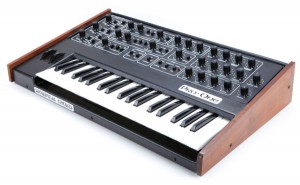
The Sequential Pro One is a wicked little monosynth! It comes from the same period and genre as the Roland SH-101 and Moog Prodigy. The Pro One was basically Sequential’s attempt at taking their legendary Prophet 5 poly-synth and packing it into a compact, inexpensive, monophonic analog synth! It has two VCOs, a great 4-pole lowpass filter, two ADSR envelopes (one for filter), and a compact three-octave keyboard. With a Pro-One, you can easily create punchy analog bass-lines and leads or quirky analog synth effects.
The Pro One is an extremely flexible synth with lots of modulation possibilities (ie: the filter, VCO B and LFO can modulate VCO A or B frequencies or pulse widths, or the VCF). There’s also an onboard sequencer, something common on many Sequential synths but not often found on other monosynths of the time. It is very basic, however, storing only two patterns and up to 40 notes max. Also, only pitch info is recorded (and in step time only); you can not assign a note duration to any notes. So it’s basically a short melodic sketch-pad…but useful. Also onboard is an arpeggiator which has UP and UP/DOWN patterns.
“A voyage into the heart of the SCI Pro-One from the year 1981. Exploration by Marko Ettlich
monophonic analog synthesis
2 Osc I Saw, Pulse, Square, Sync, Noise
Filter – 24dB lowpass
Crossmodulation, FM
step sequencer, arpeggiator
It has been used by Prodigy, Depeche Mode, Vince Clarke, New Order, Soft Cell, Sigue Sigue Sputnik and many more.”
SOUNDOR – new free Max4Live FM Synth
A quick demo of SOUNDOR, a free and open source Max4Live FM Synth for AudioCubes by Percussa, smart cubes for sound, music and visuals.
In this video, you can see how you can easily create wind and bubbling water sounds using an AudioCube, the free SOUNDOR application and a simple foot pedal. Press the pedal down to enable control of the synthesizer using the AudioCube, and release the foot pedal if you want to “lock” the sound where it is or stop controlling the sound using the AudioCube. One AudioCube can control up to 4 parameters simultaneously, using your fingers and hands. The sensors are high speed and resolution (1kHz and 10 bit).
Learn more at http://www.percussa.com/soundor/
DATAMASKIN

