
Time machine: YAMAHA AN1x
All sounds: Yamaha AN1x Virtual Analog Synthesizer from the year 1997
recording: multi-track without midi
I use the internal step-sequencer for the bass sequence
fx: a little bit delay and reverb
About the synth:
The AN1x is a powerful retro-analog synth with a really cool new feature that lets you record real-time editing and filtering and be able to store it as part of the sound! A major contender in the new wave of analog-digital synths using DSP modeling of analog waveforms to recreate the coveted sounds of analog synths with modern digital specifications. It offers truly traditional yet modern methods of analog synthesizing, 10 notes of polyphony, 8 knobs for tweaking, and an arpeggiator with dozens of inspiring patterns!
Although the AN1x is not a follow-up to the CS1x (which has since been followed by the CS2x and the CS6x) it has borrowed many functions and technologies from the CS1x synth. First, it’s built in an almost identical case with the same layout of buttons and knobs as the CS1x. However the function of every knob and button has been greatly expanded. The AN1x also has 2 Scene memories for instant recall of any envelope and filter settings and the mod-wheel can be used to morph between the two scenes. On-board effects and a state-of-the-art arpeggiator section also are on-board for giving your sounds life and motion.
The AN1x adds a new Ribbon controller for increased real-time control. It also includes pulse width modulation, ring modulation and oscillator syncing. The AN1x may not be the next evolution of the CS1x but it is basically a more advanced synth capable of increased sound potential and quality. It has a better feeling keyboard than the CS1x as well assuming that the AN1x is for those looking for something more professional than the CS1x.
Polyphonics: CASSINI Synth for iPad
An introduction to the CASSINI Polyphonic Synthesizer for iPad
http://iphone.icegear.net/cassini_ipad/
3 OSCs + 2 Filters + AMP + 9 EGs + 6 LFOs + 3band EQ + Saturator + 2 Delays + Arpeggiator
Synth artist Solvent meets the Make Noise Phonogene
Here’s what Solvent has to say about the video:
Hi my name is Solvent and I make electronic music. Here is a rather indulgent video of my first experiment with the Make Noise Phonogene module. Actually, indulgent as this may be, I liked this enough to press record. I used a square wave LFO to chop the splices evenly, and the SH-101 krbrd is choosing the splices via the “Organize” Cv-in. End-of-splice (“EOS”) triggers a TipTipAudio BD808 kick drum, running through the Doepfer A-189-1 Bit Modifier. Phonogene loop is processed through a Pittsburgh Modular Filter + Midiverb reverb. The source of the sample was some lame YouTube film trailer about space.
Yamaha DX7IID
Background information from Style City Records: “Here are my sounds that i created- WITH NO Internal or External FXs on the Yamaha DX7IID. Many of the keyboard videos show off the user presets and that’s fine. This sound bank, which is part my Beyond FM Series, is for those who choose to live outside “Preset Sound” boundaries. Contact me at stylecityrec@aol.com RE: DX7IID”
Time machine: Crumar Performer “1979”
Crumar Performer Analog Stringmachine/Synth from the year 1979
recording: multi-track without midi
fx: a little bit delay and reverb
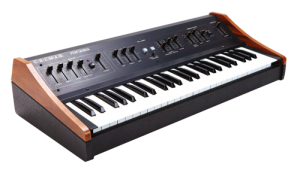
The Performer is a polyphonic analog Strings and Brass machine produced at the end of the 1970’s by the Italian synth company. It is slightly compact with just 49 keys. But it is fully polyphonic – you can play all 49 notes simultaneously! Programming is simple and clearly laid-out with just 15 sliders and a few buttons. A solid black chassis and wood end-cheeks round out this classic and often overlooked string machine.
The Performer is best remembered for its Strings. A simple 3-band equalizer with high, mid and low sliders can be used to give the strings shimmering sparkle or moody dark timbres. The Strings section uses two oscillators per voice with 8′ and 16′ settings. Simple Attack and Sustain sliders give you some control of your string’s envelope settings.
The Brass section is less exciting. It uses a single oscillator with just a square wave to generate a weak Brass sound. It has a low-pass VCF filter with resonance, but it too is pretty weak. Simple Attack and Decay sliders control its limited envelope settings too.
The LFO is pretty nice, with delay length, rate and depth control. It can modulate both Brass and String sections and can be routed either to the VCF or pitch. There are three outputs on the back: main output, brass output and signal output (for external processing) as well as CV and Gate connections.
Mutable Instruments showcases their new Anushri synth
This is a teaser of the Mutable Instruments Anushri synthesizer, currently in development.
Features not demoed in this video:
- Arpeggiator
- VCA envelope and envelope modulation of VCO / PWM
- The 8 LFO shapes and LFO > tempo synchronization
Here are the details on the Anushri synthesizer:
Analog synthesis
- Analog VCO with saw and pulse waveforms, freely mixable.
- Optional automatic VCO calibration in software for those who don’t like messing with trimmers.
- -1 or -2 octaves sub-oscillator.
- Auxiliary square oscillator (DCO) with accurate digital tuning available as an FM modulator or as a sync master for theVCO (yes, it means “ewwwwwwiowwww” and “wongwong”).
- 12dB/octave multimode filter, with smooth self-oscillation.
- Post-filter overdrive/fuzz circuit.
- Linear VCA.
Modulation sources
- 1 main ADSR envelope routable to pitch, pulse width, cutoff frequency.
- 1 simple 1-parameter envelope (morphing through various stages, including the shape of the main ADSR, and a rigid “GATE” style envelope) routed to VCA.
- Velocity routed to either cutoff frequency or VCA gain.
- 1 LFO routable to pitch, pulse-width and cutoff frequency ; with 8 waveforms (triangle, square, ascending and descending ramps, S&H, bernouilli process, piecewise linear random process aka “autodubstep”, noise).
- 1 triangle LFO for vibrato and/or growl.
Arpeggiator and sequencer
- Arpeggiator with 4 modes (up, down, up&down, random) ; 1 to 2 octaves ; 6 patterns.
- SH-101-style note sequencer with step by step recording, up to 128 notes. Easy recording of pauses, ties, and glides.
- Tempo set by internal clock with shuffle, external MIDI clock or external 6/12/24 ppqn trigger.
Drum machine
- Algorithmic drum pattern generator using an innovative “pattern sculpting” approach – allowing a large combination of drum patterns to be sculpted from 5 knobs
- Digital sound generation of BD / SD / HH with tone control
- Drum sounds can be freely triggered from an external sequencer using MIDI channel 10
Interface
- 9 pots and 4 switches for hands-on access to synthesis parameters.
- 9 “soft-pots” for editing modulations / arpeggiator / drum machine settings.
- 3 dedicated navigation buttons (“modulations”, “arpeggiator / keyboard”, “drum machine”).
- 3 dedicated sequencer buttons (“record”, “play”, “hold / rest”).
In/out
- VCO CV in/out (Note: manual VCO calibration is required for accurate 1V/Oct I/O).
- VCF CV in/out (Note: manual VCF calibration is required for accurate 1V/Oct I/O).
- Gate signal in/out (5V level for output).
- 24, 12 or 6 ppqn clock signal in/out (5V level for output).
- External Audio in.
- Audio out.
- MIDI in/out (thru + arpeggiator and sequencer notes).
- CC control over modulations and some of the digitally controlled synthesis parameters. Some parameters like filter resonance cannot be CC-controlled.
“Eurorackable”
- Remove main audio in / out and solder corresponding minijacks on PCB
- Remove LT1054 and solder 2×5 power connector
- Route MIDI in/out to front panel (if you want…). And that’s it!
Availability
- DIY product (full kit)
- Price < 200€ / kit
- Available < October 2012
Dave Smith: Mopho x4 Synthesizer Keyboard Introduction
Dave Smith takes us through the Mopho X4 synth, below are the details:
It’s a polyphonic Mopho keyboard!
Mopho x4 is the newest addition to DSI’s revered line of analog subtractive synthesizers. Building upon the same award winning voice architecture of the Mopho and Mopho Keyboard, the Mopho x4 boasts huge sound and 4 voice polyphony in an ideally sized, portable, and elegantly designed package. Use it to create huge unison basses, creamy leads, maniacal sequences, and ethereal pads.
4 times the voice 4 your pleasure
Each of Mopho x4’s four voices is composed of two analog oscillators, two sub octave generators, selectable 2- or 4-pole famed Curtis low-pass filter, three 5-stage envelope generators, four LFOs, a re-latchable arpeggiator, and a 16 x 4 step sequencer. Its voice also comes packed with 20 modulation sources and almost 50 destinations!
FM the filter to create metallic bell-like sounds and use the feedback path to add subtle or destructive harmonic content to your sound. Mopho x4’s 100% analog signal path is powerful, monstrous, and sonically dynamic!
Work less, play more
Mopho x4 is intuitive and inviting. Every parameter is fully programmable and editable from the front panel. The controls are logically laid out, lending themselves to quick access so you can tweak knobs without missing a beat.
The x4’s full sized 44-note semi-weighted keyboard has aftertouch and velocity sensitivity. The sturdy full sized pitch and mod wheels are freely assignable and sport smooth reliable action.
It grows with you
Expand Mopho x4’s polyphony using it’s Poly Chain port. Mopho, Tetra, and Prophet ’08 can all be connected to the x4 to increase its voice count. You can Poly Chain up to three Tetras with Mopho x4 to create a 16 voice analog super synth!
The Mopho x4!
Dave Smith Instruments is the only company pioneering and producing fully programmable polyphonic analog synthesizers. In fact Dave’s been at it for 35 years!
Designed and manufactured in San Francisco, Mopho x4 has the high quality sound and build for which DSI is renowned. From its feature packed analog voices and unmatched sonic versatility to its refined design and engaging interface, you won’t find a polyphonic analog synthesizer like this anywhere else.
Yamaha SY85 with Korg Kaoss Pad effects – live improvisation
Music video improvisation on a Yamaha SY85 with Korg Kaoss Pad (mini-KP) effects. Using the HOLD button on the Koass this is another way of connecting music gear together rather simply. If there is interest I might show how to connect the devices together and recording the audio. In this case I record to a Zoom H2n.
Rob Papen’s Predator soon on Reason
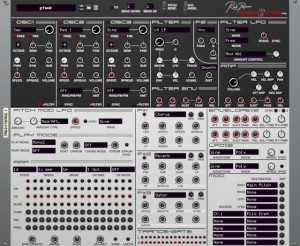
Rob Papen has announced that he is bringing RP Predator synthesizer to Propellerhead Reason as a Rack Extension, Predator RE.
Predator is a “phat sounding” killer synthesizer that combines inspiring presets and first-class features to make this your ‘go-to’ synth for contemporary music production.
The user interface has been designed so that almost all controls are visible on screen, making it fun and incredibly easy-to-use. And if you’re unsure about a particular synth function, simply right click your mouse to access the help screen.Predator is packed with powerful features such as Preset Quick Browser, Preset bank mananger, Preset Morphing, Intelligent Preset Variation, MIDI and Synth Controllable FX, Unison Detune, Chord Memory and an extremely versatile Arpeggiator.
Included preset banks: HipHop (NY, Club, DirtySouth and Gfunk) banks. Jump, hardcore, breakbeat, various Trance styles, DnB banks. Hardcore dance, House, SFX banks and much more…
Last but not least …Predator also includes PredatorFX, allowing you to use the incredible filters, modulations, effects and vocoder as an FX plug-in within your music host.
Predator 1.6 is out now with even more presets included klangMedium “Ambient bank/Downbeat bank” and JoMal bank.
Details are to be announced for Predator RE, but Papen says it will be available soon.
Roland Juno-60
BRUNO ENDER LEE – “Roland Juno-60” – recorded February 2007, every sound is made with Roland Juno-60, on three stereo-tracks, just added some delay & chorus, taken from the CD “Analogue_Syn”
Among the first in Roland’s amazing Juno family! Six analog voices of polyphony and patch memory storage!! The Juno-60 sounds great, however, like the Juno-6 it lacks MIDI control. The Juno-60 includes 56 patches of memory storage. The Juno-60 is still popular due in part to opinions that it sounds better (punchier) than the Juno-106. The Juno-6 and 60 are very rich sounding synthesizers and are great analog machines as long as you can withstand the absence of MIDI control. The JSQ-60 sequencer is an external sequencer controller for the Juno-60 and is usually worth acquiring. Of course nobody can deny that the wooden side panel look is a true sign of Vintage status!
DATAMASKIN

