
Vintage style improvisation featuring the EMW-200
http://youtu.be/BhkTveCkatI
An improvisation featuring the EMW-200 from Electronic Music Works. No external effects or processing was used. The main patch contains three sub-patches. The first is the S/H module controlling VCO2 and then fed to the delay module. The second has the triangle wave on the master oscillator and VCO 1 ring modulating in the wave shaper section. And finally the noise output is being low pass filtered and then being ring modulated by the dedicated LFO (which is also modulating the pitch of VCO 1). Each sub-patch is routed to the left and right channels of the six channel mixer.
“I am struck by the warm and organic tones that can be generated by this instrument, as well as the sometimes unexpected sounds that can result from very small changes in the controls. In an upcoming video I will be pairing the EMW-200 with some external effects.”
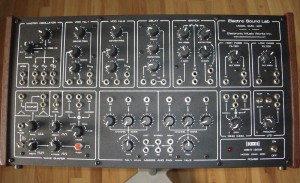
The EML-200 was designed primarily for electronic music courses at Universities. It had no keyboard and leaned in a more abstract direction from the start. The EMW-200 also has no keyboard and will not do 1 volt per octave. The only controls are knobs and one button that can trigger a simple envelope. Where the new version differs from the original is in size. The original was quite large, close to the size of an Arp 2600. The EMW-200 is 16 inches wide, a little over 8 inches tall and 6 inches deep. Nice and compact. The other two places where it differs is a delay unit where the original had a spring reverb, and an a dedicated LFO where once there was a microphone amp. It uses 3.5mm patch cables so if you own Euro Rack gear this will assimilate easily. With the right adaptors it was more than happy to take some modulation from various DotCom modules. This is an analog synth. It is sturdy, steel cased and the knobs do not wobble at all. Nice.
SJS-ONE – new 8-bit mono synthesizer

Here’s a new treat for 8bit synth fans, check out the SJS-ONE.
SJS-ONE is a software defined 8-bit mono synthesizer with a dual (series) MAX261, switch-cap filter, which we are, as far as we know, the only ones to use at this point in a DIY-synthesizer.
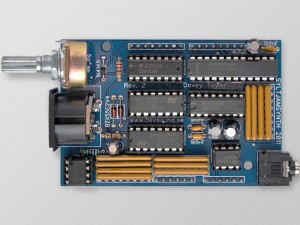
The synthesizer has some interesting history that has certainly colored its development and ultimately it’s sound. The initial version was developed as an instructional workshop for a synth-event called SyltJam in 2011. The workshop idea was to show people how quickly you can design the basic hardware and software required to produce a platform for versatile audio and music generation.
As it turned out, people liked it’s sound so much that we decided to refine the design – which more or less involved adding peripheral components to increase configurability and improve on stability and ESD, ground-mismatch and noise sensitivity while keeping the actual design minimal and simplistic.
It’s beginnings are as humble as it’s production – less than 50 of these have been made available and all parts are hand assembled and hand soldered, while the manual is hand drawn and cases hand painted.

Perhaps the most unique aspect of this synth is the choice of digital platform – the Arduino. We did not want to build something static and opted to keep the Arduino instead of adding an on-board microcontroller. Because this will make it so much easier to modify the functionality of the synth firmware provided by us, or to write your own software with a completely unique sound using the vast community support that is available for the Arduino platform.
All aspects of the synth can be fully controlled by designing your own custom firmware and we sincerely hope that people will share their firmware in the spirit of the open source and hardware that inspired us to drive this project from idea to final product.
Link:
http://devsound.se/2012/sjs-one
JayB’s sounds for Roland V-Synth III
DOWNLOAD SOUNDBANK HERE: http://www.jaybmusic.net/
“Aaaand a new one. New trance and progressive sounds for Roland V-Synth / XT / GT, inspired by the Trance Around The World and A State Of Trance series. Different camera angle this time and I think this video is somewhat less awesome than usual… Anyway, enjoy this. =) For question, just ask.”
Time machine: KORG Polysix
The Korg Polysix’ main features are six-voice polyphony (with unison and chord memory voice assignment modes), 32 memory slots for patches and cassette port for backing up patches, and an arpeggiator.
On its release it was, along with the Roland Juno 6 released around the same time, one of the first times a polyphonic analog synthesizer was available at a cost effective price ‘for the masses’. It cost about twice as much as the competing Juno 6 but had far more features and ‘real’ VCOs in place of the Juno’s DCOs. It also had on-board patch storage and back up which the cheaper Juno lacked until the upgraded Juno 60 model.
Korg developed the Polysix with an eye on the Sequential Circuits Prophet 5, trying to provide some of the features found on the more expensive synth in a compact, reliable and much cheaper design. While not as powerful, it used SSM2044 4-pole voltage-controlled, giving the Polysix a warm, rounded and organic sound.
Although the Polysix only had one oscillator per voice, it also featured built chorus, phaser and ‘ensemble’ effects (using a ‘bucket brigade’ analog delay line design), to provide a fuller sound.
Background info:
(c) 2012 vintage synthesizer track by RetroSound
“Rainy Days”
all sounds (self-programmed): KORG Polysix (1982)
I use the Arpeggiator for the line and the internal effects Ensemble and Chorus.
recording: multi-track without midi
fx: a little bit delay and reverb
more info: http://www.retrosound.de and
http://www.facebook.com/pages/RetroSound-Marko-Ettlich/265713782347
New synthesizer from Yonac – Magellan
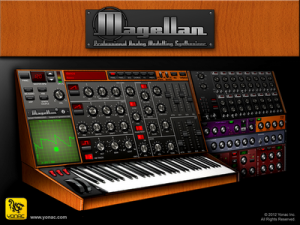
Magellan is a new synth with two independent polyphonic engines from Yonac, here’s what they have to say about it:
We’ve been hard at work this year, and are very excited to present our new synthesizer. Magellan boldly travels waters where others have not dared to sail: Two independent polyphonic synth engines, with a total of 6 configurable oscillators. Polyphonic unison mode giving 24 simultaneous wave generators. Two filter banks per synth engine, each bank with its dedicated envelope and 11 unique filter types to choose from. FM synthesis module with blend and dedicated envelope. Dual LFOs in each synth with 4 freely assignable destinations each. Complete FX rack with modulation, time-delay, reverb and wave shaping effects. Dual traditional keyboards, as well as dual touch pad performance interfaces with individual parametric control over each voice. Built in arpeggiator for each synth engine, allowing you to run two different arps simultaneously, as well as a built in analog-inspired polyphonic step sequencer, and much more!
Listen to it here:
Time machine: ARP Odyssey
A voyage into the heart of the ARP Odyssey from the year 1972.
Exploration by Marko Ettlich
2 Osc per Voice I Saw, Pulse; PWM, FM, Sync, Noise
Filter – 24dB lowpass
static highpass filter
sample/hold
It has been used by Ultravox, Gary Numan, John Foxx, Vangelis, Elton John, Jethro Tull, Tangerine Dream, ABBA, Herbie Hancock and many more.
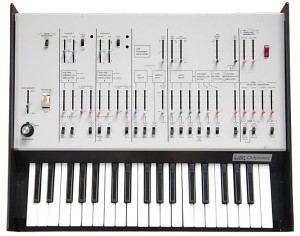
The Odyssey essentially gives you a simplified hard-wired ARP 2600 in a much smaller and affordable package. The Odyssey is a 2-oscillator analog synth (with duo-phonic capability) and it sounds really nice; the Minimoog has three oscillators and is capable of thicker sounds. The Odyssey comes well equipped with all the tweakable features and analog goodness you’d expect: a resonant low pass filter, ADSR envelopes, sine or square wave LFO, and a sample-and-hold function.
The Odyssey also added a few new features such as a high pass filter that could be used in series with the low pass, oscillator-sync capability, and pulse-width modulation. It is a very professional and expressive machine that can create nice analog basses, interesting leads, great effects and sweeping sounds straight out of a Tangerine Dream album!
There were many versions of the Odyssey over the years, each a little different. They can be broken down into 8 models spanning 3 Mark “Mk” versions
Mesh – new virtual synthesizer instrument for Windows
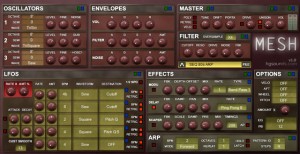
Homegrown Sounds has announced Mesh, a virtual synthesizer instrument for Windows.
The idea behind Mesh was to create a Virtual Analogue mono synth in the style of the Minimoog with the addition of 5 Tempo based LFOs for exploring rhythmic potential. In comparison to previous Homegrown Synths, Mesh is very simple using 3 Oscillators and a Sub Oscillator to shape the sound, a single oversampled Low Pass Moog style filter, and 3 Envelopes. The LFOs can modulate most parameters, and there are several quantized pitch destinations to enable complex one finger sequences to be constructed. Add to this a compact effects section comprising of a Modulator, a Delay and SoundScaper and Finally an Arpeggiator which all adds up to a simple lightweight sonic playground.
The Oscillators provide the usual suspect waveforms such as Sine, Saw, Ramp, Triangle and Square, but also add a large selection of Digital Waveforms to expand it’s sonic capabilities. The filter can be oversampled up to 8 times which improves the quality of the sound as well as providing a different character for each of the modes.
Although Mesh is designed as a non velocity based Mono Synth, it can be used as a Polyphonic instrument, and velocity can also be enabled. There are also a set of modulation parameters for assigning Velocity, Aftertouch, Mod Wheel and Pitch to a wide selection of destinations.
Mesh for Windows (VST) is available to purchase for the introductory price of $20 USD for a limited time (regular $40 USD).
Time machine: Roland Juno-106
Time for a new trip with the time machine. A voyage into the heart of the Roland Juno-106 from the year 1984.
Exploration by Marko Ettlich
1 Osc per Voice + Sub osc
6 Voice Polyphonic
LFO – 1 LFO
Filter – analog lowpass with ADSR envelope
Chorus
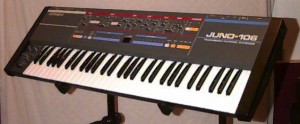
The Juno-106 is a very common and widely used analog polysynth. It continues to be one of the most popular analog synths due to its great sound and easy programmability. It was the next major incarnation of the Juno-series, following the Juno-60. While it has virtually the same synth engine as the Juno-60, the 106 added extensive MIDI control making it one of Roland’s first MIDI-equipped synthesizers. There was also increased patch memory storage, up to 128 patches instead of the 56 patches available in the Juno-60. However, the Juno-60 is often said to have a slight sonic edge over the more advanced 106. The 60 had the ability to modulate oscillator pulse from its envelope and has a “punchier” sound quality.
The Juno-106 is a six-voice polyphonic and programable analog synth with one digitally controlled oscillator (DCO) per voice. While classic monophonic synths used two or three oscillators to create a fatter sound, the Juno-106 uses built-in Chorus to fatten up its sound to dramatic effect. The nature of its DCO meant it was stable and always in perfect tune but still warm and analog. There is an excellent 24dB/oct analog lowpass filter with plenty of resonance and self-oscillating possibilities and a non-resonant highpass filter. The programable pitch/mod bender can be assigned to control the DCO pitch, VCF cutoff, and LFO amount all at once or individually.
The Juno-106 was the first MIDI equipped Juno and its implementation is quite good. There are 16 MIDI channels available and MIDI SysEx data can be transmitted/received from all the sliders and buttons for total remote control and sequencing capability. A switch on the back of the keyboard, next to the MIDI ports allows the user to switch between three types of MIDI modes: Keyboard and Hold data only; Keyboard, Hold, Bender, Patch selection data; or All data (including SysEx). Most users simply set it to MIDI Function mode 3 and forget it.
This synth is incredibly straightforward and very powerful. It’s SH-series derived panel layout is easy to understand and very hands-on. Use it to generate lush pads, filter sweeps, and funky bass lines and leads. The Juno-106 is an awesome learning tool for anyone new to analog synthesis, as well as an electronic musician’s dream for its warm analog sounds coupled with modern features like MIDI and memory – all at a very reasonable price. And still the Juno-106 has an even cheaper alter-ego in the form of the HS-60 – a hobbyist version with built-in speakers.
DSI MEK / Mono Evolver – demo
Demo of Dave Smith Instruments Mono Evolver Keyboard. All sounds programmed by WC Olo Garb. Video editing by WC Olo Garb.
Synth exploration: POLIVOKS Filter Demo
Here’s a new video focusing on filters appearing on the Russian Polivoks synth:
It’s a strange synth. But what great filter …. can be switched from low pass to bandpass in an instant. It also posesses two envelopes that can be looped over the attack-decay sections.
I understand that Rammstein use this synth as does Franz Ferdinand.
This is the first of two videos comparing an original Polivoks Filter to one of its many clones.
In this demo, its Blue Lantern’s LM4250 VCF.
http://youtu.be/6RM2HqfXOwg
Im starting with an open filter… Cutoff at max – level 6, resonance at 0.
I’ll update this later with a more detailed explanation of the controls (for those who cant read Russian).
Modulation is via an LFO on the extreme left and an ADSR envelope.
DATAMASKIN

