
Pearl Syncussion demo
You can see that not only “PEEWW” sounds can be done with this percussion synth.
This unit is modified, the OSC 1 can track the V/oct CV, you can play it in tune with any keyboard or system that can send CV.
Very rare unit with lot of sounds very analog and electronic feeling.
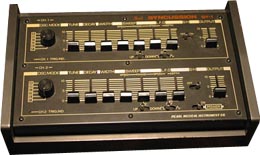
“Released in 1979 by respected drum and percussion manufacturers, Pearl, the SY1 Syncussion was the forerunner to the Simmons SDSV.
It offered two completely independent (and identical) channels which were typically triggered from two bongo-like drums fitted with transducers. However, they can be triggered from almost anything including an old synth with a gate output or, indeed, the trigger outputs of something like a TR808.
It was most commonly seen, however, as an adjunct to drum kits or percussion rigs as a source of electronic drum and percussion sounds and sound effects.
Unfortunately, the SY1 earned itself a fairly dreadul reputation almost overnight when it featured on disco tracks with tasteless and gimmicky ‘beeyooo beeyooo’ sounds and of course, as soon as one of these records became a hit, so an endless stream of other, similarly tacky records followed.
Each channel has an oscillator that can produce different basic waveforms which can be shaped with its own simple enevleope generator. Oscillator pitch can be swept with the SWEEP control either positively (i.e. start high and drop in pitch – the source of the dreaded ‘beeyoo’ sound!) or negatively (the pitch rises through the sweep). However, each channel also has an LFO with variable speed and depth and a choice of square and sawtooth waveforms. There’s also a noise generator and a sample/hold function and so, with some adventurous programming, a very wide range of sounds is possible.”
Got a million dollars to spend on a synth?
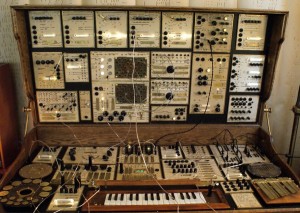
This is creative instrument artist Arius Blaze’s Impossible Box, a musical instrument containing synthesizers, sequencing, MIDI, multi-tracking, sampling, a drum machine, electronic filters, and, er, thumb pianos. Blaze writes that “there was a desire in the creation to not come out the other end with million ways to make bleepy sounds.” You can own it. For $1 million dollars. Impossible Box

The masterwork by Arius Blaze – relatively complete, still somewhat raw and imperfect. Though it has synthesis and though it is in essence modular, it is not intended to be a “modular synthesizer”. Specifically, there was a desire in the creation to not come out the other end with million ways to make bleepy sounds. The purpose of this work is to create sound scapes and music by any means necessary – designed with film music in mind and the concept of creating a whole living organism of sound.. Effect processing, acoustic interaction, drum synthesis, sequencing, midi clock connection, multitracking, filtration, sampling and so on. The sound can be rather sweet or rather raucous.
There will be details to come shortly, music/sound to be listened to – so please check back.
For those wondering…yes it is for sale. The price is 1 million US dollars. Funding goes toward the evolution of the work of Arius Blaze
MonoSynth Controller for Mssiah
Testing the MonoSynth Controller for Mssiah (C64 Midi cardridge)
Available at the Apple AppStore for iPad
MonoSynth Controller for Mssiah
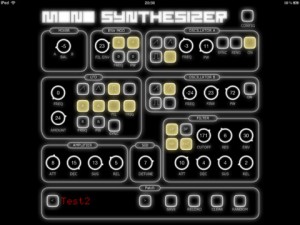
The Mssiah is a Midi cardridge for the Commodore C64. With this app you can easily control the mono synthesizer component of Mssiah via a midi connection.
– load/save patches
– generate random patches
– share your patches with your friends (itunes file sharing enabled)
a Commodore 64 and the Mssiah-Midi-Modul is required.
** this is not an official 8bitventures app **
** this is just a little homemade project to support the mssiah community **
BleepLabs & the Transistor Bass
“i put a Thingamagoop 2 into the Filter Audio input of my x0xb0x and that Noise came out of it …”
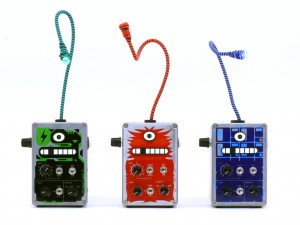
The Thingamagoop 2 is a handmade, analog + digital synthesizer you control with light.
What’s new in Thingamagoop 2?
– Analog VCO controlled by photocell.
– Digital mode with sample and hold, Arpeggios, noise, and bit crush effects.
– Open source, Arduino code so you can program your own sounds!
– Analog mode with all the sounds of the original Thingamagoop.
– Controllable “LEDacle” – Ramp and random waveforms with rate control.
– New modulators – Square wave amplitude modulator and triangle wave pulse width modulator.
– Tough, stomp box type body with silk screened graphics in 3 different styles.
– Easy to access battery – No more screws.
– Much fuller and louder speaker.
– CV out. Control your vintage synth or modular with light!
– Kit now comes with a pre-drilled enclosure.
– Still assembled in Austin, Texas by Dr. Bleep and friends.
Ambika – a new DIY polyphonic synthesizer
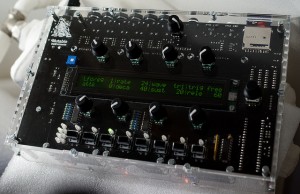
Mutable Instruments has announced the Ambika – a new DIY polyphonic synthesizer.
Translucent, polyphonic, DIY and even a bit sexy – the Ambika will allow for six voices. It can be configured so that all of the voices have the same synth design or with unique synth designs on a per-channel basis.
“It’s huge,” they note, “And it draws a lot of power!”
Mutable Instruments Ambika Features:
- Up to 6 voices, each with an individual output — in addition to a global mix output.
- MIDI channels/patches/voices are distinct entities, allowing many different flexible configurations, from 6 independent monophonic parts each on a different MIDI channel, to 1 polysynth, with everything in-between (unison, keyboard split, layering, voice doubling).
- Connectors for up to 6 voicecards. In true Mutable Instruments spirit, you can mix and match voicecards with different filters, and in the future with different synthesis engines.
- Easy to use sound programming interface with a large 2×40 LCD display, 8 knobs, 8 switches and 15 bicolor LEDs. Each module of the synthesis engine has a page, each page has a direct access button.
- Massive patch memory, easy backup/data exchange, fast firmware upgrades with the integrated SD card reader. And there might be other things you’ll load from the SD card in the future…
- Patch versioning and undo/compare/redo of editing operations.
- Sequencer, arpeggiator and rhythmic chord generator available for each part. 2 step-sequences per part. Each part can be clocked at a different multiple of the MIDI clock.
- And of course: DIY friendly, through-hole assembly.
Time machine: Korg DW-8000 from 1985
Time again for another trip with the time machine, this time back to 1985 tocheck out the KORG DW-8000:
A voyage into the heart of the Korg DW-8000 from the year 1985.
Exploration by Marko Ettlich
DWGS (Digital Waveform Generator System) Synthesizer with 16 digital waveforms
analog filter and amp
arpeggiator
digital delay
It has been used by Depeche Mode, Dream Theater, Joe Zawinul, Keith Emerson and many more.

Take Korg’s first digitally controlled analog synth hybrid (DW-6000) two steps higher and you get the more popular DW-8000. Sound is digitally generated from the DWGS (Digital Waveform Generator System) and has been doubled from 8 sampled digital waveforms to 16 simple analog to complex digital waveforms. The DW-8000 has 8 voice polyphony in two modes, or one monophonic mode with all eight voices stacked. The analog VCF resonant filter and VCA both have independent ADBSSR envelopes. Parameters can be altered in real time via a single programmable slider. There are 64 presets that can be reprogrammed by the user.
When the DW-8000 succeeded the DW-6000, it expanded it to 8 notes polyphony, 16 sampled waveforms, a velocity sensitive keyboard with programmable aftertouch, auto-bend, a simple arpeggiator and a digital delay unit. The Digital Delay was an astonishing goody for the time, offering up to 512ms delay, phasing, flanging, chorusing and other time effects. Both the Arpeggiator, Auto-Bend and Digital Delay make this synth an inspiring and great sounding machine to use for great 303 basslines, techno and house bass and synth sounds and more! The EX-8000 (pictured above) is a rackmount version of the DW-8000. Several 3rd-party developers offered expansion boards for the DW-8000 providing up to 1024 presets, layered sounds, keyboard splits and Sample+Hold for the LFO.
Shapesynth and Sphero – NEW Controls test
Testing out some code having sphero control arpeggio, delay and the filter in shape synth.
Shape is a polyphonic synthesiser allowing the user to draw the shape of the oscillator wave form. The positive side of the oscillation is represented by 32 blocks and the negative side is its mirror, generating all sorts of possible raw retroish sounds. Shape is best experienced with akai synthstation 25 or any other midi device.
Powered by Sparrow.
+++ 16 voices.
+++ Attack.
+++ Decay.
+++ LFO envelope.
+++ Delay.
+++ Akai synthstation 25 compatible.
+++ On screen 25 key stylophone style keyboard.
+++ Arpeggio.
+++ Finite inpulse respons pong filter.
+++ sequencer.
+++ sampler.
+++ coreMIDI (usb and network).
+++ MAPI audio copy.
+++ Soundcloud upload.
Moog Realistic Concertmate MG-1 Sound Demonstration
A brief demo of some sounds that the Concertmate can make.
This is the very source of cheap Moog bass! It is a lot like the strap-on Moog Liberation in its design and architecture and also looks and sounds very much like the Moog Rogue. The MG-1 was built by Moog for Realistic (Radio Shack), and was designed specifically for the home market. Very basic and easy to use, this is a nice cheap way to get your hands on Moog sounds!

The MG-1 is a 2-VCO monophonic/polyphonic analog synth with a genuine 24dB/oct Moog filter, however the overall sound is thin. On the MG-1, the VCOs are referred to as ‘Tone Generators’. It can produce sawtooth, square and pulse waveforms, and the oscillators are detunable and syncable. A simple ASR (attack, sustain, release) envelope called ‘Contour’ can be applied to both the amp and the filter. The LFO section provides triangle or square wave patterns as well as Sample-and-Hold. Additionally there is a simple Ring-Mod effect called ‘Bell’.
Unique to the MG-1 is a slider on the far right side of the keyboard which controls the volume of a simple divide-down polyphonic organ sound. This feature makes it at least a little more versatile than the Rogue. There are RCA inputs and outputs (the input is routed straight to the output for playing along with music from your stereo system) but no external speakers as in most other home marketed synthesizers. There is also no sign of Midi or patch memory on the MG-1.
“Sorry about the video quality. It was shot using my computer’s webcam (terrible resolution). While it might not look great I made sure to try and keep the audio quality up. I figured sound was the most important part anyway.”
Mikrosonic RD3 Groovebox HD Demo – Android Test – HTC EVO
“I downloaded the app from Mikrosonic called “RD3 HD Demo” and started messing around with it. It was pretty easy to figure out and fun to use. I would recommend it to anyone who likes to play around with a looping/drum machine. The only bothersome thing is that you can’t save your sessions and an ad pops up every few minutes to encourage you to buy the full app. Which makes sense because this is the free version of the app and just lets you get a taste for what it can really do.”
RD3 – Groovebox is a high quality audio application for Android devices that is easy to use. It combines a 303-style synthesizer and a drum machine with different drum kits. Create grooves on-the-go with these machines that defined the sound of early electronic dance music.
If you have a high-end Android phone or tablet please check out the RD3 HD version with more features.
Features
Musical Features:
- Virtual analog synthesizer
- 3 types of waveforms
- Reminiscent of the legendary 303 synthesizer
- High-quality or regular filter modes
- Drum machine with 8 drum kits: 808, 909, 606, CR-78, Linn, KR55, RZ1, DMX
- Real-time step sequencer
- 4 bars with 16 steps per instrument
- 3 play modes: Solo, loop or random
Technical Features:
- Multi-touch control
- Audio loop export feature
- Session save capability
- Cut/copy/paste pattern
- App2SD
Closer look at Alchemy Mobile on iOS
“We’re back this episode with a look at Alchemy Mobile from Camel Audio – an impressive sounding synthesizer with a long pedigree on the desktop, now just updated for iOS. Gaz appears to have fallen in love with the wide range of sounds it can offer as a standalone App and the integration with the desktop version is impressive.”
Snapshot overview:
Turn your iPhone/iPad into a powerful synthesizer! Alchemy Mobile includes everything from evolving soundscapes and fat basses to lush pads and pulsing arpeggios, and is available for free from the iTunes App store. This is the iOS version of Camel Audio’s award-winning Mac/PC Alchemy synth – the leading sample manipulation synthesizer which can be heard on thousands of records and films by world-class artists.
Touch Remote for Alchemy on Mac/PC
With the Pro Upgrade (only $14.99 / €11.99 / £10.49), you can remotely control Alchemy or the free Alchemy Player on your desktop computer. This is the first iPhone App to offer a dedicated touch remote feature for a desktop synth! Easy one touch access to the remix pad and preset selection means you’ll spend more time getting inspired and less time reaching for your mouse. What’s more, with the Pro Upgrade you can download your Alchemy desktop presets and Sound Libraries onto your iPhone or iPad.
Pro Upgrade Features for iOS Only Musicians
The Pro Upgrade also has lots to offer for iOS only musicians. Load and save projects so you can recall your song sketches. Use Virtual MIDI to control Alchemy from other Apps such as SoundPrism Pro. Export WAV and MIDI files so you can load them up on your desktop. Pitchbend each note by sliding your finger left and right on the keyboard for unique sounds impossible with a conventional keyboard. Layer up as many synth parts as you like using Bounce. Automatically sync the tempo to your computer or other apps. There’s also an extra 75 sounds and 25 loops included, and lots more features.
Remix Pad
Discover an almost limitless palette of sounds using the unique remix pad to morph between sound variations. 16 controls including cutoff, resonance, ADSR and effects parameters are specially selected for each preset to make tweaking sounds to fit your music easier than ever. Move the remix pad using the new Tilt function to translate your physical hand movements into morphing sound changes, while Inertia lets these moves continue under their own steam while you carry on playing.
Easy Keyboard
The Alchemy Mobile interface was designed with ease of use in mind. The mini keyboard features scalable keys and one touch major and minor chords. You can also plug in an external Core MIDI keyboard.
DATAMASKIN

