
Analog – new soundset for the Saurus software synthesizer.
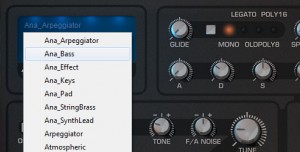
Tone2 has announced Analog, a new soundset for the Saurus software synthesizer.
Taking you on a journey through an analog world, the Analog soundset digs deeper into Saurus’ offerings with a strong emphasis on authentic vintage sounds.
A collection of 200 classic synth sounds including emulations of the Moog, Oberheim, Jupiter, Arp Solina, Clavinet and many others that suit almost every style of Electronic music. Let Analog take you back to a time when these machines were at the center of every studio and now be the source for your creative productions
Enjoy its warm strings, expressive brass, dirty leads, squelchy basses, screaming synths, vibrant pads and just let it inspire you.
Analog for Saurus is available to purchase for 39 EUR.
DSI Dave Smith Instruments Evolver Keyboard
What a little beauty this synth is – lots of knobs, spacey blue colors and LEDs – nice, too bad DSI’s keyboards normally has a pretty hefty price tag
The Poly Evolver Keyboard is DSI’s flagship synthesizer, a nearly-knob-per-function knockout that sounds unlike any other synth out there—except another Evolver, of course! Don’t like a high-end hardware synth that requires wading through endless menus to program? Not an issue with the Poly Evolver’s 78 knobs—60 of them potentiometers—and 58 buttons, incuding a keypad for direct access of programs.
An analog/digital hybrid, the four-voice Poly Evolver features four oscillators per voice—two analog and two digital—in a unique stereo voice architecture with a real Curtis analog low-pass filter per channel. The digital processing does not simply add effects at the end of the signal chain, but is tightly integrated with the analog electronics for tuned feedback, distortion, bit crushing, and synced delays. It can also process external audio and has separate stereo outputs for each voice.
The Poly Evolver is capable of producing sounds ranging from classic analog to more brash and edgy digital sounds. It is also multitimbral, with the ability to play up to four parts simultaneously through separate stereo outputs. And it can process external audio.
The Poly Evolver is not a generic “slab” workstation. If you’re looking for realistic pianos and strings, keep looking. But if you want a truly unique, inspirational, real instrument, look no further.
- Each voice is a complete Evolver with four oscillators per voice, two analog and two digital.
- True stereo signal path with separate Curtis analog low-pass filters in each channel for each voice. Each voice has its own independent effects (feedback, delay, distortion, high-pass filter, etc.).
- Highly accessible sound control for easy, intuitive operation: 78 knobs and 58 switches.
- Clocked, pulsing blue LEDs and hardwood end-panels.
- Each voice has an independent 16 x 4 step sequencer. Everything (sequencer, LFOs, and delay) syncs perfectly to MIDI.
- In Program mode, all four voices play the same sound. In Combo mode, voices can be allocated however desired: stack all 4 for a huge unison sound, split or layer the keyboard in any configuration, and/or play one or all sequences at the same time. Each voice can respond to a different MIDI channel.
- Each voice has its own stereo output in addition to the mix and headphones outputs.
- Stereo audio input that can be routed to any or all of the voices, enabling parallel audio processing of external stereo or mono signals. The output of one voice can be routed to the input of another for interesting double-processing effects.
A synthesizer test recorded in real time
A synthesizer test recorded in real time.
http://meatbeatmanifesto.com/
Review: Rob Papens Blade Additive Software Synthesizer
Rob Papen’s additive synthesizer with unique XY pad and endless modulation possibilities.
TAL-U-NO-LX – new Juno-60 synth emulation plugin
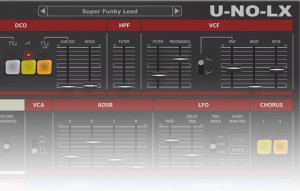
Togu Audio Line has announced the TAL-U-NO-LX, a new Juno-60 emulation with a fully rewritten new engine and GUI.
Up to date zero feedback delay filters and carefully calibrated controls make this synth a good replacement for the analog device with all the advantages software plugins have. It’s even possible to recreate old Juno patches from an existing patch sheet. As an addition, the TAL_U-NO-LX also supports portamento and different LFO waveforms and some more useful features. An arpeggiator with different sync modes and hold function is also included.
This new version will also be available as 64bit OSX AU and VST plugin. It was hard to calibrate a synth that has different envelope times on every voice, but we even copied this to some degree

TAL-U-NO-LX will be available to purchase within a few weeks. People who donated $17 USD or more (up to June 11th, 2012) will get a free license.
Close encounters with MFB Dominion-X
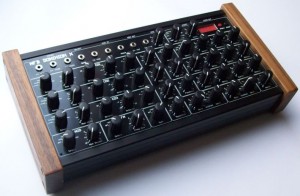
DOMINION X is MFB’s latest synthesizer. It combines analogue synthesis, programmability and modular patching. With advanced circuits, increased functionality and a new design, DOMINION X is the first of MFB’s next generation musical instruments.
DOMINION X offers three oscillators for maximum flexibility. Each waveform can be varied in symmetry. Besides altering the pulse width of a rectangle, you may also continuously turn a saw tooth into a triangle and a triangle into a sine. All oscillators also offer ring modulation. In addition, VCO 2 and VCO 3 can be synced to VCO1. Finally, VCO3 can modulate the frequency of VCO 1 and VCO 2. The analogue oscillator circuit is processor-controlled for stable tuning. To complete the available sound sources, noise or an external audio input can be added to the VCOs in DOMINION X’s mixer section.
The filter offers six operation modes. Available are three low pass variations with 12, 18 and 24 dB/oct. slopes. Also available are high pass-, band pass and a notch filter with slopes of 12 dB/oct. respectively 6 dB/oct. Variable filter modulations are possible via an invertible envelope, keyboard tracking, LFO, VCO, different MIDI controllers as well as by the use o the CV-input.
The two ADSR-type envelops are internally routed to the VCF- and VCA-sections. In addition, envelope 1 can also modulate the VCO section. LFOs 1 and 2 offer six waveform shapes including sample & hold. They may be switched to one-shot-modes to emulation simple envelopes. A third sine-LFO works in combination with a keyboard’s modulation wheel and can dynamically address the VCO, VCF and VCA sections.
Modulations are assigned by the use of selector switches, located at the destinations. This allows easily setting and re-routing internal modulation paths – ideally for your live-performance.
To integrate external modulators, control- and audio sources, DOMINION X offers nine inputs. Therefore, oscillators, filter, VCA, CV/Gate and mixer can be easily combined with other analogue synthesizers such as MFB’s MEGAZWERG, analogue sequencers such as MFB’s URZWERG PRO or modular synthesizer systems.
An additional selector switch allows assignment of velocity for up to eleven modulation destinations.
DOMINION X offers 128 programmable patches for your personal sound creations. To support sound programming without an attached keyboard, different demo sequences are available. To use DOMINION X as a filter box for external audio sources, the VCA can be opened permanently. Finally, there is an insert available to integrate an effect or distortion unit into the signal path.
A very very very short run on the patches memorized in the RAM-B bank of the small, but very effective, MFB Dominion-X Synthesizer
The small, but highly effective, MFB Dominion-X synth under CV/Gate control from Synthesizers.com 960 Step Sequencer. Out of sight, a plain MIDI keyboard for (occasional) key changes. Row 1 of seq goes on VCO 1, Row 2 goes on VCO 2&3, Row 3 goes on VCF.
Fiddling with control panel while playing the MFB Dominion-X synthesizer
The MFB Dominion-X synthesizer has some interesting capabilities of waveform shaping and its filter (developed by Carstein Schippmann) has some great modes
[Android App] EerieSynth – Harmonics
A quick spectral improvisation of an up and coming Android synthesizer, EerieSynth.
“Recorded with my laptop webcam. The application has been in development for a long time (hey, I couldn’t stop adding features), but yes, it is finally pretty much finished, and it will soon be purchasable from the Market.”
Jordan Rudess’ singing keyboard
Here’s Jordan’s comment about the video:
“After three days of experimentation, I was finally able to make my keyboard sing!”
Time machine: Yamaha DX7 II FD
A voyage into the heart of the Yamaha DX7 II FD from the year 1987.
Exploration by Marko Ettlich
FM Synthesizer
16 Voice Polyphonic
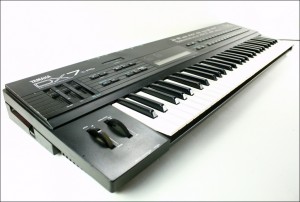
It has been used by Human League, a-ha, Depeche Mode, Tony Banks, Toto and many more.
The DX7 was an amazing digital FM synth. The DX7s carries on the torch once held by the DX7. It offers the same great FM synthesis method and can also create sounds just as unique and wild as the DX7. However, they can be just as difficult to program and understand for most users. Some general improvements include enhanced MIDI support, micro-tuning, aftertouch controlled pitch bending, and multiple LFOs. Although many improvements have been made to the DX7 in this upgrade there still could have been room for improvement, which is where the DX7IID and DX7IIFD come in.
These next models allowed for keyboard split and layering capabilities. The DX7IID (pictured above) and DX7IIFD hold 64 voices in internal memory, as well as an additional 64 voices in a RAM/ROM cartridge that can be accessed. These voices can be layered in dual mode providing very rich sounds or a nice combination of sounds that would be impossible on the original DX7. They can also be split, for a two voice multi-timbral capability. Again, impossible on the original DX.
They have wonderfully clean sound and are stereo, providing pans and chorus and a few other nice effects. There are two real time sliders on these instruments, allowing control of user-programmable items in real time. Micro-tuning, as well as fractional tunings for eastern music etc. is possible. The FD includes a floppy drive for storage of patches, performance presets and sysex information.
MauSynth – new free polyphonic synthesizer plug-in for Windows
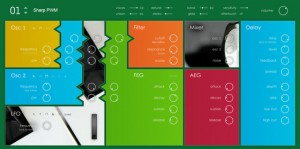
Pekka Kauppila has released MauSynth, a free polyphonic synthesizer plug-in for Windows.
MauSynth is a polyphonic analog-modeling substractive synthesizer VST plugin by Pekka Kauppila. You can create all sorts of awesome sounds with it.
MauSynth features
- Band-limited oscillators.
- Zero-delay feedback filter.
- Audio-rate modulation.
- 32 voice polyphony.
- Stereo unison.
- Friendly user interface.
MauSynth for Windows (VST) is available to download as donationware.
DATAMASKIN

