
Yamaha CS-15 :: Sonic Death Factory
Exploring the classic Yamaha CS-15, description of the synth below
This synth really has its own sound. The CS-15’s got style. Built like a tank with a lot of nice knobs and best of all, not one but two of those funny sounding multimode filters. It’s actually a duophonic / bitimbral synth but you have to connect it to CV (Hz/V like Korg not V/Oct) to get the extra voice. Each of the two VCOs has its own CV/Gate control.
The best things about it are the flexibility of the VCFs and the routings to the filters and envelopes. You can rout VCO 1 to both VCFs and the VCFs to any of the envelopes positive or negative voltage. The VCFs are 12 dB/Oct and are switchable between low, band or high-pass. They are the key to the nice sound of the Yamaha CS family. Other nice features are noise, external-in for processing other sounds, LFO with Sample & Hold for those bubbling sounds and an individual auto-bend for the VCOs.
The CS-15 is great for strange blips, bass and tiny highpass sounds. The ADSRs aren’t as fast as the CS-10 but they are ok. A nice feature is the ‘brilliance’ slider that can control either or both VCFs. At their extremely low prices, the CS-15 is an analog that’s definitely worth checking out for yourself.
Korg Radias – Two Ways To Live
Youtube alias MrRidgebackman has released this video featuring the KORG Radias, his details below:
This is a piece performed on the Korg Radias, using both Step Sequencers and played live. I took one of the presets and played around with the settings and the sounds.
Recorded live into Logic Pro 9 and then added the drums from Logic. Only processing used is Compression, no other effects used.
Hope you enjoy
Cheers Andy
Music and Video is sole property of ©Andy Barrow 2012
Reaktor Tutorial: Building a Basic Synth
This Reaktor Tutorial serves as an introduction to Reaktor, and covers building a two oscillator synth.
The video starts with an overview of the Reakor manuals, and then looks at building the synth example from the getting started manual.
The example ensemble can be found at flipmu.com/work/software/
Futureretro 777, MPC-60 (Oberheim DMX Sampled) Acid Funk Demo by Jordan Passmore
Here is a brief demo of the Futureretro 777 monophonic analog synthesizer/sequencer and the Akai MPC-60 sampler/sequencer. The 777 is running off of it’s internal sequencer and is sync’d via MIDI clock to the MPC-60. The MPC-60 has a sampled set of Oberheim DMX sounds. The delay that the 777 and drums are sent to is the Ibanez DMD2000. All are mixed on my StudioMaster mixer and sent straight to my soundcard (Native Instruments Kore 1).
A little noodling around on a Moog Voyager XL
Wednesday morning synth noodle, details below:
“More music at umop.com/parallax.htm
The wife and I were lucky enough to get a tour of the Moog factory in Asheville, NC recently, and while there I spent a little while in the sound lab making spacey noises. It was like being inside my own brain. I could have set up a tent in there.”
Jennings – new Kontakt version of an early all-valve synthesiser designed in 1946
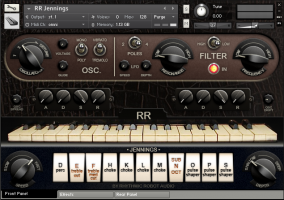
Rhythmic Robot Audio has released Jennings, a Kontakt software version of an early all-valve synthesizer designed in 1946.
The original Jennings Univox was played by The Beatles during their early sets at the Cavern in Liverpool, and by the Tornadoes, who used it to create the signature synth sound of their 1962 synth-pop hit Telstar.
It was designed by Tom Jennings who went on to form Vox amplifiers, and comprised a valve-based oscillator which could be run through a series of wave shapers, filters and EQs controlled by tab switches on its front panel, capable of creating over 2000 variations on the basic waveform. Vibrato added movement to the sound, while a knee lever controlling volume allowed the player to manage swells and tremolo wobbles in real time. The sound was output through a dedicated speaker cabinet into which the keyboard packed for transportation, making it a real alternative to other more cumbersome valve-based synthesisers like the Hammond Novachord for gigging bands.
The Jennings Univox was similar to the Clavioline, another valve-based portable synth, but differed in its use of a sawtooth variant as its source waveform where the Clavioline used a square-wave variant. It is this valve-based sawtooth, rich in harmonic overtones and minor valve instabilities, that gave the Univox its uniquely warm analogue sound.
The Rhythmic Robot software version of Jennings starts with a meticulous recreation of the original instrument based around 24-bit, 20-second chromatic samples of a professionally restored Univox and using a combination of multiple sample sets and convolved IR maps to simulate the behaviour of all of the Univox’s control tabs. Key click samples and a full sample set of the “Sub Octave” tab can be trimmed in level relative to the main wave forms, allowing more comprehensive balancing of the Univox’s tone.
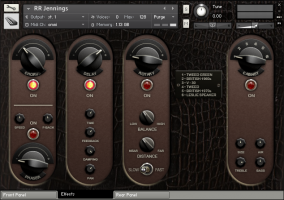
For musicians wanting to explore the start of the synth era with complete authenticity, a “compliance mode” can be enabled to allow the user quickly and easily to dial in patches which conform exactly to the standards of the 1946 original. Patches designed in “compliance mode” sound indistinguishable from the original hardware Univox. However, for anyone wanting to go beyond the limitations of the original, Jennings extends the capabilities of the Univox considerably, adding polyphony, dual oscillators (drawing on different sample sets for a richer tone), a multi-mode resonant filter with LFO, precise control over envelopes (including attack curves) and a comprehensive effects section incorporating Chorus, Phaser, Echo, Rotary Speaker simulation and Amp Cab modelling.
Accessing these effects and additional controls allows the user to create patches using a familiar subtractive synthesis model, but drawing on Jennings’s front-panel tabs to create a base palette of over 2000 “oscillators”. Any tab combination can be used as the starting point for a patch and then doubled up, detuned, filtered, effected and so forth. The result of this versatility is that Jennings is capable of creating both authentic, 1946-accurate tones in “compliance mode”, and modern synthetic patches with a signature valve character, all from one clearly laid-out graphic UI.
Jennings is available now from www.rhythmicrobot.com priced at £59.95.
Features:
- 24-bit, 20-second samples of a professionally-restored Jennings Univox.
- All-valve waveforms.
- Convolved IR maps and multiple sample sets combine to recreate all front-panel tabs.
- One or two oscillators, with detune and Osc Spread control for stereo width.
- Multi-mode resonant filter switchable between 2-pole (12dB/octave) and 4-pole (24dB/octave), high or low pass.
- Filter and Amplitude envelopes; Amplitude envelope with specific attack-curve control (for “sucky” or “snappy” attacks).
- Filter LFO and switchable Amplitude (tremolo) / Pitch (vibrato) LFO, with adjustable ramp time.
- Full effects section with Chorus, Phaser, Delay, Rotary Speaker and Amp Cab simulator.
- Stereo Widening in combination with Osc Spread maps keys across the stereo sound field.
- “Compliance Mode” makes creating authentic 1946-style patches simple.
Jennings requires Kontakt version 4.2.3 or later (including Kontakt 5). Not compatible with Kontakt player.
(Via KVR)
D16 introduces the LuSH-101
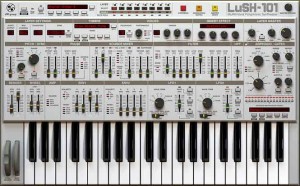
The D16 Group has announced the imminent release of their newest virtual analog synth, LuSH-101. Here’s what they have to say about it…
Prepare to have your notions of what a plugin should be capable of forever redefined! Extremely powerful multilayer architecture, a palette of the finest insert effects (each selectable per layer), and an extensive mixer with compression, EQ and send effects all add up to a truly modern synthesizer with vintage playability–and all in the absolute highest sound quality possible at every point along the signal path!
LuSH-101 is a synthesizer created from modules that can be found in many modern virtual synthesizers, all combined into a single compact and logically intuitive design. However, this basic simplicity combined with its multilayer architecture turns it into an easy-to-use but extremely powerful instrument that can be programmed and tweaked quickly, almost effortlessly leveraging its maximum potential.
The multilayer architecture guarantees that both the sound design possibilities and number of unique situations in which LuSH-101 can be used are virtually limitless. Layered sounds can be created simply by assigning the layers to the same MIDI channel; the results can sound as massive as anything imaginable! Assigning the layers to different keyboard zones allows you to create even the most sophisticated splits. Of course, you can always assign the various layers to different MIDI channels for 8-part multitimbral usage. And, virtually any combination of splits, layers, and multitimbrality is possible with just a single instance of LuSH. With each layer working as an independent synthesizer with its own polyphony, parameters, enhanced arpeggiator, and a palette of only the finest insert effects, LuSH-101 can push your creativity to unprecedented levels!
Pricing and Availability:
Pricing and release date will be announced soon.
More information:
Tymkrs Typical Week – Protosynth Sequencer and More
Last week we saw the first video of the Protosynth, now a follow up demo has been released, check it out
Keep http://tymkrs.com/ viewer supported, please donate!
Show Notes:
Chat with us live every day:
#tymkrs on irc.AfterNet.org https://tymkrs.com/chat
Help us continue to provide free educational videos, podcasts, and blogs! Your equipment and monetary donations are what make this possible. With just a few clicks you can make a one time donation or set up a monthly subscription, see http://tymkrs.com/ for details. If you would like to donate parts or equipment to the show, let us know at feedback@tymkrs.com.
DR-OM app by Fluxama – Demo
Demonstrating one of the three DR-OM instruments included in Fluxama’s DR-OM App for iOS. Works on iPhone 4, iPhone 4S, iPad 2, & New iPad. Developed by Shawn Wallace, Shawn Greenlee, and Elliot Clapp.
DR-OM is a virtual synthesizer that simulates the hackable yard sale treasure of the same name. Dozens of DR-OM units have been adapted from a rare, limited science lab function generator that started turning up in flea markets in the 70s. DIY synth enthusiasts discovered the device was easily hackable, and closely-guarded photocopies of the modded schematics have been handed around the community for years. The directions show how to rewire the generator into a nice little synth with two mixable Low Frequency Oscillators and a Voltage-Controlled Filter.
Listen to the voice of Buddha
More tunes form Raspberry Pi, check it out:
OK, I cannot tune the latency to any lower than this without totally busting my head, so I’m pushing this particular stack and will move on to how to get sounds of out I2S. Which involves getting my hands on a rev 2 board or 2.
More at http://raspberrypisynthesizer.blogspot.co.uk/2012/09/listen-to-voice-of-buddh…
DATAMASKIN

