
Demo of PPG Waveterm A + Wave 2.2
This video, via retrosound, is a demo of the PPG Waveterm A + Wave 2.2 – a vintage wavetable synthesizer from 1982.
PPG Waveterm A and Wave 2.2 Wavetable Synthesizer from the year 1982.
The Waveterm is the heart of the legendary PPG system and based on an old german computer called Eltec Eurocom II with Motorola 6809 processor.
– creation of Waves and Wavetables
– fourier analysis / resonator
– additive synthesis
– 8 bit Sampling for the WAVE 2.2
– sequencer / event generator
– storage of sounds on 8″ discthis first demo video shows only a few functions (creation of waves, wavetables) of the Waveterm A. more coming soon.
For all you Buchla fans out there
Here are two videos of the Buchla in action and a lot of other goodies as well of course
a live aand looped Buchla 200e improv
Cary Grace performs an impromptu improvisation on the Buchla 200 Series Electric Music Box, while taking a break from hand-crafting Wiard 300 Series Modules. Programming assistance provided by Michael Murphy of Modern Implement Company. – The Airtight Garage: http://www.fromefm.co.uk/profile.php?…
Sending the application of the Korg iMS20 Ipad in module Frequency Shifter for treatment with the 285e Balanced Modulator.
More on the Buchla:
The original Buchla Music Box was the brainchild of Don Buchla and came from a commission by composers Ramon Sender and Morton Subotnick. First built in 1963, this synthesizer was composed of several “modules” that generated or modified a music event. Each box served a specific function: oscillator, filter, sample and hold, etc. This would have an effect on the pitch, timbre, amplitude and spacial location of the sound. The idea was to allow musicians and composers to create sounds suited to their own specifications. Previously, one had to utilize either discrete audio generators such as test oscillators or via musique concrète, recorded sounds from natural sources. Although it was a fresh and exciting idea and an excellent way to get new sounds, this was very time-consuming and arduous. The Buchla Box allowed musicians to bend and manipulate sound all in one device. This would lead to the many kinds of electronic instruments available today.
Buchla 100
The Buchla 100 series Modular Electronic Music System was commissioned specifically by Subotnick in 1963 for use on his first major electronic work Silver Apples Of The Moon. He gave Don Buchla ideas and specifications for what the instrument should do. Along with Robert Moog’s Moog synthesizer, it would go on the revolutionize the way music and sound is made.
Buchla 200e
The Buchla 200 series Electric Music Box replaced the previous model in 1970 and represented a significant advance in technology. Almost every parameter can be controlled from an external control voltage.
In the mid 1970s, Don Buchla began experimenting with digital designs and computer controlled systems. The results were the 500 series and the 300 series, both of which paired the new technology with existing 200 series modules to create hybrid analog/digital systems. The Touché was also the result of this research.
Kinect Drawable Synthesizer and the Impromptu Sound Board
Cool take on the Kinect 
You draw buttons, and they become key you can play. See the impromptu sound board video for a demonstration of drawing buttons.
Using the Kinect, I can create buttons by just drawing enclosed shapes on a piece of paper! The kinect identifies those regions as buttons that can be activated when I press them with my finger. This program uses ROS, the openni kinect drivers, and software I wrote here at MIT. You can find the code in the mit-ros-pkg repository.
Cableguys updates the Curve
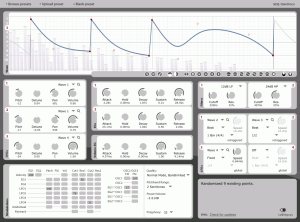
Cableguys has released version 1.1.1 of Curve, a virtual synthesizer instrument for Windows and Mac.
With this update now demo version users of Curve can also add their presets to the preset library. Besides this, the release is all about fixing bugs and flaws
Changes in Curve v1.1.1
- Fixes:
- [Mac] Crash bug, loading VST and AU versions at the same time could lead to crashes.
- [Mac] Waveform editing, double-clicking in the waveform area could behave strange.
- Syncing presets, the list of presets was not always updating while syncing.
- Improvements:
- Adding presets: Demo version users of Curve can also add their presets to the preset library.
- Editing release: Now, changing release time has immediate effect on releasing sounds.
- CPU consumption: Decreased CPU usage for pitch modulation.
Curve for Windows and Mac (VST/AU) is available to purchase for 119 EUR / $159 USD.
More information: Cableguys / Curve
Via Ronnie
Phosphor Overview
A quick run-through of Audio Damage Phosphor vintage digital additive synth plug-in in two parts. The first part shows multiple Phosphor instances in a musical setting, and the second part touches on the highlights of the UI and creating a sound from the init patch.
http://www.youtube.com/watch?v=QZILUYsqoTQ
So retro analog synth
Cool retroish synth. Samsara Cycle Audio has released DEISK-O, a virtual classic analogue mono synthesizer instrument for Windows. The synth is a free to use. See the specs below.
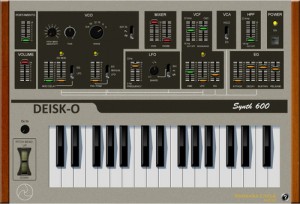
Features:
* Mono
* Single 2 Wave Oscillator Plus External Signal In:
* Ramp
* Pulse
* Ext In
* Pitch bend sensitivity
* Tune control 1 note + / – tolerance
* Range – Sub / 64′ / 32′ / 16′ / 8′ / 4′
* EG Modulation Level Slider
* Modulation Delay Level Slider – LFO / EG
* PW/PWM Level Slider – Selectable EG / LFO / Manual
* LFO Section
* Frequency Level Slider
* Waveform Select – S/H / Triangle / Pulse
* Waveform Mix Control (Between Selected Wave and Sine Wave)
* White Noise
* Mixer section
* Oscillator level slider
* Noise level slider
* Voltage Controlled Filter Section
* Cutoff level slider
* Resonance level slider
* KBE – Keyboard enhance slider
* LFO level slider (pitch)
* EG slider (filter)
* VCA
* Switch – Hold / EG
* HPF
* Level Slider
* EG – Envelope Generator Section
* Attack Level Slider
* Decay Level Slider
* Sustain Level Slider
* Release Level Slider
* Volume Level Slider
* External Input Level Control
* Pitch Bend Wheel
* Power On /Off Switch
More information and how to make a donation for the synth at http://samcycle.blogspot.com…
Sound in Motion – all about the Hartmann Neuron Synthesizer
http://www.youtube.com/watch?v=w3waFytr8CQ
this was the promotional DVD produced in 2004 for the Neuron.
The German-made Hartmann Neuron was a polyphonic synthesizer that attempted to break new ground using a new form of synthesis and sound-modeling they say was based on technology found in neural networks. What the Neuron actually does is it analyzes audio files (samples) and creates digital computer models of these sounds which can then be re-synthesized and processed using the extensive amount of on-board data-wheels and joysticks with control of more ‘musical’ sonic aspects such as instrument shape, size and acoustic behavior. The joysticks allow for real-time tweaking of up to three parameters at once – 3D modeling in a true 5.1 surround sound environment.
The Neuron shipped with 200 modeled sounds already in its memory, but using their proprietary software application, ModelMaker (Mac/Win) a user can add their own sampled sounds to be modeled by the Neuron’s neural network, and these can be stored in the user memory banks (sounds could be brought into the Neuron via analog, S/PDIF or USB connections). Instead of oscillators, the Neuron uses Resynators, of which it has two. Each resynator holds a single model (you can freely assign any models in memory to each resynator to build your sound). Each resynator has a joystick that lets you adjust the ‘scape’ and the ‘sphere’ of the sound. ‘Scape’ refers to the generation properties of a sound (such as the excitation source in a real instrument), ‘sphere’ would contain all parameters referring to the properties of the resonating ‘instrument’ body. The Neuron’s Blender function lets you mix the results of the two resynators in a variety of ways, including morphing and crossfading. It even lets you manipulate one resynator using another.
Kick drum synthesizer plugin
KICKWOrK is a kick drum synthesizer plugin. From deep hiphop basses to hard rave kicks – everything available with the turn of some knobs. A clear and easy GUI helps you to find your bass drum sound quick. No samples inside – pure analogue emulation. A minimum of knobs for a maximum of variations. Kick sound can be triggered by any incoming MIDI note or by an audio input (bass drum of a drumloop). Available for Windows PC as VST-plugin.
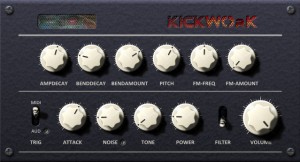
Special intro offer: PAY WHAT YOU LIKE !
(later normal price will be 19 €) Listen to demos and learn more at http://music.service-1.de/ht…
trouby modular demo
trouby-modular.com – own device resting on a drumbox including 17 tone generators…
Shared by therealtrouby
“New handmade DIY stuff from germany – as addons for curetronic, DotCom and other 5U modular Systems. Do you need for your Liveact a precise clock for your sequencer? Here’s the Masterclock Generator Smile Or you like quite random triggered percussive sounds? Check the Math Trigger Sequencer i describes shortly. Or just a single-bar trigger sequencer – in combination w/ the trigger decay envelope generator for percussions. Or a fuzz w/ visualation? Try the LED FUZZ Smile The front design is mostly non-shining anthazit.”
Ambient, darkwave soundscape created entirely by the SynFactory
Pervading Omnipotent Manifolds of Expression
Pervading Omnipotent Manifolds of Expression is an ambient, darkwave soundscape created entirely by the SynFactory 1.15 modular software synthesizer. This amazing piece of software can be configured in an almost infinite combination of possibilities to produce modulating or sequenced waveforms as simple or complex as the composer wishes to create.
For this composition, the main sequenced lines were created by feeding the patterned 8-step sequencer into the FM inputs of a sinebank module (multiple sinewave oscillators for additive synthesis). The sequenced output from the sinebank was then fed into a ring-modulator unit and modulated by a sinewave. The output from the ring-modulator then fed twin delay units to produce the stereo delay output. It was by manipulating the controls of the sequencer module that produced the real-time variable output, recorded as a continuous waveform that could later be integrated into a multi-track recording structure. A 6.5-minute sequence was produced in this manner, and inserted into a multi-track recording session. Because the tempo bpm was unknown, a “tempo track” was created as a series of high-frequency bleeps (as a visual reference for timing). To this “tempo track” a rhythm track was created manually – by positioning snare and bass drum samples by precision editing in accordance to the visual reference of the “tempo track”.
To create rhythmic variety, the same manually-created rhythm track was ring-modulated by a 150 Hz sinewave, and positioned on the timeline to create an interesting rhythm combination. This first session was then mixed down to create the main sub-master mix to add further elements. A second session was created by introducing a pulsating dark ring-modulated sequence. Surreal chimes fade in and out (created by ring-modulated sequences subjected to extended delays), and “twinkle tones” add to the surreal quality (created on the Korg R3 synthesizer). Other added sequences include additional atonal melodic elements, and “shimmering” passages toward the conclusion of the composition. All these additional elements were then mixed together to create the final stereo master. The result is a darkwave-ambient piece of electronica, partially inspired by the feel in music as evident by the group Bauhaus.
The visuals comprise wide-screen modulating textures and patterns forming a background. Added to this were images of mannequins and science-fiction robots and other strange characters. The Autons from Doctor Who feature quite heavily. This visual composite was then used as the source to process multiple keyed versions of itself to create visual complexity. An outlined composite mix was also created, as well as several multi-coloured variations. Sections of all these variations were edited to the soundtrack. The result is a surreal wash of colours and textures to complement the strange ring-modulated tonalities created entirely by the amazing SynFactory 1.15 modular software synthesizer.
Shared by JeffreyPlaide
DATAMASKIN

