
Nice pictures of the Pyramid Synth
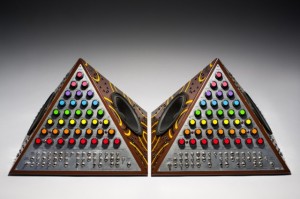
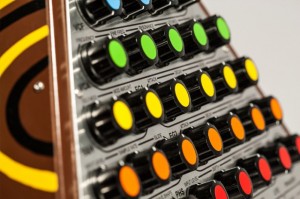
The Pyramid Synth is a unique collaboration between instrument designer David Cranmer and monsterist Pete Fowler. They created two pyramid-shaped analogue synthesizers with hand painted casings. The design began as part of an animated music video that Pete made for The Horrors, and then afterwards Richard Russell (XL Recordings) decided to commission a real life version. It was decided to make two synths in the end, one for Richard and one for The Horrors to use.
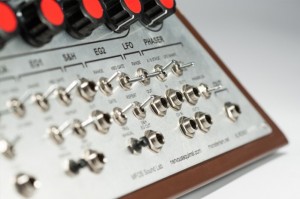
Each synth contains a Music From Outer Space Sound Lab mark II. This provides each synth with two stable VCOs, a state variable VCF, two envelope generators, VCA, LFO, patchable sample and hold, white noise generator and an audio mixer.
There are plenty of switches and sockets for creative signal routing, and external inputs to process your microphone, guitar or electric ocarina. Control voltage inputs allow other synths and sequencers to control different parameters. Each pyramid also has a MFOS 8-stage phaser, built in speakers and 72 colour changing LEDs.
Nebulophone Synthesizer – the tiny synth trend continues
Nebulophone synthesizer built from parts kit.
There appears to be a trend to do micro synths right now – the Nebulopone is one example, another one is the one we showcased earlier this week, watch below:
Steelberry Clones had the opportunity to try out one of only 50 copies of the unique micro synth Travel Weevil at a Bug Brand hosted modular synth meet up in Sweden, on October 29th
Time machine: PPG wave 2.2 synthesizer – “Dark Voices”
all sounds self-programmed: PPG wave 2.2 Wavetable Synthesizer from the year 1982
recording: multi-track without midi
fx: a little bit delay and reverb
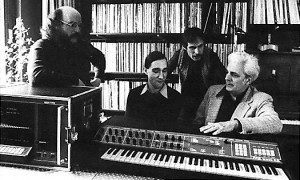
The German made PPG (Palm Products GmbH) Wave 2 series of synthesizers are incredibly great sounding analog/digital hybrid vintage synths. They use digital samples of wavetables and feature analog VCA envelope and VCF (filter) sections for a classic and warm sound. The Wave 2.2 has oscillators that can generate over 2,000 different single-cycle 8-bit digital waveforms! Covered by knobs, the Wave still looks analog and this comprises the “Analog Control Panel”. More complex and new-wave editing of the wavetables and samples is covered by the “Digital Control Panel” where there are several key-pad buttons and an LCD screen. Another familiar treat to analog junkies is the inclusion of an 8-track sequencer which features automation of pitch, loudness, filter cutoff, waveforms and more. A cool feature – its onboard sequencer will also record any filtering and wave changes, in real-time!!
The more commonly encountered Wave 2.3 followed the 2.2 and had enhanced sample-playback capabilities. The sampler was pretty full-featured for its time and included upgraded 12-bit digital waveforms, Fourier analysis and linear playback of samples. The 2.3 model also featured 8-parts multitimbrality and MIDI implementation. The PPG Waves are know to create excellent pads, brass and bass sounds.
In fact it was Tangerine Dream who helped the company and the Wave develop. 1978 saw the development of the PPG Wave Computer 360. But the Wave Computer sounded harsh and tinny. In 1981, the PPG Wave 2 was released which added analog VCF and VCA filter and envelopes to warm the digital sound. The original Wave 2 had 8-voice polyphony, like the 2.2 and 2.3, but it had only one oscillator per voice. The 2.2 offered two oscillators per voice which opened up a whole new realm of sonic possibilities because two separate wavetable sounds could now be combined.
more info: http://www.retrosound.de
Yamaha Synth MX61 & MX49 Introduction
MX Serie Synthesizer Introduction with Adrian Zalten: MX61 & MX49
Differentiated only by keyboard size, each of these 61-part multitimbral keyboards contains over 1000 of Yamaha’s flagship MOTIF sounds, effects and an ‘easy’ split/layer/performance mode that enables you to quickly come up with custom tones.
What’s more, the MXs are designed to integrate tightly with your DAW: audio can be piped directly over USB, and you can switch to a DAW Remote mode that enables you to use the hands-on controls to adjust parameters in your software.
You can also use the Ms as an audio interface, though disappointingly, the only input comes in the form of an aux mini-jack. Another thing that’s lacking at present is the option to use the MX’s synth as a VST instrument (complete with software editor) though we’re told that this is on the way.
The MX49 and 61 both ship with a copy of Cubase AI, plus Steinberg’s Prologue synth and Yamaha’s own YC-3B virtual organ. As such, anyone who buys one is getting a full music production starter kit.
Perhaps the most striking thing about these keyboards, though is their price: the MX49 has a target price of £499 and the MX61 should be available for £649. Both models will be shipping in December.
Yamaha MX49 and MX61 specs
- 166MB of internal Wave ROM
- More than 1000 Voices taken directly from MOTIF
- USB Audio/MIDI interface built in
- VCM Effects
- Auxiliary input and WAV/MIDI file playback
- One touch Layer and Split function
- 128 note Polyphony / 16 part multitimbral
- 999 arpeggio patterns
- Advanced synth editor
- Remote Mode for DAW control
- Bundled with Cubase AI, YC-3B organ emulator, Steinberg Prologue analog synth
- Lightweight design: (MX49: 4kg, MX61: 5kg)
Roland Synth Story Tour
Roland has come a long way since its inception in 1972. Its synths, drum machines and effects have been used on some of the most famous records ever and have helped artists push sonic boundaries, creating new sounds and even radical new musical genres. Taking part over three dates in November, the Roland Synth Story tour will explore this rich history through a roster of artists and experts. Roland says that it’s an exciting opportunity for visitors to learn more about the company’s synths, speak to three musical icons and even get their hands on some classic Roland vintage gear.
The panel of experts, including Richard Barbieri (Porcupine Tree and Japan), Graham Massey (808 State) and Jody Wisternoff (Way Out West) will all talk about their experiences creating electronic music as well as discussing their favourite Roland synths. They’ll also be on hand to answer questions and chat to visitors after the event. All three guests are intrinsically linked to the history of the synthesizer. Richard Barbieri’s first ever synth was the Roland System 700, and he’s never looked back. His band, Japan, notched up numerous hits in the ’80s and they became a cornerstone of the influential synth-pop movement.
Graham Massey infamously named his band ‘808 State’ after the famous Roland TR-808 drum machine, which – along with the TB-303 – was an essential component to the way the band produced their music.
Jody Wisternoff uses a stable of Roland synths, including the Juno-106 and the legendary Jupiter-8, to make progressive house and breaks as one half of Way Out West. Their music didn’t just hit the charts, it also found its way into TV shows and video games.
Guests will also have the chance to get their hands on some rare and ultra-covetable Roland gear, including the following: Jupiter-8, Juno-60, Jupiter-6, Jupiter-4, Juno-106, JX-8P, D-50, JD-800, JV-1080, JP-8000 and XV-5080.
Dates and Venues
- 26 Nov. – The Roland Music Academy, Walsall College, Walsall
- 28 Nov. – The Roland Music Academy, Ealing, Hammersmith & West London College
- 29 Nov. – Huddersfield University, Huddersfield
Pricing and Availability:
Free but spaces are limited and demand is high (two tickets per person)
More information:
Introducing the powerful LuSH-101 multilayer synthesizer
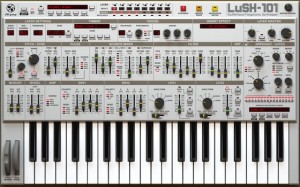
D16 Group has announced the availability of LuSH-101 (formerly known as SHIOITOR), the long awaited authentic sounding virtual synthesizer for Windows and Mac.
LuSH-101 is a synthesizer created from modules that can be found in many modern virtual synthesizers, all combined into a single compact and logically intuitive design. This basic simplicity combined with its multilayer architecture turns it into an easy-to-use but extremely powerful instrument that can be programmed and tweaked quickly.
The multilayer architecture guarantees that both the sound design possibilities and number of unique situations in which LuSH-101 can be used are virtually limitless. Any combination of keyboard splits, layers, and multitimbrality is possible with just a single instance of LuSH-101. Each layer working as an independent synthesizer with its own polyphony, parameters, enhanced arpeggiator, and a palette of eight insert effects.
LuSH-101 comes complete with a powerful built in mixer, complete with layer-independent parametric equalizers, compressors and three send effects: reverb, delay and chorus.
Innovative oscillator algorithms developed by D16 Group make LuSH-101 sound exactly like a sampled hardware analog synth. Filters with constant resonance across the entire frequency domain has natural warmth and character.
A generous factory library contains more than 1600 presets of every type, while intuitively designed preset browser keeps everything organized and easy to locate.
LuSH-101 for Windows and Mac (32 & 64bit VST/AU) is available to purchase for 149 EUR/$199 USD/£119 GBP incl. taxes (if applicable). LuSH-101 is now also included in the Total Bundle. Discounts are available to registered product owners from their User Area at the D16 Group website.
First video of the new Yamaha synths – MX49 and MX61
Motif Sounds for Inspiration,
Xtensive Controller Integration.
It doesn’t get better than this.
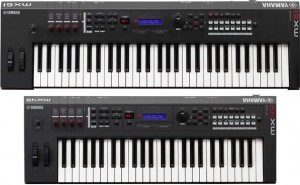
The MX series synthesizers feature carefully selected sounds taken from the Yamaha MOTIF XS. That powerful sonic palette is packed into sleek packages (available in 49- and 61-note versions) that fit today’s on-the-go life style. But the MX Series aren’t just synthesizers; they are designed to bridge the gap between hardware and software. By adding extensive audio and MIDI USB connectivity, advanced DAW and VST controller features and a suite of powerful music production software, the MX integrate hardware reliability with controller flexibility to give you the best of both worlds at a ground breaking level of affordability.
The new MX series combines Motif XS sounds, USB Audio/MIDI connectivity and advanced DAW/VST controller
features at a ground breaking level of affordability.
– Over 1000 sounds from the MOTIF series
– Equipped with VCM effects
– Easy Split /Layer Performance Mode for Instant Inspiration
– 16-Part Multi timbral and 128-note polyphony
– Extensive Hands-On controls for VSTs and DAWs
– Bi-directional USB Audio/MID interfacing
– A complete suite of music production software included
– A lightweight design with a quality Yamaha keyboard
– Complete analog and digital connectivity
Illuminati secret machines revealed in abandoned underground base in ex-soviet union
Old secret illuminati base discovered underground. This video reveals some of its secrets.
“Time Synthis” a tour inside the Ensoniq SQ-80 Hidden Waves
Jack Girouard explores hidden waves on the Ensoniq, here are the details:
An electronic piece called “Time Synthis” explores some of the hidden waves of the SQ-80 “Cross Wave Synthesizer”. Photo slide show of pictures I took showing the steps of the upgrade as well as other shots inside and outside. This is a very special synthesizer, super clean inside too! (its not for sale).
I bought this synth from an ebay member: thomasb93. I don’t want to give a source away, but he does a great job refurbing synths! I found this one, and was well worth it!
Here is a description of what he did with this SQ-80: “All buttons, wheels, faders, keys and disk drive work as they should. It has a new 3V lithium installed. The power supply passes the correct voltage at all test points and the CEM 3360 analog filter sounds great. This synth also features polyphonic aftertouch. The insides of the synth look new and the key contacts, foam pads and keyboard pcb look new as well.” I feel proud to own this well cared for instrument! Thanks Tom!
I did the upgrade when I got it. Had a little scare, I put the Hi Lo eproms in backwards, for the record, when doing that and restarting your SQ-80, the display shows nothing but a single digit 3 off to the very left bottom corner of the display. Note: in the dark angle view shot of the main board, if you look closely enough you’ll see the eproms in reversed. I wouldn’t recommend doing this but fortunately taking them out and putting them in correctly brought me to the Soft Reset screen seen here. Press one button and the new OS version can be read…none of the patches were lost because it was a soft reset and had the latest eprom previously, 1.8. These eproms, Oshi and Oslo, are designated as version 1.8HW, I believe it can be refered to as version 1.83 as well.
This is an improvisation done on two tracks, all SQ-80 with a Lexicon MX-300 doing some effect processing. Note: these are patches I’ve created, the upgrade to 1.8HW doesn’t give you a new set of patches, it just gives you 52 more wave types that can be used for the three oscillators. They simply add to the list of waveforms simply as numbers 75-127. The patches used in this video used hidden waveforms 78, 79, 80, 82, .
Tiny TV and the Raspberry synth
“I hooked up a USB bus-powered tiny TV to Piana. Now the little children of Stonehenge can play synthesizers. Or they could if I could find a similarly tiny keyboard.”
DATAMASKIN

