
Glowing magic on the iPad
This film explores playful uses for the increasingly ubiquitous ‘glowing rectangles’ that inhabit the world.
We use photographic and animation techniques that were developed to draw moving 3-dimensional typography and objects with an iPad. In dark environments, we play movies on the surface of the iPad that extrude 3-d light forms as they move through the exposure. Multiple exposures with slightly different movies make up the stop-frame animation.
Iliadis new Combo organ for Windows
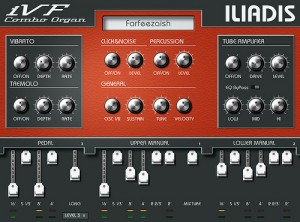
Iliadis unveils iVF Combo Organ, an organinstrument for Windows.
“The iVF Combo Organ is a Two Manual Transistor Organ Simulation for Windows Compatible VST Hosts, inspired after famous Transistor Organ models, withe special characteristics and the feeling of an incredible Retro Sound close to the sound of favourite models of the past.”
Features:
- 33 Notes Polyphony
- 9 Steps Drawbars (Flute OSC)
- 6 Drawbars for the Upper Manual (16′, 5 1/3′, 8′, 4′, 2 2/3′, 2′) and 1 Mixture (1 3/5′, 1′), 6 for the Lower (16′, 5 1/3′, 8′, 4′, 2 2/3′, 2′) and 4 for the Pedal (16′, 5 1/3′, 8′, 4′) + “Long” (Decay Drawbar) and Level Selector
- Yellow LEDs (Strings Oscs) and Green LEDs (Reed Oscs) available for UM, LM and Pedal
- Click&Noise Section (only UM). Adjustable Level. A Knob switches Off/On
- Percussion Osc (only UM). Adjustable Level. A Knob switches Off/On
- Vibrato. Adjustable Depth and Rate. A Knob switches Off/On
- Tremolo. Adjustable Depth and Rate. A Knob switches Off/On
- Tube Amplifier. Adjustable Drive, Level, Low, Mid, Hi, EQ Bypass Switch. A Knob switches Off/On
- General. OSC Selector, Sustain (only UM), Tune adjustable and Velocity Off/On Switch
- Midi Channel Selectors for the 2 Manuals and the Pedal
- 32 Programms available (16 ready Patches)
- A LCD Screen
- Retro Look
- CPU Power needed
Price: EUR 45,00 (Donation)
Dig that robot bass
A video on Youtube featuring the Tetr4 and the Tenori in a massive robotish interaction, enjoy 
Tetra is DSI’s next-generation analog poly synth. Tetra takes the award-winning sound and features of Mopho, multiplies them by four, and packs them in a box less than half an inch larger!
Tetra has multiple personalities. It is a four-voice, analog poly synth, a sort of “mini Prophet.” It’s a four-part, multitimbral synth with separate outputs, essentially four Mophos in one very compact box. And it’s a voice expander for other Tetras or the Prophet ’08.
Getting up to speed on step sequencers
A basic description of what the seq does.
I have been getting questions about what my pseudo random or fuzzy microcontroller sequencer does, and how it does it. You may remember about 6 months I talked about several kinds of sequencers including the microcontroller sequencer. The concept behind this sequencer is to let it do the work of composing and triggering whatever toys are connected to it. This allows focusing on tweaking the modifications on the toys, and to use a mixer to layer or enhance sounds. The toys have to be prepped with rca jacks to be connected to the sequencer. After this is done the sequencer acts as remote buttons for the toys. The microcontroller is programmed to trigger the buttons in randomly generated patterns. When powered on or reset the code randomly, as random as small digital can be hence pseudo and fuzzy, creates an array of numbers that correspond to the four channels of the sequencer. Then an increment or step size is randomly selected as well as a number of times to repeat moving through the array using that increment size. For example an array of 32 elements might looked like this:
1, 1, 4, 3, 1, 3, 2, 4, 2, 4, 1, 4, 4, 4, 3, 1, 1, 2, 3, 1, 2, 3, 1, 4, 4, 4, 2, 3, 2, 3, 1, 1
Rocking the Fairlight and Yamaha
Jan Hammer rocks out with his Fairlight and Yamaha KX5 remote keyboard on BBC Rock School series 2 from 1987
About:
Jan Hammer (born 17 April 1948, in Prague, then Czechoslovakia, today the Czech Republic) is a composer, pianist and keyboardist. He is probably best known for playing keyboards with the Mahavishnu Orchestra in the early 70s, as well as his “Miami Vice Theme” and “Crockett’s Theme”, from the popular 1980s US television program, Miami Vice.
Hammer has collaborated with some of the era’s most influential musicians such as Jeff Beck, Al Di Meola, Mick Jagger, Carlos Santana, Stanley Clarke, Neal Schon, Steve Lukather, and Elvin Jones among many others. He has composed and produced at least 14 original motion picture soundtracks, the music for 90 episodes of Miami Vice and 20 episodes of the popular British television series Chancer.
His compositions have won him several Grammy awards.
How to turn stock prices into music
AAPL 1984-2010 is a project which takes the stock price information and converts it into music. The AAPl stock was chosen for its wide price range and because it was one of two stocks the author once owned.
The prices where scaled to a range between 36 and 124 in Open Office spreadsheets. The stock was broken into years because this allowed for a wider range of progressions especially with regard to price. The volume was scaled to between 40 and 120. While midi can be between 0-127 the extreme values are not really audible and not often playable on instruments.
The rhythm is a scale of the difference between daily high and low prices and scales to values between 0.5 and 4. The final values are from an IF macro where values less than .8 become 0.5, values between .9 and 1.7 become 1 and larger than 1.7 is two.
Each time period’s pitch, velocity and rhythm values are exported separately and imported into AC Toolbox (see “A Simple Song” video for AC Tool box info) and used as stockpiles to define a musical piece.
The piece is exported as a midi file to Cognitone’s Synfire to check the harmony and ensure a playable range for the piano. The midi from that process is saved and imported in Reason/Record for instrumentation.
The pieces where conceived roughly as piano pieces so that was the initial instrument with some bass and pads added.
The final works are a bit more monotonous than I initially envisaged but the experiment does lead to further work in this area.
The next steps possibly include adding in more technical analysis figures for controller values. More than one companies stock can be use to construct duets, trios, quartets etc. There is also the use of macro economic data to construct songs.
Via tladb
The lost Yazoo track – Get set – reappears
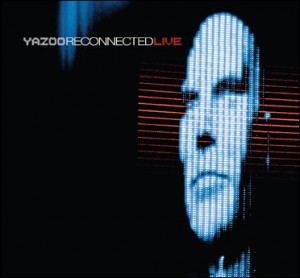
It’s been a long time coming (almost 30 years!) but the Yazoo track “Get Set” is finally getting an official release as it features as an exclusive bonus track on pre-orders for the iTunes release of “Reconnected Live”. The previously unreleased and much sought after “Get Set”, was originally recorded in 1983 and used as the theme to the BBC Children’s TV show “Get Set For Summer”. Order it right here.
Recorded live in Summer 2008 it features classic tracks from Yazoo’s albums “Upstairs At Eric’s” and “You And Me Both”, including “Only You”, “Don’t Go”, “Situation” or tracks such as “Nobody’s Diary” which are performed live for the first time ever.
Teaser below:
Yazoo – Reconnected Live (sampler) by MuteRecords
The sounds of Japan in your music

Impact Soundworks has announced the release of Koto Nation: Classical Instruments of Japan, a koto, bass koto and shamisen library for Kontakt, featuring world-class performer Masayo Ishigure.
We created Koto Nation out of a desire to see traditional Japanese instruments receive a deep, thorough sampling treatment, much like our acclaimed North Indian sample library Sitar Nation. While there are a handful of libraries which include samples of the koto and shamisen, they feature only the most basic articulations and few (if any) velocities or round robins. To our knowledge, the bass koto has never been sampled at all! Given the popularity of the shakuhachi and taiko in many Western film soundtracks, we wanted to allow film composers, hobbyist producers, ethnomusicologists, anime fans and everyone in between access to these classic instruments and complete the repertoire of traditional Japanese sounds available.
This library includes a massive number of samples spanning a wide variety of both traditional and extended playing techniques all recorded by koto legend Masayo Ishigure (Memoirs of a Geisha). We’re confident that this is, without a doubt, the most comprehensive koto, bass koto and shamisen library ever to be released!
Koto Nation features
- World-class performances.
- Up to 8x round robins and 5x dynamic layers.
- Traditional and contemporary techniques.
- Close and room mic positions.
- Special FX patches.
- Nearly 9gb of unlocked, 24bit audio.
Koto Nation for Kontakt is available to purchase for $99 USD.
More information: Impact Soundworks / Koto Nation
Exciting new HTML 5 Chip Tracker appeared
The recent builds of firefox have included support for realtime synthesis through javascript, and I though I would get in on the fun and build a toy with them. I of course went overboard, and decided to make something that you could actually use to write music with, and implemented a tracker. To note, this is a prototype, and rather than discarding it without showing it to world, I have posted it here for people to play with, and potentially dissect.
The tracker currently allows for 8 channels of monophonic patterns, and each channel controls a synth that has either sine or noise waves, with a simple AD volume envelope.
The worlds worst help file follows:
- arrow keys navigate
- enter goes down one screen, escape back up one screen
- the bottom two rows of keys are used for entering notes, like a piano keyboard
- places that seem to take numbers, try typing numbers into them, it should work
- not everything that is on screen is actually implemented
- spacebar stops and starts the song
- / goes down one octave, ’ goes up one octave
Inside the Yamaha Motif XF Music Production Synthesizer
Nova Musik’s Tony Esqueta highlights some of the best features of the new Yamaha Motif XF Music Production Synthesizer, the latest generation of the Motif XS series.
As we reported earlier in the year, the Yamaha Motif XF offers a ginormous sound library, plus it offers 2GB of Flash Rom.
New Generation of MOTIF line added with a flash expandability and seamless music production flow.
Soon after the original MOTIF was released in 2001 it was recognized as the best sounding, top selling and most requested music workstation on the market. Over time, it has continued to evolve and improve its expressiveness and functionality. At the same time, the online community of end users, sound programmers, software developers and product support specialists at www.MOTIFATOR.com has expanded into a vibrant on line music production community. The MOTIF breathes new life into live performances with its expressive sounds and intuitive control. In music creation, the MOTIF not only offers its own music creation capabilities, it also offers a system for integrating those capabilities with a variety of software applications. And now, the next generation “XF” builds on the decade long heritage of MOTIF, and provides groundbreaking with Flash memory expansion capabilities that will set a new standard for keyboard workstations for years to come.
DATAMASKIN

