
The legend returns
Fairlight at NAMM 2011

In 2009, Peter Vogel, one of the founders of the Fairlight of the ’80s, re-established Fairlight Instruments with the objective of developing musical instruments utilizing the latest audio technology developed over the last decade by Fairlight.au
Audioprom V1.0 audio sequencer for iPad
Demo showing shift the pitch of individual markers
Audioprom was originally called Sausage Sequencer. The idea was to build a sound sequencer that uses slices of sausages placed on the iPad as physical markers to make sounds. After our first prototype we realized that sausages, or any other food item, is sensed reliably only when touching your hand. As soon as you let go of the sausage, the iPad thinks it’s gone too. Our dream of chopping and placing food on the screen to make sounds ended there, but we were left with a decent audio sequencer. So we kept at it, trying to make an intuitive and simple interface that takes advantage of the multitouch screen.
Sausage Sequencer turned into Audioprom, a sequencer for fingers on the iPad.
Free VSTs from Samasara Cycle Audio
New free virtual instruments from Samsara
Here’s what they have to say about it:
Samasara Cycle Audio is dedicated to bringing quality products for the creation of music and sound since being established in 2003. We provide 100% FREE Virtual instruments, effects and soundfonts. We rely on donation to help support our projects. Please enjoy! Check out their latest offerings of VMP1 – Virtual Mono Poly Analogue Synth, RMS1 – Virtual Rackmount Synth, E.S.P. – Enhanced Soundfont Player and Big Beauty – Multi Effects Unit. All of these VSTs can be downloaded for free now at http://samcycle.blogspot.com…
Feed my speakers
Feed My Speaker is a composition completely based on feedback. It is written for 4 player, 4 microphones, 4 speakers and a computer.
Every players has a score in front of him where instructions tell when the player needs to place the microphone above the speaker.
The feedback that occurs is tuned by means of the computer (and MaxMSP) which is placed in the feedback loop. The first player can select presets which are indicated in the score and change the scales so harmonic content can be played.
Lunapark Ensemble asked me to write a compositon based on Pendulum Music by Steve Reich. Feed My Speaker is the result.
This composition is written for Lunapark and was funded by the Fonds PodiumKunsten in the Netherlands.
This performance was in de Toonzaal in Den Bosch on october 7th 2010
A score of this composition can be obtained via the composer:
dannydegraan.nl“
Shinect 0.3 alpha test with FL Studio
Just a quick and dirty demo of Shinect 0.3 alpha on FL Studio.
Shinect is a midi controller that uses Kinect. It’s based on the OpenNI library and written in C++.
You can use 3 axies on both hands to send MIDI data, plus virtual midi pads that you can display on top of the video. It’s also multi-user (2 persons or more in front of the camera)
µTonic 3.0 is here after 5 years
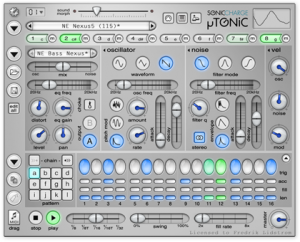
Sonic Charge has released µTonic 3.0, an updated version of its virtual drum machine instrument for Windows and Mac.
It’s the first major update to µTonic in five years. µTonic users will find more than 20 new features, though, and an updated user interface. It’s free for registered users, too!
Details below.
Here’s what’s new in µTonic:
- A morph slider allows you to interpolate all eight drum patches simultaneously between two end-points. You can edit the drum patches with the morph slider at any position and it will adjust the interpolation end-points accordingly. Morph is an automatable and MIDI controllable parameter, so it can be used both as a performance parameter as well as an editing feature.
- Matrix editor window for viewing and editing the pattern steps of all eight drum channels simultaneously. (Bonus feature: you can drag channel labels to reorder the drum channels of the preset.)
- MIDI Program Change message support for instantaneously switching between up to 16 different presets (loaded into memory). (It is also possible to switch programs with MIDI notes.)
- Drag and drop patterns as MIDI files directly into your sequencer (supported by all major hosts).
- “Edit All Channels” button enables adjusting parameters for all drum channels simultaneously. E.g. turn up the distortion on all channels. µTonic will write parameter automation for all affected channels, so the effect can be automated.
- A new “choke group” feature lets you assign two or more channels that should play mutually exclusively and cut each other off. Useful for closed and open hi-hats for example.
- A preset name display sits in the top of the window, with previous and next preset buttons and a popup list when you click the display.
- Support for MIDI Pitch Wheel for real-time pitch transposition with a range of up to 2 octaves.
- A new “Stop Voices with MIDI Note Off” option makes it possible to sustain the sound while you hold down MIDI keys (if you use µTonic as a synth). It is also useful for changing the length of drum sounds with note lengths in your sequencer.
- Alternative “pattern launch modes”: “Switch Next” (the behavior in earlier versions of µTonic), “Switch Directly”, “Retrigger” and “Retrigger Gated”.
- Undo / redo.
- Shift-click menu buttons to quickly repeat last selected menu item.
- New 3D-rendered skin. Sharper, brighter, sexier with 32-bit graphics. (Yes, µTonic version 2.0 was using 20th century 16-bit RGB graphics still).
- Lots more, details here.
µTonic for PC and Mac (VST/AU) is available for US $99. Registered customers can update for free.
Maestro W-2 – Sound System For Woodwinds
This is demo of the W-2, as used by Kraftwerk, Van Der Graaf Generator, The Mothers, Wayne Shorter, and MANY other greats! The delay is added (for effect). NOTE: The high-end digital noise (aliasing) in the audio seems to be an anomaly of the video compression.
Via superfroe
35 Q119 Analog Sequencer Showcase
This is a showcase of the synthesizers.com Q119 analog sequencer. Analog sequencers are fun and useful, especially if they are as capable as this one with quite a few different options for modulations. I show how to use the different outputs of the sequencer for different purposes and how to use the clock input for speed manipulation. I also show a “secret” mode!
More rumors and gossip on the new KORG KRONOS
Just thought I should share some rumors and gossip around the new release from KORG – the Kronos
KRONOS stands for:
K – Korg, Karma?
R – Realtime, Reactive, Recordable, …?
O – Open, Open-ended, Organic,
N – Next, …?
O – ?
S – Synthesizer, System, Station …?
or perhaps: Korg Realtime Oscillator Navigation Operating System as Jack suggests
Some claim:
>> it is quite logical that KORG would release something to compete with the Motif XF
>> If the images and other leaked details are accurate, what we have here seems to be either a scaled down Oasys or a some kind of new Wave Station?
What does it sound like?
>>
I suspect the audio background was generated by the Kronos. I hear synth sounds and drums.
And what is all this talk about the Ketron?
Has to be none other than the Ketron Audya. The prototype was on the road for years before people could actually buy one, and even now it’s still plagued with problems and is still far from being unfinished. The lenght of time it took to come to the market caused a lot of heated debates online. Not to mention the lenght of time Ketron were trying to bring out OS 4.0, and then delayed the PCM launch by telling lies saying it was done, but didn’t have the means to upload it. ..he..he..
Or why not this one?
Radias successor?
Wonder if it’s anything like the Nucleus.
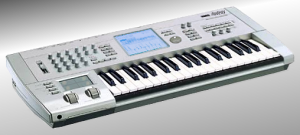
And….
What could the 9 mean? The number of waves? Number of synths? Number of voices? The word “workstation” is being thrown around a lot.
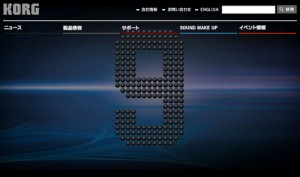
Perhaps McHale is on the right track here stating:
KRONOS is a 32 voice MOSS VA with real analog filters. They also included all of the wavestation functionality into it as well…
Anyhow January 13th is the day to keep in mind 
17 000 USD for a Fairlight, come on…
Got some spare cash? Well then this one might be for you
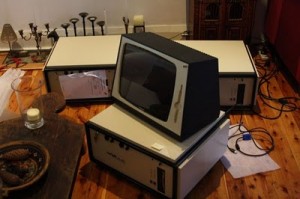
Peter Vogel and the Fairlight Family are proud to announce the arrival of the first CMI-30A. Our new baby has already left the nest and is currently winging its way to the US in readiness for a first performance at NAMM. Its parents are recovering well and are looking forward to receiving visitors in the near future.
Here are a couple of early pics, but more baby photos and recordings of first words will be posted in time. We thank our friends and loved ones for their support during the gestation period.
Happy New Year and Happy Fairlight!
The first CMI since 1989. Awaiting transport to US for NAMM
All packed and ready to go on 31st Dec 2010 with Peter Wielk (left) and Peter Vogel (right).”
DATAMASKIN

