
MIDI Breakout Box Version 1.5 demo
This is a demo of the MIDI Breakout Box app version 1.5 which allows MIDI channels to be routed and transposed using an iPad. See our website at http://www.vinclaro.com.au/ios/midibreakoutbox/default.html for more info.

The MIDI Breakout Box allows you to:
- Route MIDI input to one or more different channels
- Transpose input up or down in pitch before sending it to the output channels
- Change instrument presets, volume and stereo panning on output channels
Selecting the Input Channel
The input selection panel is at the top of the screen. Touch the channel from which you would like the MIDI input to be received
Tip: For best results set your music keyboard to “Local OFF” mode to prevent the notes on the keyboard from sounding when you play them, so that the only sound is transmitted from the MIDI Breakout Box app. This will allow the full range of 16 channels to be available without interference.
Selecting Output Channels
There are 16 switches down the left side of the screen. Turn a switch to the “ON” position to allow MIDI output to that channel.
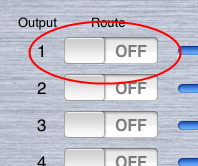
The “All On/Off” button underneath the switch for channel #16 allows all channels to be turned on or off simultaneously.
Setting Output Volume and Pan
Use the Volume and Pan controls for each channel by moving the Slider controls
The sliders below channel #16 can be used to adjust all channels simultaneously.
Setting Instrument Presets
Touch inside the “Bank” and “Preset” text fields to enter numbers. The touch Keyboard will appear to assist in data entry:
The values you enter must be a number from 0 to 127. Instrument presets are generally provided by the MIDI device manufacturer and many devices today confirm to the General MIDI specification.
Touch the green “Update” button at the bottom of the Bank/Prog list to send the new instrument settings to the MIDI device. Settings will not be applied until you touch this button!
Tip: Some MIDI manufacturers label their presets as starting from instrument #1. MIDI Breakout Box uses the raw MIDI value so it may be necessary to subtract 1 so that the preset list is 0-based.
Transpose
MIDI Breakout Box can transpose the MIDI input in real time. Enter a value in the “Transpose” field next to each channel.
This value can be a positive or negative number corresponding to the number of semitones by which to adjust the input. For example, setting the Transpose value to “12” will output a note that is one octave higher than the note value played. Setting Transpose to “-12” will output a note that is one octave lower.
Transposing will happen immediately as you type values into the fields. Use the “INIT” button under channel #16 to reset the Transposition of all channels back to 0:
Other MIDI Controls
Use the buttons at the bottom of the screen to send MIDI control messages to the connected MIDI devices.
These are:
- GM Reset – Performs a “General MIDI Initialization”
- GS Reset – Performs a “GS Initialization”
- Ctrl Reset – Resets all MIDI controllers to their default values.
Synth Party
Experimental Synth shared this video of us and judging by the gear we sure hope to get invited next year.
If it’s not fun, it’s not music. -Chris Stack
Sneak preview of the “Compassion” plug-in
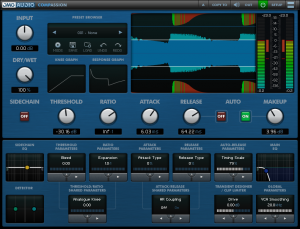
DMGAudio has sent us a little sneak preview of their latest plug-in called “Compassion.” Judging from the name and and images showing off the various parameters, it appears to be a compressor of some kind.
Check out their official Dev blog for updates as they happen at http://blog.dmgaudio.com/
Testing ReBirth – Propellerheads drum machine on iPhone
Testing rebirth iphone version in box the original rebirth … lol rss
Buchla Random Ambient #1
A variation on the patch used for Buchla Rhythm Study-3c only all the voltage controls are slower and longer. all self-generating except for a few times where I tweak the eg (281e). oh yeah, a ton of reverb. for a higher resolution audio track go to: soundcloud.com/user7621213/buchla-random-ambience-1
Shared by todd barton
Circuit Bent Roland TR 505 Drum Machine
I just bent this Roland TR-505 with a 55 point patchbay for some really weird sound modulations and sequencer glitches, a pitch knob, distortion and feedback distortion.
Right know I am building a new case for this to make it look a little betterIf you’re interested in this, feel free to contact me. I’m planning to use this as a prototype and build a few more of it.

New professional Online Mastering service

Loopbased has announced the launch of its professional Online Mastering service.
We all know the situation. You’ve just finished your next hit but the mixdown still sounds a bit flat and is clearly missing the proper loudness and dynamics.
Since we already provide everything you need to get started, inspired and to create a great-sounding track we figured it is only logical to offer a solution to give your songs the finishing touch.
With the Loopbased Online Mastering service we are catering to dance music producers and labels looking for that professional treatment and the clean, full and warm sound for an insanely low price.
Loopbased Online Mastering
- “Mastering Single” – perfect for one or more songs
- “Mastering EP” – a discounted package for 5 songs
- “Mastering Album” – a discounted package for 12 songs
Prices for the online mastering service start at 12 EUR per song.
More information: Loopbased / Online Mastering
A reconstruction [RECON] of John Cage’s infamous 4’33” (silence)
A reconstruction [RECON] of John Cage’s infamous 4’33” (silence) using 68 amateur and professional performances sourced from YouTube.
Featured on Rhizome.org: rhizome.org/editorial/3747
In this film (and others) I am interested specifically in the idea of folk art. Although the term “folk” when applied to art and music has been reduced to a genre in recent times, it was originally used to talk about songs and artforms that belonged to the people (to the volk). For instance, before the music industry territorialized folk as a “genre” of music (to help with categorizing music into sellable units) folk music referred to songs which “ordinary” or “everyday” people would sit around and sing together (at parties, at celebrations, etc.). What interests me is that particular avant-garde works which up until a few years ago would never have been seen by the general population have suddenly become “folk” works – they are being remade and revisioned by large numbers of people, many of them who do not claim to be “artists.” In a sense these works deterritorialize the category of “high-art” and reclaim these works for the people (as “folk” art).
Other RECONS:
Andy Warhol Eats a Hamburger: vimeo.com/14317171
Death of the Author (Psycho Shower Scene): vimeo.com/14235738
RECON Animated GIF Project: recons.tumblr.com/
ZynAddSubFX Demonstration – Wild Cat in Space
This was my entry to the 26th One Synth Challenge – ZynAddSubFX
One Synth Challenge Web Site:
http://sites.google.com/site/kvrosc/osc-26-zynaddsubfx
ZynAddSubFX was originally developed on Linux by Paul Nasca
All the sounds come from the new VST version (ported to the VST platform by me – Vlad Ionescu a.k.a. VDX, using the original 2.4.1 linux codebase).
To make this video I used
ZynAddSubFX VST v2.4.1.475beta
available for download here:
http://www.kvraudio.com/forum/viewtopic.php?t=268277
The patches used are available here:
http://www.mediafire.com/file/zl26kcsico4zoxc/One_Synth_Challenge_VDX.zip
The melody can be downloaded here:
http://www.mediafire.com/file/c09332dpy4695ei/VDX%20-%20Wild%20Cat%20in%20Spa…
The Far and Brilliant Night
Music and photomontage by Michael McNabb
Photography by Egon Dubois
The Far and Brilliant Night explores the psychological power of combined aural and visual symbolism. Perhaps there are certain classes of sounds and images which are imprinted on our genetic memories, or which exist in our collective unconscious. They may stir within us memories from ancient times, from before our birth, or even from before the origin of our species. But far from creating a universal experience, the primitive and deep associations that these sounds and images invoke may clash with or intensify each individual’s current emotions, thoughts, and anxieties, creating a unique and unpredictable experience for each person.
The Far and Brilliant Night in its current version premiered at a concert held in conjunction with the 1992 International Computer Music Conference in San Jose, California. Other performances include the International Symposium on Electronic Art in Montreal, the Quandt Foundation Transatlantic Conference, and the Northwest Electroacoustic Music Festival.
In these performances the Lightning was performed by percussionist Mark Goldstein. Designed by synthesizer pioneer Don Buchla, the Lightning is a specialized controller that senses the movement of hands in space and transforms this information into MIDI signals for control of electronic musical instrumentation. The device senses a wide range of movements including conducting, percussion, and dance. Its primary function in this work is to perform changes in the parameters of real-time computer algorithms. The algorithms in turn control signal processing routines that transform triggered digital recordings and live vocal sounds into expressive music.
DATAMASKIN

