
Punch – virtual drum synthesis and sampler featuring built-in samples and groove sequencers
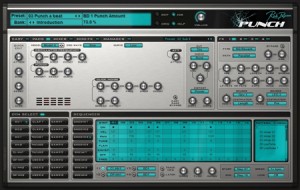
Later on this Spring, Rob Papen will be releasing Punch (Mac / Win), a virtual drum synthesis and sampler instrument featuring built-in samples and groove sequencers.
According to Rob Papen, Punch is one heck of a “speaker busting, body rattling software instrument.” The Punch plugin is said to deliver synthesized drums in the finest audio quality, with “breathtaking” features for the contemporary producer.
With the new plugin, you can can create your own sounds, use the included samples, or build your own unique sounding drum-kit. You can also load your own samples into Punch to complete your kit.
Punch boasts built-in sequencers, which give you instant access to multiple patterns. According to the maker, these grooves can be triggered in a live environment to build a song, as well as be used for improve and jam sessions.
What’s in the Punch:
- Drums
- 2 Bass Drum with 4 different models and built-in 4 classic samples and 19 punch samples
- 2 Snare Drum with 2 different models and build in 4 classic samples 61 built-in punch samples
- 2 Open Hi-hat and 2 Closed Hi-hat, with 3 models and build in 4 classic samples and 7 built-in samples
- 3 Tom / User with 2 Tom models and 8 built-in Tom samples (classic / punch)
- 2 Claps with 3 models, and 13 built-in samples
- 3 User Drum, with 9 models and 37 samples
- 8 Dual Sample slot, each with there own amp / pitch envelopes and filter and filter envelope
- Each drum has its own “easy controls,” distortion (20 different models), output destination (to dry or any of the 4 FX channels), and choke groups
- Each drum can be preview and selected by clicking in the Drum Preview Pad
- Classic samples are samples taken from several classic analog drum machines and punch samples are RP library samples
- Sequencer Patterns (4x groove and 4x breaks)
- Punch has its own internal sequencer that can play 8 different patterns of up to 16 steps long
- 4 Grooves and 4 Break patterns
- Each pattern is composed of 4 tracks, each track having its own drum output, and each step in each track can have different velocity, panning, pitch, envelope speed, flaming, time offset, and free row
- Each pattern also has free row for modulation step values which can be used to modulate controls
- Swing amount, flaming time, and humanization controls
- Modulators: Punch has 2 envelopes, 2 LFOs, and 8 modulation slots, which allow you to use a wide variety of modulation sources to control Punch’s controls
- Mixer: A full screen shows the volume and panning of all the controls, plus the FX mix and panning allows you to easily mix the drum sounds
- Easy Screen: Easy to use sliders allow to alter the main controls on the fly during use
- Effects: 4 FXs, each with 26 different type of FX (delays, reverbs, chorus, filter, distortions, and so forth), which can arrange in 5 different ways. In the multi-channel version of Punch, these FX are output to the different output channels
- Manager Screen: Big manager screen shows you all the presets, banks, and presets; allows you to load, save, copy and paste, and so forth
Rob Papen plans on releasing Punch (AU / VST / RTAS) by the end of May, 2011. For more details, visit robpapen.com.
Roland Octapad SPD-30 demo
Like the kings and queens of pre-annexation Hawai’i (‘sup, Sarah Vowell), the Roland Octapad SPD-30 has a long and storied lineage. Building on the successful design of the SPD-20, the newest Octapad adds better triggers, more sounds, a nicer user interface, and a fairly flexibly built-in phrase looper.
The majority of this demo is devoted to an examination of the Looper functions on the Roland SPD-30, during which non-drummer Owen O’Malley bravely attempts to lay down a 3/4 groove inspired by the world music he never listens to. If you like this video demo, you’ll love Owen’s solo album Ragas in the Key of White Guy.
Moby and his obsession with Drum Machines
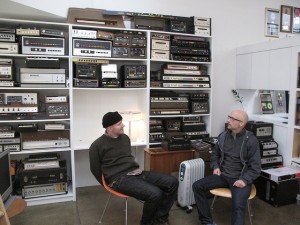
Excerpt:
Rick Moody: So when you say you obsessively collect drum machines, just how obsessively do you mean?
Moby: There are seven billion people on the planet, and I realize I will never ever be the best at anything. But I can potentially have the world’s largest collection of drum machines. So when I say obsessively, it’s obsession with a purpose. Ultimately, I want to have one of every drum machine made up until 1982. After 1982, they became more digital, and I sort of lose interest. But the old analog ones, I have always loved them.
Moody: What would the last one be, in 1982, the Roland 808?
Moby: The end point would be the very early digital drum machines, like the Linn Drum. So I collect the early digital ones like the DMX, which is an early hip-hop drum machine, and the 808 and the 909, but then, after that, the digital drum machines started to get a little too fancy, and a little too slick.
Moody: So when you collect all these things is it with the intention of actually using them in your own work or is this a collection just for the sake of a collection?
Moby: I love to use them in my own music. The great thing about a drum machine is that you just kind of turn it on, and it does quite a lot of the work for you. But the old drum machines were never that good. The drum machines post-1982, 1983, actually sort of tried to sound like drummers. But what I liked about the old drum machines is that they never sounded like a drummer, they sounded like a drum machine.
In the sixties and seventies, drum machines were just compared to other drum machines, they weren’t compared to real drummers. And they were never supposed to replace a real drummer. And then, in the eighties, with digital technology they could actually have drum programs that in a crummy sort of way tried to sound like a real drummer. That’s when I lost interest. I liked them when they sounded more synthetic and electronic. Also, nowadays, a lot of electronic music is produced exclusively on the computer, so there’s no physical sound production. So no one makes drum machines anymore.
I’m almost a custodian of these old drum machines that have been in church basements and lounges at Marriott hotels, somewhere in New Jersey. And a lot of them have notes written on them, like this one, I don’t know if it works or not, but someone at some point put masking tape on it, with a little note to himself. This one, down here, see, someone again, someone wrote their own little codes in pencil. Samba, here, they put a red X there, and wrote a note that says, “No.” Clearly, whoever it was hated the samba?
Upcoming release by Brian Eno on Warp

4th of July Warp Records will release a new album by Brian Eno called Drums Between The Bells.
Brian Eno – glitch (taken from Drums Between The Bells) by Warp Records
Brian Eno first came across the work of Rick Holland in the late 90’s during the Map-Making project; a series of collaborative works between students of the Royal College, the Guildhall School of Music, the Royal Academy of Music, the Royal College of Music, the National Youth Orchestra and the English National Ballet, among others.
In 2003, Brian and Rick made their first music together (the resulting work does not appear on this album). In the intervening time since that initial session they have met infrequently to work on new compositions.In early 2011, following the release of ‘Small Craft on a Milk Sea’ (Brian’s debut album for Warp Records), the pair resolved to finish the project. ‘Drums Between the Bells’ is the result.
IAMX – Ghosts Of Utopia official video re-edit
Slightly re-edited and higher quality version of the official Ghosts Of Utopia video.
Credits:
Directed and edited by Chris Corner
Camera – Chris Corner, Janine Gezang, Alberto Alvarez
Assistance – Janine Gezang, Alberto Alvarez, Caroline Weber
Purchase the video at www.iamx.eu/special.html
DigiEnsemble – “St. Anna” for iPod, iPad & iPhone
The DigiEnsemble Berlin is an experimental study group founded and led by Matthias Krebs that follows a systematic approach to playing on mobile devices (iphone, ipad & co). Regular meetings are held for group practice as well as discussion and refinement of the approach.
If you would like to join us for the ensemble or would like to have more first hand information, please contact us at [info(at) digiensemble.de]
Coagula MIDI Ribbon Controller 2.0
DIY MIDI Ribbon Controller with Arduino, new version. Details on www.coagula.org.
A few months ago I published a post on how to make a MIDI Ribbon Controller with Arduino. In the meantime I had a few ideas to improve both hardware and software and also felt the need to change many parameters without having to reprogram every time Arduino. Finally I placed the controller in a case, thanks to Laura who built it. So this is version 2.0 of my MIDI Ribbon Controller, which finally becomes a much more practical tool.
NOTE: I am not an electronics expert so if you decide to implement this project I am not responsible for any damage to computers, houses, people and animals that may arise . I do not exclude that there are some errors in this article, eventually I will try to correct.
This is the componens list:
* Arduino UNO
* Spectra Symbol Ribbon sensor 50cm
* Interlink Ribbon pressure sensor 60cm
* 6 10khom resistors
* 1 220 hom resistor
* 1 megahom resistor
* 1 female MIDI DIN-5 connector
* 1 stripboard
* 1 LCD Hitachi HD44780 compatible 20×4 (but you can use a 16×2 version if you modify the code. I suggest to search on Ebay for some cheap model)
* 4 buttons
* 1 switch for the power
* wires
* breakaway headers
* 1 case
Music video: Austra – Beat and the Pulse
AUSTRA “Beat and the Pulse” by domino
Austra – Beat and the Pulse
‘Beat and the Pulse’ is the lead single from Austra’s debut album ‘Feel It Break’, out on Domino May 16/17 EU/NA.
Directed by Claire Edmondson
Kenny Larkin & Novation Launchpad
Kenny Larkin talks to Novation about how Launchpad forms the heart of his Ableton Live setup on stage and in the studio.
Voice of Saturn Synth II Prototype
Here’s what they have to say about it:
I’ve implemented 3 of the possible 6 oscillators on this one (though the old sequencer case I used will hold 5). The circuit is based around a schmitt trigger oscillator. Super simple, and easy to make a lot of them. Sorry for the horrible video quality. Just finished it and wanted to get a quick demo done. Hopefully circuitboards will be tested and available sometime this summer. I will likely do a Kickstarter campaign to fund the first run. Keep an eye out!
DATAMASKIN

