
Nitzer Ebb & Die Krupps – Blood Money video
http://youtu.be/KfZDgARG9fI
New video with Nitzer Ebb and Die Krupps. Read our interview with Nitzer Ebb here, that we made some weeks back.
Reason CV to MIDI to Oberheim Xpander
Reason MIDI Sequence routed as CV over Audio to an Oberheim Xpander. The Xpander is a six-voice desktop version of the Matrix 12 with which it shares an identical voice architecture. In many ways they are the most flexible non-modular analog synths ever built. Each voice has five LFOs, each with about five different wave shapes, plus the ability to sample most other modulators; five envelopes that can repeat themselves, sync to an LFO, and so on; a lag processor (like portamento, but more general); three tracking generators (that apply a series of linear functions to a value over its range); some ramp generators (the attack portion of an envelope); a 15-mode filter and a user interface to make all of this accessible.
This is kludgey. Here’s the data patch:
1. Reason MIDI Sequence to a Thor
2. Thor Converts MIDI to Control Voltage Note and Gate signals.
3. CV Note/Gate are converted to Audio Signals and routed to Hardware interface audio outputs.
4. Audio Outputs are directed to Soundflower
5. CV as Audio routed through Soundflower into MaxMSP
6. MaxMSP converts CV as Audio to MIDI
7. MIDI directed to a hardware port on a Novation controller
8. MIDI cable to the Oberheim Xpander
9. You cut a hole in the box
Because this configuration does not use Rewire, Audio from the Xpander can be recorded back into Reason. There is, however, a considerable amount of latency.
Absynth version of Aphex Twin’s “Rhubarb”
http://youtu.be/exsuWe6Beds
ABSYNTH 5 is an exceptional synthesizer with unique sonic potential and 1,800 preset sounds. Its speciality is a limitless spectrum of unusual, evolving sounds created using the powerful, hybrid synthesis architecture and sophisticated modulation and effect system – resulting in sounds far removed from the everyday. What’s more ABSYNTH 5 is not just a synthesizer, but a powerful effect plug-in for treating audio tracks using the unique ABSYNTH 5 effects bank.
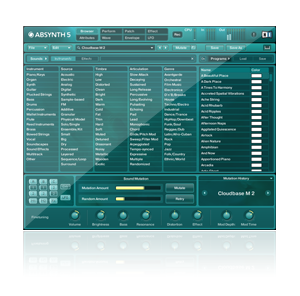
ABSYNTH 5 is unrivalled as a tool for creating unique sounds. The hybrid architecture features three oscillator channels and a semi-modular signal flow combined with diverse sound generating methods such as subtractive synthesis, FM, wave-table, granular sampling, and sampling with wave-morphing, filters, modulators and effects. In addition, a uniquely flexible envelope control with 68-stage envelopes allows for sounds to be subtly or radically animated. From softly undulating pads to aggressive rhythmic synth attacks – everything is possible with ABSYNTH 5.
In this video:
My Absynth version of Aphex Twin’s “Rhubarb ” from Selected Ambient Works Vol. 2.
How to Play Hip Hop Beats for Drums – tutorials
Although I do not personally enjoy hip hop that much, which is a gross understatement by the way, there are some great tutorials on how to create effective drum beats and I guess it is up to you if you prefer to use these tips in any other music genre 
In this video:
Starting on the high hat symbol, then combining bass drum and snare drum rhythms, this drummer demonstrates how to build a hip hop groove in 15 minutes. Create a hip hop groove with the drum beats in this free video on hip hop drumming from a professional drummer.
Expert: Ryan Larson
Bio: Ryan Larson is a young jazz composer whose teaching technique focuses on the basics of music theory in all twelve keys.
Filmmaker: Christian Munoz-Donoso
Depressive Disorder release video prior to new EP
http://youtu.be/GBXArN-FVNY
The brand new video and single from the Czech electro act Depressive Disorder. The new song is accompanied by the pictures taken from the upcoming live DVD.
The new EP will be released on May 30th on Czech Monpolrecords label in limited edition. The edited visual footage to the video was shot at the beginning of May at the gig in Brno where the whole concert was professionally recorded and will be released this autumn as the first official live DVD of Depressive Disorder.
Depressive Disorder have been around for ten years now. They have released 4 LPs, including the great “Chronicle of Fear” album in 2009. They are the only current dark electro band from the Czech Republic that can be heard on gigs and releases abroad.
At the end of 2009 the band experienced a personal earthquake when one of the founding members (and actually a half of the band) Radim Cap (keys, programming, production) left the project. However, the remaining member Patrik Lev (vocal, lyrics, programming) decided not to let the band die and put together a whole new lineup consisted of VeNa (keyboards, programming, pads), head of the now suspended EBM classic No Name Desire from Prague, and Ez on guitar. After several successful gigs e.g. with Rabia Sorda, In Strict Confidence or KMFDM, attracted by the fresh feel and drive of the band, Radim decided to join Depressive Disorder again.
In the making of a mega synthesizer
Bugaboo is in the process of building a massive synth and here’s a status update. 5 days into building my mega synth with little sleep and lots of coffee. Just tested the FX section which is working well after a few rounds of debugging. The large wooden case in the background is what it will all be housed in. Lots more work to do!
House on the Roland TR707
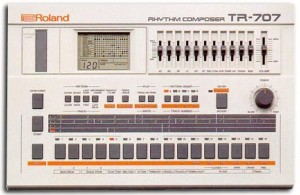
The TR-707 is a great source for cheap 909 samples. It has some other cool features too such as its Matrix display which clearly maps out your pattern for you in an easy to read display panel. It also features both MIDI in/out and DIN sync control – the best of both worlds. Why this unit even has individual outputs for each of its drum tones! For programming, it features a shuffle and flam effect and its programming abilities are very impressive. But it does have its limitations, the only adjustment you can make to each drum tone is volume.
In this video:
This time, tributing early house tracks of 1986-1987 era, based on the Roland TR707 drummachine.. As always, all tracks selected and recreated by ear. None of the original tracks were sampled.
All TR-707 & additional TR-727 and TR-808 beats were rebuilt on a Korg Electribe SX sampler (no stock sounds). Basses and some synth parts were loosely remade with my analog synths (see below).
Tracklist:
Rick Astley – Never gonna give you up (707, 727)
Michael McDonald – Sweet Freedom (707, 727)
Taylor Dayne – Tell it to my Heart (house mix) (707, 808)
Mr Fingers (Larry Heard) – Washing Machine
Rick & Lisa – When you gonna (707, 808)
Jungle Wonz – The Jungle
Wired – To the Beat of the Drum (707, 808)
Marshall Jefferson – Move your Body
Phuture – Your only Friend
Joe Smooth – Promised Land (707, 727)
Similar beats are for sale @ www.zenhiser.com/1980 series.
Synthesizers used:
Sequential Prophet VS (pads), Moog Source (most basses), Roland Juno 60 (Mr Fingers, Wired, Phuture), Roland S10 sampler (M1 piano), Korg Polysix (Promised Land), Yamaha DX200 (When you gonna), SCI Pro One (Wired bass)
KORG SyncKontrol for monotribe [iPhone App]
KORG SyncKontrol for Monotribe is an iPhone application that lets you dial in a tempo and output a sync signal to control the Monotribe, they’ll let you dial in a tempo, tap in a tempo and add swing. Korg SyncKontrol also supports wireless syncing, demonstrated about a minute into the demo video above.
Based on what Korg SyncKontrol appears to be doing, it looks like you may also be able to use it to trigger other analog devices that can be triggered with audio, like the Sequential Circuits Pro One.
EISENFUNK – PENTAFUNK
Really cool video
“The first video of our upcoming LP “PENTAFUNK”. Worldwide release is at August, 12th 2011.”
Sound Sculptures & Installations
Zimoun : Sound Sculptures & Installations
Compilation Video V2.8 / Last update: May 27, 2011
«The sound sculptures and installations of Zimoun are graceful, mechanized works of playful poetry, their structural simplicity opens like an industrial bloom to reveal a complex and intricate series of relationships, an ongoing interplay between the «artificial» and the «organic». It‘s an artistic research of simple and elegant systems to generate and study complex behaviors in sound and motion. Zimoun creates sound pieces from basic components, often using multiples of the same prepared mechanical elements to examine the creation and degeneration of patterns.» Tim Beck
«It is a poetic and humorous absurdity we find in Zimoun’s work, which opens up a wide, refreshing and enriching space for discoveries, associations and a multitude of approaches.» Nina Terry
«Zimoun is best compared to a watchmaker of a self-reproducing time constructing his own gauging station.» Radjo Monk
«The clean, elegant sound sculptures combine visual, sonic, and spatial elements in an organically balanced entirely artwork. Using simple and well- conceived mechanical systems, Zimouns‘s work transforms and activates the space.» Jury Prix Ars Electronica 2010
«Zimoun creates complex kinetic sound sculptures by arranging industrially produced parts according to seemingly simple rules. Using motors, wires, ventilators, etc.., he creates closed systems that develop their own behavior and rules similarly to artificial creatures. Once running, they are left to themselves and go through an indeterminable process of (de)generation.
These quasi autonomous creatures exist in an absolutely synthetic sphere of lifeless matter. However, within the precise, determinist systems creative categorioes suddenly reappear, such as deviation, refusal and transcience out of which complex patterns of behavior evolve.» Node10
«I perceive Zimoun’s work as a unique, playful, light-hearted, and utterly complex approach and examination of the present.» Tom Gray
«The components used in Zimoun’s work are simple, functional and raw, whereas only aesthetically high-level and purposefully chosen elements and materials are used in minimalist fashion. Through radical reduction, Zimoun creates works of art which allow for a plethora of associations without being pinned down to a specific direction. Radical abstraction functions rather like a code in the background of things, thus elegantly avoiding an insinuation of direct, concrete attribution. Thanks to the abundance of mechanical activity, the range of perception, possibilities and interpretations is wide open.» Amanda Neumann
«Indeed, one of the refreshing elements of this work is the immediacy with which one can understand the sound-making process, where each micro-event is present, visible, and concrete. Yet at the same time the resulting complexity of the total system, conjured before your eyes, defies any attempt to dissect it. You might find yourself feeling there is a «prime mover» at work behind the scenes, but in fact it is just the characteristic reaction of materials behaving together and in unison with the space of their activity. A magic of the real.» Xymara
«Minimal yet complex, monotonous yet varying constantly, these sound sculptures develop an uncanny strength.» Markus Spörndli
«Observing Zimoun’s work opens connections to nature and natural phenomena, physics, quantum mechanics, complexity, simplicity, vitality, individuality, evolvement and growth, but also to industrialization, robotics, mass production and social phenomena, to space, architecture, cosmic white noise, phantasms and highly enjoyable experiences popping up at any moment. Art is supposed to activate and focus our attention. Zimoun’s work seems to be a sweeping and beautiful example for this.» Anton Richter
«Zimoun’s primary instruments are entirely of his own making, each a large-scale installation of small mechanical devices — tables lined with whipping little bits of tubing, small sets of fetishistically situated mini- motors. They are architecturally precise and their beauty is forged by that precision. The meticulous engineering of Zimoun’s work is a set- up — not an end unto itself, but a staged step toward its end result, an orderly step enacted so as to let chaos flourish. His chaos takes place in close settings, in carefully defined spaces, in systems as thoroughly considered as a laboratory experiment. And the sound emited by them is not an after effect, or an afterthought. It’s a core principal of his practice.» Marc Weidenbaum
DATAMASKIN

