
More Synplant for the Reason Rack !
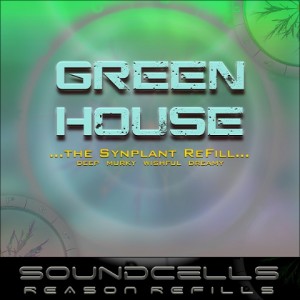
“Greenhouse v2” Contents:
• 159 combinator patches full of the typical and widely acclaimed Synplant character.
• 850 Synplant samples, 830 MB uncompressed.
“Red Token” tangible musical interface by Pixelh8
Here is a simple tangible musical interface programmed in Processing using a webcam and some gaming chips. The sounds are made from samples I made on a BBC Micro you can get them from my website at http://pixelh8.co.uk/ . I have always been a fan of of “I eat beats”and “Beat Machine” and many more at http://modin.yuri.at/tangibles/ and even though this is very similar to them, it was a good experience and good fun to make. Loads of people make chocolate cake and it’s still pretty good.
Commodore 64 Synthesizer Sessions (Free Sample Pack)
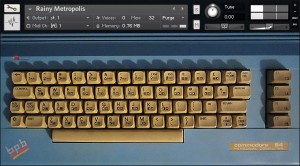
BPB’s Tomislav Zlatic has released a free sample library, Commodore 64 Synthesizer Sessions, that features classic C64 sounds:
I’ve released the first part of what will be the “Commodore 64 Synthesizer Sessions” free sample pack series. The sounds were created in the MSSIAH Mono Synthesizer running on my Commodore 64 with the SID 8580 chip installed. All samples are recorded and kept 100% dry for maximum authenticity.
The goal is to capture famous SID sounds, as well as some classic synth sounds you wouldn’t expect to hear coming from a Commodore 64. The first pack includes two classic lead sounds and one called Rainy Metropolis, inspired by Yamaha CS-80 sounds used by Vangelis in the Blade Runner opening sequence.
Listen to a preview below:
Details and download are available at BPB.
The Paradiso Synthesizer
In 1973, Media Lab associate professor Joe Paradiso was an undergraduate at Tufts University, and didn’t know anyone who had built an analog music synthesizer, or “synth,” from scratch.
It was a time, he says, when information and parts for do-it-yourself projects were scarce, and digital synthesizer production was on the rise. But, he decided to tackle the project — without any formal training — and sought out advice from local college professors, including his now-colleague in the Media Lab, Barry Vercoe. Paradiso gathered information from manufacturers’ data sheets and hobbyist magazines he found in public libraries. He taught himself basic electronics, scrounged for parts from surplus stores and spent a decade and a half building modules and hacking consumer keyboards to create the synth, which he completed in the 1980s.
That synthesizer, probably the world’s largest with more than 125 modules (http://web.media.mit.edu/~joep/modlist.html), is now on display in the MIT Museum.
Every few weeks, Paradiso changes the complex configurations of wires connecting the synthesizer’s modules, called “patches,” to create a new sonic environment. The synthesizer streams live online 24 hours a day at http://synth.media.mit.edu; starting this week, visitors to the synthesizer’s website can even change the patch parameters online.
Learn more about Paradiso’s synthesizer! http://web.media.mit.edu/~joep/synth.html
The Magnetic North – Rackwick
The debut single from the forthcoming album ‘Orkney: Symphony of The Magnetic North’.
http://www.facebook.com/themagneticnorth
http://www.twitter.com/magneticgonorth
http://www.symphonyofthemagneticnorth.com
Director/Editor/Animation: Tal Rosner
DOP: Adam Woodhall
Lighting Designer: Zoe Spurr
Stylist: Hannah Birchall
Make-up Artist: Portia Graham
Hair: Hiro Hirata
Grading: Sonny Sheridan at The Farm
Producer: Tal Rosner
With thanks to Jack Clough
Synchronization Of Metronomes
Synchronization of Five metronomes using beer cans 
Grendel Drone Commander Listening Test
A listening test – more or less, function per function – on the mighty Grendel Drone Commander.
With a total of 9 knobs, the Drone Commander offers two manually-tuned oscillators and two LFOs, plus an unusually colorful and nasty filter. LFO1 is an analog variable-shape oscillator, and LFO2 is a pulse waveform that auto-synchronizes to LFO1 at a ratio of 2x, 4x, 8x, or 16x. Both LFOs can be routed to the filter for rhythmic patterns. A line-level output jack is provided for connection to amplifiers or effects.
The sound samples on this page are recorded with one Drone Commander plugged straight into a Fender Princeton Chorus.
Six of the Drone Commander’s nine knobs double as push-pull switches to control signal routing and waveform selection. Scroll to the bottom of this page to view the control layout.
http://ericarcher.net/devices/drone-commander/
Shown with red panel / silver text / natural aluminum knobs.
Filter CV In & Clock Out.
Enclosed in a steel ammunition can with detachable lid.
New pad based controller: Traktor Kontrol F1 – Scratch Clips demo
Traktor Kontrol F1 is the definitive controller for the new Remix Decks™ in the included Traktor Pro 2.5 software. In stores May 30th, the F1 blurs the lines between DJing and live performance – the perfect addition to any Traktor-based setup.
Light up your DJ sets with 16 multi-color LED pads, and launch clips in a perfectly intuitive, DJ-centric way, switching between up to 64 tracks, loops and one-shot samples on each Remix Deck.
The second video in our series on different ways to use the F1 shows the Remix Decks working hand-in-hand with scratch techniques. Watch turntablist extraordinaire DJ Shiftee rock out with the multi-colored pads while old-school partisan Greg Nice has some fun on the mic.
Whatever your setup, Traktor Kontrol F1 puts your signature sound at your fingertips. Get ready to remix.
More info:
http://www.native-instruments.com/f1
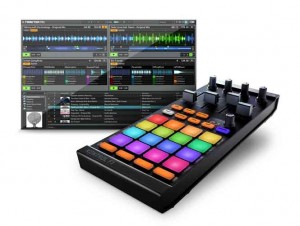
Native Instruments has announced TRAKTOR KONTROL F1, a pad-based, USB-powered hardware controller built to control the advanced Remix Decks™ in the included TRAKTOR PRO 2.5 software. TRAKTOR KONTROL F1 provides 16 multi-colored, touch-sensitive LED pads, an advanced global control section as well as an ergonomic mixer section including four volume faders and dedicated filter knobs. Designed specifically for DJing, NI says that the KONTROL F1 offers a DJ-centric workflow for launching clips in an intuitive way, allowing users to switch between up to 64 tracks, loops and one-shot samples on each deck.
TRAKTOR KONTROL F1 includes the full version of the TRAKTOR PRO 2.5 software, also available as a free update to all users of the TRAKTOR 2 generation. NI tells us that version 2.5 introduces the innovative Remix Decks, giving access to a powerful loop suite made up of 64 slots, each able to hold loops, one-shot samples or even tracks. DJs can control up to four Remix Decks at once and save their work as an entire Remix Set with its respective beat grids, BPM and key information in a new file format that can be comfortably imported into a track deck via TRAKTOR’s browser.
TRAKTOR KONTROL F1 was designed specifically to control the Remix Decks and provides full and tactile control over the new feature, benefiting from seamless bi-directional software-hardware integration and offering full visual feedback through the multi-colored LED pads. Advanced parameters such as Punch mode and FX assignment can also be comfortably changed from the KONTROL F1 and four smaller pads at the bottom of the matrix stop or mute a group of samples. Controlling Sync, Quantize, Sample Size, Reverse and other functionality, the comprehensive global section also features a push encoder to switch through the four pages of the 16 pads and offers a ‘Capture’ button, which allows DJs to grab samples from running tracks of each track deck within the TRAKTOR software, both before and during the actual DJ performance.
Each regular track deck within TRAKTOR PRO 2.5 can be switched to a Remix Deck, thus offering dedicated transport, sync and tempo master controls. This allows DJs to control an entire Remix Deck via Native Scratch timecode control with vinyl or CDs, or using the jog wheels of the KONTROL S4 and KONTROL S2 hardware.
TRAKTOR KONTROL F1 was designed to integrate perfectly into any TRAKTOR DJ setup. With the same form-factor as TRAKTOR KONTROL X1, KONTROL F1 fits neatly alongside standard DJ mixers and the all-in-one DJ systems TRAKTOR KONTROL S4 and S2. The TRAKTOR Bag provides reliable protection for the KONTROL F1 during transport, and also doubles as a solid stand, elevating the KONTROL F1 to standard mixer and turntable height.
Free Roland MC-202 Kick Drum Sample Pack By Robotik Audio
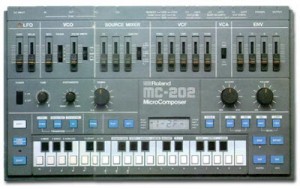
Robotik Audio has released a set of free kick drum samples recorded from the Roland MC-202 MicroComposer analog synthesizer.
The Roland MC-202 is capable – just like any other (monophonic) synth – of creating some very powerful kicks. Zeroing the oscillators using only a low freguency sine, resonance, envelope, ultra short attack, different decays and very little sustain and release. I’ve created my own little sample kit from it. The kit contains 26 dry WAV samples of the MC-202 with no normalizing or any eq’ing. Personally I really like the sound it produces so here you go.
The samples are available for free download via Robotik Audio.
This is an analog synthesizer/sequencer. It sounds very much like the TB-303 and SH-101 bass synths. Sometimes considered the “poor man’s 303”. It has a very evolved form of TB-303 like programming (more like the MC-4) and SH-101 like controls of the VCO, VCF, VCA, LFO, Envelope and Mixer sections. The LCD display is a great feature too.
The MC-202 was sort of a next-generation TB-303. So the idea was to program sequence/patterns into it internally which would give you those 303 basslines that we’ve come to love. But programming the MC-202 is a bit too intense and over done for the simple monophonic bass line. However you can control it externally by hooking up a MID-CV/Gate converter. Then you basically have yourself an SH-101!
The sequencer is actually a 2-channel CV/gate sequencer, with both channels being capable of driving a separate external synth. It’s a very useful unit, also, for its DINsync capabilities; it can receive on one port, and send over two, and also can ‘split’ DINsync to branch a sync signal out to multiple devices.
This machine is best for those who want to get 303-like patterns (it has accent just like the 303) and basslines with an SH-101 sound. If you can handle programming the notes into its sequencer you can have a lot of fun.
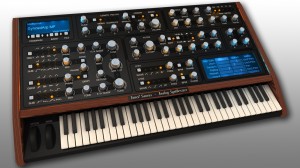
Will we see it live at MusikMesse next week – the Tone2 Saurus – Analog Synthesizer ??
This is all that is mentioned on their website:
“Tone2 Saurus will be available soon…”
DATAMASKIN

