
Review: Arturia MicroBrute – Pure Analog Monophonic Synthesizer
Alex from Sonic Sense Pro Audio demonstrates the new Arturia MicroBrute analog synthesizer.
MicroBrute is pure analog sonic powerhouse of a synth. Small in size but loaded with features, it follows in the footsteps laid by its big brother the MiniBrute.
Packed with mixable waveforms, a new sub oscillator design, the famous Steiner-Parker multimode filter, super fast envelope, syncable LFO and the new step sequencer, not to mention the patchable mod matrix the MicroBrute is a landmark new synth at an incredible price.
Modular Brain Food
A first experiment with MakeNoise Maths and the 5U modular synth.
Patch is basically;
West Coast Random Source (Sputnik) fluctuating random voltages to Maths input 4.
Slewed S&H of the same into the Maths input 1.
Stored random voltages to the Maths input 2.
STG Voltage Mini Store through Q171 quantizer into Maths input 3.
Maths 4 out into channel 1 Both.
Maths 1 out into channel 4 Both.
Maths Sum out into quantizer then Q106 VCO 1v/oct.
Maths EOR to ADSR for filter and vca.
VCO waveforms to Manhattan Analog cp3 mixer.
Mixer to STG Soundlabs Sea Devils filter.
Filter to Strymon Blue Sky then VCA.
Post mix includes Lexicon digital delays and TCE D-Two delay.
Three tracks in Cubase with adjustments to the Maths and octaves of the Q106 VCO.
Future Retro MondoVox
In this demo we go through some of the features of the Future Retro MondoVox with Korg’s most recent line of analog monosynths. The Mondovox turns these 3 MIDI capable monophonic synthesizers into a 3-voice, 8 oscillator polyphonic synthesizer with 4 independent filters!
The Mondovox takes polyphonic MIDI data and translates it to so that each voice is on its own MIDI channel. This allows for new ways to engage a spread of monophonic synthesizers or anything with MIDI! This can include multi-timbral, polyphonic, or virtual synthesizers.
Check out techno veteran Neil Landstrumm’s crucial hardware set up
UK magazine the FACT takes a tour in his studio to learn more on his 12 most important gear

Since the mid-1990s, the Scottish producer has been pushing a hardware-driven brand of burnt-out techno that’s seen him become an unintentional poster boy (to the so-called ‘wonky techno’ movement), alienate his fans (his last album for Tresor, 2001′s She Took A Bullet Meant for Me, is either sacrilege or a classic, depending on whom you ask) and explore grime and dubstep (mostly notably on Planet of Assassins and his other Planet Mu work) from an outsider perspective before it was the done thing. The most recent move in Landstrumm’s career sees him sidestep from Mu to Sneaker Social Club for a new album, Dragon Under.
To toast the album’s release on November 11, Neil makes a tour of his studio, detailing 12 of his most important pieces of gear and explaining the role that they played in Dragon Under – Full report here >>
Create your own modular synthesiser by programming Patchblocks
All you need is a Patchblock, a Mac or Windows PC and our free software. The software allows you to program your hardware module the way you want. This is done in a so called “visual programming language”, in other words, you don’t have to go into 100% geek mode and write code to make it happen. Visual programming is easy, you choose from a variety of low level sound processing elements and combine their functions by connecting them with virtual cables – a bit like a modular synthesiser, but in software. Your library of software modules includes signal generators and processors (e.g. oscillators, filters, delays etc.), signal routing options and even modules for algorithmic composition. Our editor lets you emulate how your patch will sound and once you’re happy with it you can upload it to your Patchblock hardware simply by connecting it via USB. Once programmed you can unplug the Patchblock and jam away.
Arturia Jupiter 8v multitrack: “The Elevator” – Alphaville cover
Here’s a multitrack using only the software synth Arturia Jupiter 8V, the recreation of the classic Roland synth. Only the drums and vocals are not Jupiter 8V.
The song is a cover of an old Alphaville song “The Elevator” or “The Nelson Highrise (Sector One: The Elevator). It’s the b-side of “Sounds Like A Melody” from 1984.
CV Suite Parametrix – new Rack Extension that lets you control any CV Input


Quadelectra has launched CV Suite Parametrix, a Rack Extension for Propellerhead Reason that lets you control any CV Input signal as if it was a parameter.
CV Suite Parametrix is the third “child” of our CV Suite Line series…
This is a simple straightforward and very handy device that will turn any CV Input in an automatable parameter.
CV Suite Parametrix features
- Four individual parameter to CV converters can be controlled per device.
- You can select whether each parameter will expand across bipolar or unipolar range…
- All parameters can be named by clicking to the label tapes next to the headings.
- An additional dedicated CV Modulation Input is provided per parameter, the range (trim knob) and the appliance of which you can set and automate too from the front panel.
The Rack Extension is available to purchase for 7.50 EUR.
Check out the new MacBeth Bomber – compact modular
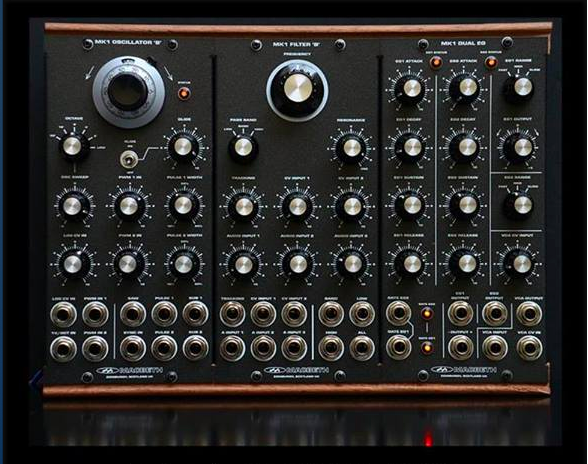
Ken MacBeth has introduced a new synth, the MacBeth Bomber, a ‘compact modular’ that sounds like a monster synth. Here’s what MacBeth has to say about this tiny beast:
I call this minimal 3 module Macbeth Mk1 synthesizer the Bomber! Specifically put together to Bomb that Bass!
The single Mk1 Oscillator ‘B’ gives you 1 x Sawtooth, 2 x Pulse Width (Square) Waveforms, 2 x Sub Octaves, one below the other whi…ch all go into the discrete Mk1 Filter ‘B’ – State Variable Filter that loves Overdrive! Gated and controlled by the Mk1 Dual EGs with built in Utility VCA.
As a modification- there is a Noise Generator normalized into Audio Input 3 on that Filter!
…and remember- this is just one Oscillator!
TR-808, Minimoog Voyager, Prophet ’08 et al.
Some old-school Electronica with classic machines. Played and edited live (with errors!)
Minimoog Voyager Project for Liine Lemur on iPad
This is a project for the Liine Lemur App on the iPad. It’s a control surface for the Minimoog Voyager.
DATAMASKIN

