
Time machine: Yamaha CS-50 Analog Synthesizer
All sounds from the 1976 Yamaha CS-50 !
The Yamaha CS-50 is the baby brother to the mighty CS-80. Actually it has almost exactly the same Voice cards as the CS-80. However the baby brother has only 4 Voice cards where the CS-80 has 16 ! Also the CS-50 is lacking the velocity polyphonic aftertouch keyboard so even though the core sound is similar the CS-80 has a more organic and dynamic sound because of the better keyboard. The Kenton MIDI gives the CS-50 the ability to play with MIDI velocity for example controlling the filter depth. Unfortunately you can´t assign MIDI aftertouch to the CS-50 Touch Response section but only to the modulation section.
All sounds coming from The mighty 1977 Yamaha CS-80 analog synthesizer.
The song is called Ode To The Holy Grail Part II composed by Firechild.
The CS-50 was released just ahead of its famous big brothers, the CS-60 and CS-80. The CS-50 looks like a scaled-down version of the monstrous CS-80, and it is! This will benefit those who crave the famous classic Yamaha synth sound without the struggle of lugging around the 215 pound CS-80! The CS-50 weighs in at about 100 pounds. The CS-50 is also just 4-voice polyphonic, and lacks the quality weighted 61-note keyboard of the CS-80. The CS-50 has just a 49-note standard keyboard. It does feature pressure (aftertouch) sensitivity route-able to several destinations, however.
The CS-50’s sound is unmistakably related to other classic CS-series synthesizers. At just four voices with one osc. per voice and lacking warm filters (at just 12dB/oct) the CS-50’s sound can be thin. There are 13 preset sounds of various instruments and synth sounds but, unfortunately, no on-board memory storage for your edited presets. At its low street price, the CS-50 makes a great way to get your hands on these classic sounds without going broke! It’s too bad their tuning is just as unstable as the other CS-series synths. It’s housed in a built-in travel-case like the other (big) CS-synths
YELLOFIER Remix Contest 2014. Win a car!
Electronic Beats by Telekom & Volkswagen present the Yellofier Remix Contest 2014.
Make music, win a car, check yellofier.com
Caustic 3 Essentials Pack 3 Demo
A sneak peek at what C3 E3 can do for your Caustic 3 tracks….. this one is HOT.
Storm 3003 – Fire Jam [Elektron Analog Four + Korg Volca Beats]
FIRE JAM
Live performance by Ciacci Simone a.k.a. “Storm 3003”
Select HD for a better experience!
Equipment for this video:
– Elektron Analog Four
– Korg Volca Beats
Check Out = “DARK JAM”:
http://youtu.be/7QDQoxOXmwA
NAMM teaser: Elektron mystery box opened
Elektron has released this sneak preview of what they are introducing at the 2014 NAMM Show. It’s just a teaser – but the layout looks a bit like the MachineDrum with a pad grid added, and the styling follows the OctaTrack, AnalogFour look.
New images: The new Moog Sub 37 paraphonic synth
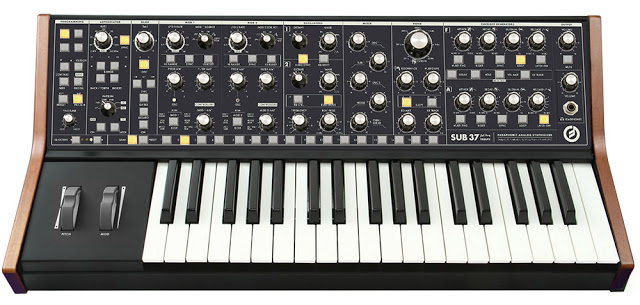
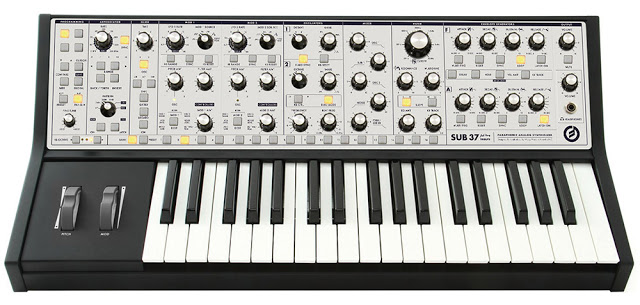
Via Moog’s Facebook page we get this message:
“…the new Moog synth is ‘2-note paraphonic’ — it can play two independent pitches from its two oscillators, in response to two keys played at once. Paraphonic still seemed less misleading than ‘Duophonic’ (to me) because of the single VCF, VCA, and their respective envelope generators. Although ultimately I had very little to do with what got written on the panel”
Paraphony is the property of an electronic musical instrument that can produce multiple notes or voices, but falls short of being truly polyphonic because the voices are not fully independent since they share at least one common element. For example, there might be just one single filter working on all voices collectively rather than the one filter per voice of truly polyphonic instruments; or there might be only one envelope generator.
One well-known paraphonic synth is the Korg Poly-800, which had 8 oscillators and could produce 8 voices (or 4 2-oscillator voices), but had just one filter.
NAMM teaser pic from Waldorf – soon we will know
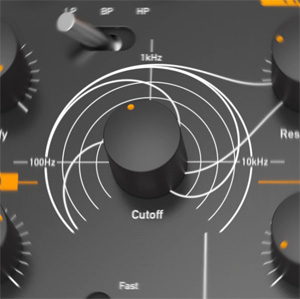
Waldorf posted this message yesterday:
“NAMM Show 2014, Here We Come! Cut-offWe just embarked on the bus from Waldorf to Anaheim, and we packed some exciting new products! If you are curious or just want to say hello, we would be happy to meet you on our booth #6009.”
Note the Cutoff knob. That’s not the Pulse 2 or the Rocket.
DJ/Producer Dave Clarke meets MiniBrute
The Techno legend welcomes Arturia in his boat studio in Amsterdam to tell you what he thinks about MiniBrute
About Clarke:
Educated at Brighton College, Clarke ran away from home at the age of 16 after his parents split up. After briefly sleeping rough, a friend offered him temporary accommodation. All that kept him going was his love for music, initially hip hop and post-punk (The Damned are a favourite of his to this day)and the money from his job in a shoe shop.His success as a DJ began with a residency at the Brighton nightclub Toppers.
In the late 1980s, Clarke used to write reviews for UK magazines such as Mixmag Update, Generator and ID, and was the first to review Aphex Twin.
In the 1990s, he began producing and releasing music using the moniker Hardcore. This project was subsequently licensed to the Belgian label R&S, enabling Clarke to be one of the first UK artists to record in the R&S studio in Ghent, and sign to the label.After this he recorded under various guises, including Graphite and Fly by Wire, but in 1993 he dropped these names and recorded only under Dave Clarke. Recognition of his talent came in 1994 when a series of EPs with the collective name of Red and his debut album Archive One received rave reviews, as they were seen as being innovative and crossing genres, something not common in the techno scene at the time.After the success of the Red series, John Peel gave Clarke his moniker, ‘The Baron of Techno’, which has stuck with him ever since.
Clarke’s sense of rhythm and DJ skills have earned him the respect of his peers – he is mentioned as an influence on the 1997 Daft Punk song “Teachers”. He has a longstanding relationship with visceral, intense techno, and is considered one of the innovators of the genre, even being used as a musical reference point in the German school syllabus.Clarke’s DJ style consists of virtuoso cutting and scratching during his predominantly techno sets (although he sometimes plays electro and even other genres). His style is showcased on two mix albums World Service and World Service 2; the former was voted #9 in the Resident Advisor poll of best mix albums of the 2000s. His album Devil’s Advocate, released in 2003, is a mixture of techno and hip hop featuring Chicks on Speed and DJ Rush. He also made an experimental John Peel Sessions EP under the name ‘Directional Force’ on the Strange Fruit label.
Clarke relocated to Amsterdam in 2008 and has become a key player in the annual Amsterdam dance event. He is a regular DJ presence at top global clubs such as Fabric in London, Berghain in Berlin, and Fuse in Brussels. He has also played a wide range of festivals including Glastonbury,Pukkelpop, and I Love Techno, as well as curating his own successful stage at Tomorrowland in Belgium since 2012.
The Knife – Wrap Your Arms Around Me
Animation by Martin Falck
http://www.martinfalck.se
Music taken from The Knife’s new album ‘Shaking The Habitual’, out now:
2x CD: http://smarturl.it/sth2cd – Digipack Includes cartoon by Liv Strömquist and a lyric poster by Studio SM/Martin Falck.
3x 12″ Vinyl: http://smarturl.it/sthvinyl – 180g heavyweight, gatefold edition with CD. Also includes the cartoon and lyric poster.
iTunes Download: http://smarturl.it/sthitunes – Includes an instant download of Full Of Fire and digital booklet.
All formats also available on the Rabid Records Store: http://www.rabidrecordsstore.com
ARP 2600 with 2 sequencers
The ARP 1601 sequencer controls VCO pitch
The Doepfer Dark Time modulates the ARP’s filter
The Doepfer Dark Energy provides some LFO action.
All sounds are live, unprocessed and from the ARP only.
A patch & setup pic can be viewed here:
http://djjondent.blogspot.com.au/2014…
DATAMASKIN

