
Moog Sub Phatty Behind the Scenes w/ Bernie Worrell (P-Funk)
Cyril Lance, Chief Engineer at Moog, talks us through some of the choices made behind the scenes on the design of the new Moog Sub Phatty, accompanied by Bernie Worrell of Parliament/P-Funk noodling on the Sub Phatty and Voyager.
More info: http://www.moogmusic.com/products/subphatty
Find a UK Dealer and pre-order: http://sourcedistribution.co.uk/dealers/area.asp?item=moog
Enjoy
Bleep Labs Thingamagoop modulated by Arduino with accellerometer
Reactive Music Experiment.
Accelerometer on springy stalk flashing led to modulate sound from Thingamagoop .
The Thingamagoops are really just simple, analog type synthesizers that you control in a different way. The Thingamagoops have oscillators just like any synth. On analog synths the oscillator that creates the actual tone you hear is called a VCO or voltage controlled oscillator. The Bleeps work a little differently so we’ll just call it the main oscillator. Instead of using a keyboard, the main oscillator in the Thingamas is controlled by a photocell. Here’s what the waveform from the main oscillator looks like.
When there is a lot of light hitting it, the resistance across the photocell goes up and the oscillator yields a higher pitch. Less light lowers the resistance and pitch. When the switch on the right is up, the oscillator is in a high range and when it’s down it’s in a lower range. One neat thing about the photocell is that it reacts to different kinds of light. Florescent lamps and TV screens give the Thingamagoops a harsher tone while natural and incandescent light produce a cleaner one. Just like any analog synthesizer, the thing-a-ma-s have another oscillator that effects some variable. This is usually called a modulator or LFO. Here the modulator’s waveform is pretty close to a square wave.
The modulator’s frequency is controlled by the knob and the type of modulation is selected by the switch on the right. When the switch is up the modulator is effectively turning the output of the main oscillator on and off. This yields a simple beep beep beep at lower frequencies but at higher frequencies sidebands are created. Sidebands occur when the modulator is oscillating inside the audible range . This creates new frequencies that are multiples of the oscillator’s frequencies.
When the modulator switch is down, the modulator is changing a variable in the LEDacle’s circuit. Now you have some control over its rate of blinkatude. The LEDacle is a modulator too but instead of adjusting knobs and switches to change how it interacts with the main oscillator, you physically move it around to effect the sound. The light from the LEDacle can be pointed at the photocell to rhythmically change the pitch. Not only can you use the speaker inside the Thingamas to listen to crazy beeping nonsense, you can also use the 1/4inch ouput jack to plug it up to all kinds of things. Plug it into some guitar effects and an amp for some indescribable electronic madness.
Eye candy: MS-20 Mini — The Legend Reborn
Take a look at the new MS-20 Mini! Overseen by the engineers who brought us the original MS-20 back in 1978, MS-20 Mini features the exact true-analog signal path. The incredibly powerful dual filters with peak/resonance, CV functionality, external signal processing, and unique hands-on patching system are all here – with 5-pin and USB MIDI to boot — and all at 86% of the original size.
For more info, check out:
http://www.korg.com/ms20mini
http://www.facebook.com/KORGusa
http://www.twitter.com/KorgUSA
Time machine: Synthesizers I YAMAHA AN1x
Time for a new time machine session:
A voyage into the heart of the Yamaha AN1x virtual analog synthesizer from the year 1997.
Exploration by Marko Ettlich (RetroSound)
10 voices
2 oscillators per voice saw, square variable pulse width, fm, sync, edge
resonant filter 12/18/24dB/oct low/band/hi pass filter, notch
61 keys (velocity and aftertouch), ribbon controller
arpeggiator, step-sequencer
In my opinion the virtual analog synth with the most analogue sound.
used by Yes, Depeche Mode and many more
Analog synthesizers – Orage Magnétique
Prototype of the orage magnétqiue analogue synth
Korg MS-20 Mini demo by Rich Formidoni at NAMM 2013
Korg product manager Rich Formidoni demonstrates the new Korg MS-20 mini Monophonic Synthesizer at the 2013 Winter NAMM show in Anaheim, CA.
The same engineers who developed the original MS-20 have reproduced its circuitry and fit into a body that’s been shrunk to 86% of the original size, yet retains the distinctive look of the original.
Features:
- Overseen by the engineers of the original MS-20, a complete replication of the original analog circuitry
- 2VCO / 2VCA / 2VCF / 2EG / 1LFO structure
- Self-oscillating high-pass/low-pass filters with distinctive distortion
- External signal processor (ESP)
- Extremely flexible patching system
- Miniature MS-20 that’s 86% of the original size
- MIDI IN and USB connector
- Replicates every detail of the original, down to the package binding and the included manual
The Korg MS-20 Mini will be available April 2013 for a U.S. Street price of $599.00.
More NAMM goodies: KingKORG, SPARKLE and Orbit
A demo of the brand new Korg KingKORG analogue modelling synthesizer.
Taking a look at the Numark Orbit – a wireless MIDI controller with an accelerometer, multi-couloured LED pads and a large rotary control.
Checking out the new mini drum machine and controller, SPARKLE. Plus FM get the low-down on the mini Arturia MINILAB controller and software bundle
Time machine: Sequential Circuits Pro-One
Vintage synthesizer demo track by RetroSound
“N°1”
all sounds: Sequential Circuits Pro-One Analog Synthesizer from the year 1981
drums: Roland TR-808 synced with the Pro-One Arpeggiator
recording: multi-track without midi
fx: a little bit delay and reverb
for me one of the best monophonic analog synths ever. perfect for basslines and fx sounds.
more info: http://www.retrosound.de
The Pro One was basically Sequential’s attempt at taking their legendary Prophet 5 poly-synth and packing it into a compact, inexpensive, monophonic analog synth! It has two VCOs, a great 4-pole lowpass filter, two ADSR envelopes (one for filter), and a compact three-octave keyboard. With a Pro-One, you can easily create punchy analog bass-lines and leads or quirky analog synth effects.
The Pro One is an extremely flexible synth with lots of modulation possibilities (ie: the filter, VCO B and LFO can modulate VCO A or B frequencies or pulse widths, or the VCF). There’s also an onboard sequencer, something common on many Sequential synths but not often found on other monosynths of the time. It is very basic, however, storing only two patterns and up to 40 notes max. Also, only pitch info is recorded (and in step time only); you can not assign a note duration to any notes. So it’s basically a short melodic sketch-pad…but useful. Also onboard is an arpeggiator which has UP and UP/DOWN patterns.
MS-20 is reborn!!! – KORG MS-20 mini Overview
Join Korg Inc.’s own Fumio Mieda and Hiroaki Nishijima – the engineers who brought us the legendary MS-20 back in 1978 – as we take a look at the new MS-20 Mini! Both personally oversaw the design of the modern-day MS-20, which features the exact same true-analog signal path as the legendary original. The incredibly powerful dual filters with peak/resonance, CV functionality, external signal processing, and unique hands-on patching system are all here – with 5-pin and USB MIDI to boot — and all at 86% of the original size.
For More Info on MS-20 Mini head over to
http://www.korg.com/ms20mini.
WNAMM13: Korg MS20 Mini First Look Its an analog MS20 only smaller
Press release:
Today Korg announced a new analog synthesizer, in a bite-size form factor. Korg’s MS-20 monophonic synthesizer, first introduced in 1978, is still coveted to this day for its thick, robust sound, powerful, iconic analog filter, and versatile patching options. It has now been reborn as the new MS-20 mini. The same engineers who developed the original MS-20 have perfectly reproduced it in a body that’s been shrunk to 86% of the original size, yet retains the distinctive look of the original.
The MS-20 Mini offers the same distinctive synthesis that made the original MS-20 popular: two oscillators with ring modulation, and envelope generators with delay and hold. The VCA (Voltage Controlled Amp) maintains the original basic design, but it’s been modified to produce less noise. Particular attention has also been paid to delivering smooth parameter adjustments, which are a distinctive feature of analog synthesizers. Special care was also taken to completely reproduce the original specifications of the MS-20, to deliver the same powerful sound, from deep, growling basses to crisp, rounded leads.
One of the most well-known – and still most sought after – characteristics of the original MS-20 was its powerful filters, which provided both high-pass and low-pass with peak/resonance. Maximizing the peak/resonance would cause the filter to self-oscillate; producing a distinctive and dramatic tonal change that was acclaimed as inimitable, and was used many years later on Korg’s monotron and monotribe. The filter circuit was changed mid-way through the production lifecycle of the MS-20; the MS-20 mini uses the earlier filter, which was felt to be superior due to its more radical sound.
The ESP (External Signal Processor) functionality carries on the experimental spirit of MS-20, allowing users to utilize the pitch or volume of an external audio source to control the synthesizer. For example, an electric guitar can be used as an input signal, and the MS-20 mini can be used as a guitar synthesizer, or the mic input can allow it to be used it as a vocal synthesizer.
The patching system enables the creation of complex sounds by allowing the rerouting of both modulation and audio (both the internal oscillators and external audio). Different combinations of the modulation input/output and trigger, sample and hold, and noise generator can produce an incredible variety of sounds. By patching according to the MS-20 flow chart printed on the panel, musicians of all levels can take advantage of these possibilities right away.
To make it even more approachable, the MS-20 mini has been shrunk to 86% of the size of the original, with meticulous care taken to accurately reproduce the knob design and the printing. The patch cables have been changed from 1/4″ phone plugs to mini-plugs, and the newly-designed keyboard is 86% of the original size as well.
The MS-20 mini is equipped with a MIDI IN jack for receiving note messages, and a USB-MIDI connector that can transmit and receive note messages. Users can also connect the MS20 mini to a computer and play it from an external sequencer.
For added authenticity, the MS-20 mini packaging replicates much of the original. Also included are the original MS-20 owner’s manual and settings chart.
The Korg MS-20 Mini will be available April 2013 for a U.S. Street price of $599.00 Additional product information is available at Korg.com.
Two hot new instruments: Vacuum Pro Polyphonic Analog Tube Synthesizer and Loom Modular Additive Synthesizer
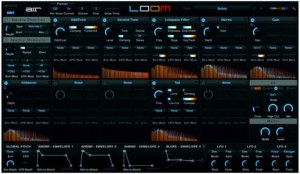
AIR Music Technology has expanded their virtual instrument offerings with the Vacuum Pro Polyphonic Analog Tube Synthesizer and Loom Modular Additive Synthesizer. They tell us that both programs are compatible with 32- or 64-bit Mac or Windows systems, and both support the new AAX plug-in format, as well as traditional VST, AU, and RTAS formats. Here’s their press release with all the details…
Vacuum Pro is a polyphonic analog tube synthesizer that travels light-years beyond the original monophonic Vacuum, first developed by the AIR team as part of the Pro Tools® Creative Collection from Avid®. The new Vacuum Pro is polyphonic, offering up to 160 oscillators plus substantial improvements in both horsepower and features. Loom is an entirely new modular additive synthesizer. While both of these new synthesizers offer an amazing amount of detailed control, each also provides programming aids and shortcuts to create custom user-created sounds quickly. Each contains 250 presets created by the AIR team. The Eco (economy) mode reduces the draw on the host processor, with minimal effect on the final sound.
“We offer the customer the best of both worlds,” said Samara Winterfeld, Principal Product Manager, AIR Music Technology, “The organic sound of a vintage/analog synths, combined with the flexibility/capability of a virtual instrument.”
Vacuum Pro
Polyphonic Analog Tube Synthesizer
The Vacuum part of the name Vacuum Pro relates to the six tube circuits that lend a particularly analog flavor to each of the main synthesis modules–oscillators, filters, mixer, etc. Vacuum Pro combines this vintage, organic sound with the versatility of up-to-date virtual instrument control. The interface is populated by single-function knobs, delivering a vintage feel that reflects the rich analog flavor of the instrument. Modulation effects, delay, and a classic arpeggiator add motion and depth to the sound.
Vacuum Pro sounds are created using one or two parts. When creating parts, the Smart Sound Randomizer allows new values to be created instantly for any or all selected modules. This makes it easy to keep an interesting oscillator sound, for example, while quickly trying out new filter settings. In addition, the Parts Lock feature allows the current settings of any modules (both parts) to be retained when changing sounds, providing a fast way to combine elements from different patches. Best of all, the Easy Sound Design Page reduces the dozens of front panel knobs down to eight, grouping related controls together for rapid results.
Loom
Modular Additive Synthesizer
Loom weaves together a unique sonic spectrum, offering between 128 and 512 individual additive harmonics. Using an innovative modular approach, Loom has made additive synthesis both powerful and easy to control. Loom provides 30 sound modules, each with a distinct function–moving filter, octaver, repeater, second tone, etc. Up to 10 of these modules can be connected in a string. Spectral modulation, extensive envelope control, and multiple LFOs deliver deep control. Onboard effects provide the finishing elements for each sound.
The Smart Morph Page is where Loom really comes to life. In addition to real-time knobs offering sound, dynamic, modulation, and effect control, this simplified editing page also opens up the extensive morphing capabilities of the Loom additive sound engine and effects. Four assignable quadrants on an X-Y display provide incredible morphing control. Custom morphing paths can be plotted using points and segments. These morphing paths can then be automated, placed under MIDI control, and even synced to the tempo of the host program, creating a morphing pattern that takes 8 or 16 bars to complete, as one example. Intuitive color-coding makes the Loom graphical user interface easy to understand
More information:
DATAMASKIN

