
NAMM 2013: NEXT FROM MOOG…
Professor Herb Deutsch, synth pioneer and collaborator of Bob Moog, visited the Moog Machine Shop during Moogfest 2012. While here, Professor Deutsch explored Moog’s next generation analog synthesizer, while still in it’s research & design phase. In the past, Bob Moog always tested his ideas, instruments and sounds with musicians and colleagues. This spirit of collaboration continues at the Moog factory to this day and is essential to our work. It is a key part of the product development process, as it furthers our ideas and helps us shape better tools for musicians.
Making its official debut at NAMM 2013, the first 24 of these new instruments are being handcrafted at the Moog Factory this week. Until you get a chance to see it in its final form at NAMM 2013, please enjoy this video. Love, your friends at Moog.
Sound of Science: The Great Vintage Synth Unpacking
Here’s Tom, one half of Sound of Science (soundofscience.org) unpacking some of the tools of the trade — all of which made their transatlantic journey without incident!
Synths for Studio A!
Gotta watch those peanuts…
ARP 2600
EML 200
EML 101
Studio Electronics MidiMii
Waves Element Synth – Video Review and all the specs
Russ takes a look at the new Waves Element virtual instrument synth and asks can Waves do for virtual instruments what they did for plug-ins?
Find out what he thinks with this show and tell video review
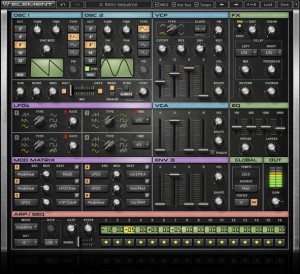
Introducing Element: The first ever synthesizer from Waves. Powered by Virtual Voltage™ technology, Element is an analog-style polyphonic instrument engineered to deliver the fat, gritty sound of the classics, with all the precision, flexibility and control of contemporary digital synths.
Element includes a vast array of convenient features and functions. Like integrated effects. A 16-step arpeggiator / sequencer. MIDI Learn for all controls. And a massive preset library, with total tweakability. Plus, all parameters are laid out right there in front of you, so when inspiration strikes, there’s no need to scroll through page after page to customize your sounds. Searing leads, booming basses, ethereal pads, electro-percussion, sequential motions, mind-blowing FX and lots more: Element does it all.
Features
Powered by Virtual Voltage™ technology
Integrated chorus, delay, reverb, distortion and bit crusher effects
16-step arpeggiator / sequencer
Plugin and standalone components
Controls
Oscillators
OCT determines the pitch range.
TUNE determines the pitch.
FINE fine-tunes the pitch.
TYPE determines the waveform type.
PW determines the pulse width. (Pulse waves only)
VCO selects between virtual Voltage-Controlled Oscillation and virtual Digitally- Controlled Oscillation.
SINE MOD controls the modulation of OSC 1 using a sine oscillator. (OSC 1 only)
FM (Frequency Modulation) controls the amount by which the frequency of OSC 2 is modulated by OSC 1. (OSC 2 only)
PhM (Phase Modulation) controls the amount by which the phase of OSC 2 is modulated by OSC 1. (OSC 2 only)
SYNC synchronizes the triggering the OSC 2 waveform to the rate of OSC 1.
Additional Oscillators & Mix Section
SUB mixes in a triangle wave one octave below OSC 1.
NOISE mixes in white noise.
RING controls the ring modulation of OSC 1 and OSC 2.
OSC 1 / OSC 2 activate each oscillator.
MIX balances the mix between OSC 1 and OSC 2.
MONO toggles between monophonic and polyphonic modes.
RTRG controls envelope re-triggering.
UNISON activates a doubling effect which creates a richer sound.
PORT determines the glide time (portamento) between notes.
LEGATO determines whether glide will always occur, or only when the previous note is still held.
Voltage Controlled Filter
TYPE determines the filter type.
SLOPE toggles between two types of pole filters.
CUTOFF controls the VCF cutoff frequency.
RES controls the amount of filter resonance.
ENV determines the envelope’s cutoff modulation depth.
KBD controls keyboard tracking using C3 as its reference point.
FM controls the amount of frequency modulation on filter cutoff by OSC 1.
ADSR determines the filter’s envelope cutoff behavior after a note is triggered.
VEL sets the VCF cutoff in relation to the Note On velocity.
SHAPE determines the contour of the envelope time constants.
Voltage Controlled Amplifier
VCA envelope controls the note level from trigger to release.
VEL sets the envelope depth in relation to the Note On velocity.
SHAPE determines the contour of the envelope time constants.
PUNCH controls the dynamic transient enhancer.
Low Frequency Oscillators
TYPE controls the LFO waveform shape.
RATE controls the frequency of the free LFO.
TIME controls the rate of the synced LFO, locked to the project BPM.
LED displays pulsate at the same rate as the LFOs.
Envelope 3
VEL sets the envelope depth in relation to the Note On velocity.
SHAPE determines the contour of the envelope time constants.
Modulation Matrix
PHASE inverts the phase, per assignment.
SRC determines the modulation source.
DEST determines the destination of the modulation source.
MOD sets the amount by which the modulation source affects the destination.
Arpeggiator/Sequencer
MODE determines the operational mode.
OCT determines the range, in octaves, of the arpeggiator.
TIME (drop-down) activates the host BPM sync function, and sets the rate using note values.
RATE sets the arpeggiator rate when TIME is set to Free.
GATE determines the length of each sequencer step as a percentage of its note length.
STEPS determines the number of steps in the current sequence.
SWING pushes even-numbered notes/steps toward the next odd-numbered note/step, to create a shuffle/swing feel.
Effects
DIST controls the amount of distortion effect.
PRE/POST is a toggle control which determines the placement of the distortion effect in the signal path, either pre-VCF or post-VCF.
CRSHR is a distortion-like effect which simulates a reduction in the bit-depth and resolution of the sound.
DELAY is a stereo delay allows separate delay times for left and right channels, using note values.
LEFT sets the delay time for the left channel.
RIGHT sets the delay time for the right channel.
MIX determines the amount of delay effect in the mix.
FEEDBACK determines the amount of gain fed back to the delay input.
REVERB controls both the amount and size of the virtual plate reverb sound.
CHORUS determines the amount of chorus modulation.
EQ
HiPASS controls the high pass filter frequency.
LoPASS controls the low pass filter frequency.
100 controls equalization at 100 Hz.
600 controls equalization at 600 Hz.
1500 controls equalization at 1500 Hz.
9000 controls equalization at 9000 Hz.
Global and Out Sections
TEMPO displays the current tempo.
SOURCE determines the clock source.
VOICES determines the number of voices which may be played simultaneously.
HD activates High Definition mode, which extends the digital resolution, resulting in enhanced depth and greater high-end definition.
GAIN sets Element’s overall output volume, after all generators and processors.
METER displays Element’s overall output energy.
9000 controls equalization at 9000 Hz.
Read more: http://www.waves.com/content.aspx?id=12081#image#ixzz2Gw3J6yqS
Arturia Minibrute Gates the Monotribe
In this sinister little piece the Monotribe makes a brief appearance (as a drum machine only) receiving gate signals from the MiniBrute. Apart from this the MiniBrute rules supreme over the rest of the tracks
Therevox ET-4 Demo
Therevox ET-4 analog ribbon synthesizer.
Inspired by the Ondes Martenot’s au ruban controller, the ET-4 is controlled by moving a finger along a reference keyboard shaped to provide tactile feedback. Dual pressure sensitive intensity keys control the amplitude of the ET-4′s two independent analog oscillators.
“A few sounds I made with my new Therevox ET-4. No processing was done to the raw output of the ET-4 other the running some of the sounds through an MXR Carbon Copy delay pedal. The reverb is the ET-4’s built-in spring reverb. With some of the sounds I control filter cutoff using a Moog expression pedal.”
Alesis Andromeda “Analog Spacepad”
The Andromeda A6 is a true analog synthesizer using two analog oscillators per voice, sub-oscillators, hard and soft sync and more! It features 16-voice polyphony. With the Andromeda, you’ll find a huge range of tonal possibilities: searing leads, warm pads, fat bass lines, extreme sound effects and more. And of course there are plenty of knobs (72) and buttons (144), even an assignable ribbon controller for addictive hands-on real-time control! The large high-resolution LCD display is excellent and shows you actual rather than relative values of parameters. Andromeda will integrate seamlessly into any studio with its total MIDI control and sync, individual voice outputs, stereo outputs and several audio inputs.
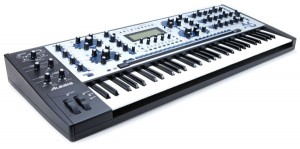
Andromeda is completely analog – no emulation! It features two analog filters per voice that sound great! They are a multimode 2-pole and a 4-pole lowpass. External audio can be routed through these filters too (three 1/4″ jacks)! As for modulation, Andromeda has three LFOs, each with six waveforms and they can be synced to MIDI clock. And there are three 7-stage envelopes with very creative and flexible functions. Also onboard is an extensive mod matrix for enormous freedom in configuring Andromeda’s sounds!
No analog synth would be complete without a set of classic effects and features. Andromeda also offers Portamento with nine slopes and legato functions. A built-in arpeggiator and analog-style sequencer are available, with MIDI sync! There are also some high quality digital effects such as reverbs, chorus, echo, distortion and more! Andromeda comes with 256 breathtaking preset patches plus 128 user. A PCMCIA-format memory card slot allows for additional programs and mixes. Andromeda is pure analog bliss, with all the features, stability and widgets of modern digital synths.
Elektron Analog Four – Creating pattern from scratch
This video is intended to show how the Analog Four can be used for Sound and Pattern creation + Parameter locks.
https://www.facebook.com/Project.Dataline
https://soundcloud.com/dataline
Time machine: FARFISA SOUNDMAKER Analog Synthesizer 1979
“Synthesizer Demo of the analog synthesizer/string machine FARFISA SOUNDMAKER. I played the Soundmaker with a Roland DC-30 analog delay. The Farfisa Soundmaker came out 1979. It looks a bit like a Synclavier  It has a string section, a “poli” section and a monophonic synthesizer section. The keyboard has aftertouch. Also it is possible to run the polyphonic section through the filter of the monophonic section – like seen in the last part of the video.”
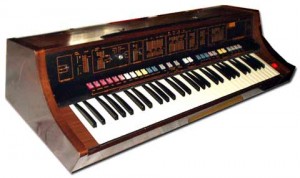
Built in 1979-81, the Soundmaker has Synth, String and Piano/Brass Sections. The Monophonic Synth section has 12 preset sounds (Tuba, Trombone, Trumpet, Sax, Clarinet, Oboe, Flute, Piccolo, Violin, Accordion, El Bass, El Guitar) and one Free patch which lets you use the controls to create your own sound. Basic controls for the filter, the one ADSR for the filter and/or the VCA, and the LFO are laid out plain and simple.
The Polyphonic Preset Synth section has Volume & Brightness controls for its four preset Piano type sounds (Piano, Electric Piano, Honkey Tonk, Brass).
The String section offers a fairly decent string sound with Volume, Brightness, Attack and Sustain controls for a choice of two preset strings (8″ footage or 4″ footage).
The Soundmaker is a bulky synth, weighing in at 27kg! Its keyboard may be split (at middle F only) and the Strings and Poly Synth sections play with the left hand and the Mono Synth plays with the right hand. The keyboard also has polyphonic aftertouch which can be used to control the Mono Synth Brilliance, OSC (vibrato), Synth Glide or Brass Brilliance. The String and Poly Synth sections can be switched to monophonic at the same time. The Farfisa is not the best String Machine you’ll ever hear, but it is very rare and that alone gives these machines some serious vintage appeal.
The return of the KORG MS20 and the NAMM King Korg rumors
NAMM is soon upon us again and just as always rumors are beginning to flourish. The first comes from KORG regarding two new products from Korg, the King Korg and the MINI MS-20.
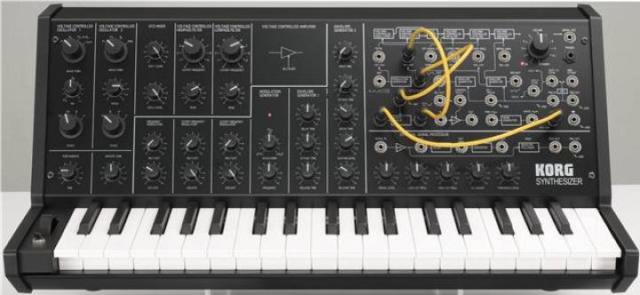
The MINI MS-20 is rumored to be a new version of their analog classic, the MS-20 in a smaller chassis and with mini keys. The picture looks at first glance like the MS-20ic controller that came with the Korg Legacy collections, but some subtle details such as screw and LED locations appear to be different. Will it be an actual analog synth, or just a repackaged, self-contained version of the Korg Legacy version? The other rumor is about the King Korg, which some believe to be a 3-oscillator analog synth. But is it real analog or just another virtual analog?
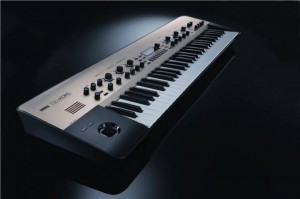
Soon we will know, but it seems that after the success of the Monotron series, this could be a logical direction Korg might take. On the other hand, a higher price point would likely make these more niche products that would do smaller numbers than a company the size of Korg might bother with.
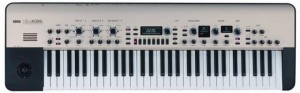
Time machine: Moog Polymoog 203a Vintage Analog Synth From 1976
Moog Polymoog 203a Vintage Analog Synthesizer 1976-77-78
using it’s 3 outputs into mixer. 1. Direct. 2.VCF. 3 Resonators. with a
Roland CR 68 drum machine played both live into tascam dp-01fx/cd 2 tracked.
The Polymoog is a preset-based and fully polyphonic synthesizer released in 1975. The eight preset sounds consist of strings, piano, organ, harpsichord, funk, clavi, vibes, and brass. Though it may not sound as good as other analog poly-synths of the time (from ARP and Siel) the Polymoog was still a popular instrument because of a great new keyboard and the ability to edit the presets into unique and wild analog sounds. There’s a genuine Moog filter in there with modulation, keyboard tracking and lots of LFO modulation sources. The full sized 71-note touch-sensitive keyboard can be split into three sections, each with independent volume sliders. There is a 3-band EQ, sample-and-hold, and a full set of envelope controls. What you won’t find, however, is patch memory–well, there’s one programmable preset, but there’s certainly no MIDI control!
DATAMASKIN

