
Close up on the Grp A4 Synthesizer
All sounds in this short demotrack including drums come from the beautiful Grp A4 synthesizer from Italy. Multitracked in Cubase, some delay, reverb and compression added.
![153[1]](http://stereoklang.se/blog/wp-content/uploads/1531-300x198.jpg)
The Grp Synthesizer was developed to offer the enthusiasts of analogical sound a more affordable synth in terms of price and dimension in comparison with the precursor model A8, without renouncing to the quality and performance that characterize our synths. Being featured with the same step sequencer used for the Grp A8, this synth is able to guarantee nearly infinite sound combinations due to the new characteristics which have been implemented in the instrument, with the possibility to filter out external signals and to manage all the important parameters of the analogical generation chain.
The A4 has been derived from an audio section of the Grp A8 (of which it takes over the structure) and it results more versatile and eclectic passing from smooth and extreme clean sonorities to harder sounds thanks to the two distortion installed in the synth (one for each filter) and due to the possibility to make interact synth, ring modulator, external signals and step sequencer in only on mechanism with an immense sonority power. Furthermore, the Loop EG function enables the conditioned and unconditioned repetition of the envelope, in order to reach particular and temporal articulated sonorities.
PreBrute Worlds First MiniBrute Based Kontakt Synth
So right before Xmas Arturia’s MiniBrute goes virtual for Kontakt, details below:
Programmed pre-sets for PreBrute are listed below for each demo
Festive Introductory Offer- 25% Saving at checkout until 07/01/13
http://www.precioussound.com/prebrute
DEMO – Downtown (Part 1)
Percussions: Synthetic Percussions (JW)
Percussions: Junkyard Orchestra (JW)
Percussions: Flabby Kicks 3 (JW)
Keys: Cyberphone (JW)
Bass: Fretless Smoothie (JW)
DEMO: Serenade
Bass: Serenade Bass (PS)
Pad: Serenade Pad (PS)
Lead: Serenade Lead (PS)
Drums: Maschine PreSid Kit Serenade
DEMO – Solitude
Keys: Grand Piano (Solitude) (JW) (two instances for panning purposes)
Pads: Retro Strings (Solitude) (JW)
Pads: Space Pad (Solitude) (JW)
Demo: Runner
Pad: Runner Pad Modulate Lp Master Filter (PS)
Pad2: Runner Pad Map Hp Master Filter (PS)
Bass: Runner Bass (PS)
Lead: Runner Lead (PS)
Drums: Maschine PreSid Kit Runner
DEMO – Downtown (Part 2)
Percussions: Res Toms (JW)
Percussions: Industry Snares (JW)
Percussions: Dance Kicks 2 (JW)
Percussions: Glitch 1 (JW)
Keys: Cyberphone (JW) (modified with a longer attack)
Bass: Fretless Smoothie (JW) (with modified cutoff)
Demo: Sunshine
Pad: Sunshine Pad (PS)
Stabs: Sunshine Chord Delay Stabs (PS)
Bass: Sunshine Bass (PS)
Lead: Sunshine Lead (PS)
Drums: Maschine PreSid Kit Sunshine
DEMO: For Clifford…
keys: Mr Wait’s Bourbon (JW)
lead: Manik Moon (JW)
Demo: Breakdown
Stabs: Breakdown Delay Chord Stabs (PS)
Stabs: Breakdown Accordion Like Chord Stabs (PS)
Bass: Breakdown Bass (PS)
Drums: Drum break used
Demos composed by Jonathan Watridge and Precious Sound
JW= Jonathan Watridge
PS=Precious Sound
Specifications:
• 2.16GB Kontakt 5 Library
– 7612 24bit samples
– 0.92GB Ram usage for first instance 200mb per instance after per project
• Equipment used
– Arturia MiniBrute
– AMS 1073lb (Class A)
– API 512C (Class AB)
– Type 1 cassette through a Tascam 122 MKIII
• 20 Waveforms sampled from MiniBrute
– 4 Flavours Per Osc (Raw/1073/512C/Tape)
– 80 Possible waveform choices per Osc
• 4 Oscillators
– Independent Amp ADSR / Filter ADSR
– 2 Switchable Envelopes per Osc Amp Adsr (Normal/Punch)
– Inv Phase per Osc
– Sample start adjustment per Osc
• Octave function
– Shift +/- 3 octaves per Osc (natively plays samples does not tune sample)
• Copy paste
– One Osc’s settings to another Osc
• 2 LFOs per Osc
– Adjustable Speed, Depth and Sync
– Shape: Sine, Triangle, Rectangle, Sawtooth, and Random
– Destination: Filter Cutoff, Filter Resonance, Osc Volume, Osc Pan, Osc Tune and Osc Fine Tune
• 7 FX per Osc
– Lo-fi / Distortion / Flanger / Phaser / Chorus / Saturation / Limiter
• 6 selectable Filters per Osc
– LP / HP / BP / Notch / Phase / Vow
– Adjustable Key track and Velocity amount
• Global Dual LP/HP Filter
– Global filters can be linked to behave like a BP Filter
• Global summing mixer
– Global Insert effects Width / Distortion / Tape Saturation / Eq / Limiter
– Global send effects Phaser / Flanger / Chorus / Ir Reverb / Delay
– Unison (up to 8 voice)
– Global Amp ADSR with a softer curve
• Onboard Preset system
– load and save presets via the global panel
– All sounds heard in all demo’s are available in the preset folder
– 45 presets to help get you started
• Intuitive design
– Large LED info Panel for a visual aide when setting up the synth
• Raw tones modulated within our engine
• Non-Intrusive Protection
– Sales are automated and you will recieve download links
– .NKI file (Instrument file) will be sent to your email address seperatly.
– Serial numbers are displayed on the global section of the instrument.
– our samples are not watermarked
– no file sent to you contains any personal information simply a serial number.
– PreBrute Kontakt £39.99 Inc VAT / $49.99 (Valid VAT numbers can be entered at checkout)
Preview of the Dubreq Stylophone S2
The new Dubreq Stylophone S2 takes the basic idea of the Stylophone, a stylus played instrument that uses a printed circuit board as the keyboard, and turns it into a fully spec’d analogue synthesizer.
The Stylophone S2 is an entirely British made, analogue synthesizer that will fit in a laptop bag. The S2 features include; All metal construction, a full 37 note 3 octave keyboard with +/- 2 octave shifter featuring a wire-free stylus and finger-touch playing method, an all analogue signal path, a classic British style 12dB/octave state-variable filter, dual all-transistor voltage controlled oscillators, sub-oscillators for super-fat bass, an eight waveform LFO with a 14 octave range, an auxiliary-input socket to use the filter and envelope-generator for other instruments, a 1/4″ output jack socket as well as an internal speaker and headphone socket and a CV and Trigger input sockets.
TANSU Synth tutorials
App Store:
https://itunes.apple.com/app/tansu-synth/id564763430?mt=8
Official site:
http://www.music-airport.co.jp/tansusynth/
Patch Tips version of iOS apps analog synthesizer “TANSU Synth” tutorial.
TANSU Synth is the miniature analog modular synthesizer.
The app in the video is under development version.
Next version up: be a universal app (iPhone / iPad)
Additional tutorials can be found here >>
The iOS application – which is named “TANSU (dresser)”, is a miniature
version of a Modular Analog Synthesizer. This synthesizer is the same as the
one used and mastered by Hideki Matsutake of LOGIC SYSTEM.
The sounds that were sampled and used for the VCO (Voltage Controlled
Oscillator) come directly from the actual “TANSU” owned by Hideki Matsutake
himself.
In addition, it also contains many original LOGIC SYSTEM recordings. The
application condenses the fun, experience and sound of an actual modular
synthesizer onto the small screen of an iPhone!!
What will the sound be like when using the application? This application is
focused on providing the user with the feeling and excitement of using the
actual synthesizer for which it is based.
Not only for a techno fan, but for any music lover!! Feel what it is like to
create your own music!!
Try this application to experience the “the birth of sound and music.”
The main functions
■LOGIC BOX
Sound effects such as Shepard Tone and rhythms from music by LOGIC SYSTEM
have been made directly into the sound source.
■MUSIC
You can use your iPhones own music library as a sound source. (However,
certain tracks which are covered under DRM may not be used).
■Microphone function
You can use sounds which have been recorded with microphone.
■Preset function
You can explore the potential of the TANSU Synth from various demo patterns.
Moreover, it can be utilized as a tutorial for beginners.
■VCO (Voltage Controlled Oscillator), VCF (Voltage Controlled Filter), VCA
(Voltage Controlled Amplifier), LFO (Low Frequency Oscillator), EG (Envelope
Generator)
Enhance the basic functionality of an analog synthesizer. (Various sound
processing is possible.)
■It has an 2 channel 8 step analog sequencer and convertible 1 channel 16 step sequencer!
■You can enjoy connecting and reconnecting the patch cord to creat sounds
just as with a real synthesizer.
■Three sound sources can be mixed by a three-channel mixer!
KORG POLY-800 II Analog Synthesizer 1986 – PATCHES
Synthesizer Demo of the polyphonic analog synthesizer Korg Poly-800 MK II.
The Korg Poly-800 II (not to be confused with the original Poly-800) is an interesting polyphonic analog synthesizer with built in digital delay. The basic sound of the Poly-800 MK 2 is different to the original Poly-800 MK 1. The filter sounds different and it has faster envelopes. It is a small, powerful synth.
In this movie no external effects or eq were used.
_______________________________________________________________
THE SOUND PROGRAMS IN THIS MOVIE:
Do you have a Korg Poly-800 II and want to get hold of those fantastic sounds heard in the video?
The “ANALOGAUDIO1 POLY-800 II PATCH BANK” costs 12,99 Euros and includes 64 great patches – warm analog pads, interesting retro sounds, fat basses, sequencer sounds and funky leads (in one word: all you hear in the video and some more).
As an experienced synth player, programmer and composer I programmed these patches at a professional level for studio use. This patchbank gets the most out of your Korg Poly-800 II. Also included is a patch list (PDF), to find the right sounds quickly. The sounds are not available anywhere else.
Please note, this patchbank will only work with a POLY-800 MK II – it will not work with the original POLY-800 or the EX-800.
After payment through PayPal you will get a sound file for the tape interface of your Poly-800 II and a patchlist via email.
If you want to buy the “ANALOGAUDIO1 PATCHBANK”, please drop me a mail:
ceramic-man@gmx.de
________________________________________________________________
I am also offering ANALOGAUDIO1 patchbanks for the following synths:
KORG POLY-800 http://www.youtube.com/watch?v=K6bG8PpSDPk
KORG POLY-61 http://www.youtube.com/watch?v=9R0bvavfibQ
KORG POLYSIX http://www.youtube.com/watch?v=Bc0uMDg_Wyc
KORG DW-6000 http://www.youtube.com/watch?v=cOoF7TeEj-o
ROLAND JUNO-60 http://www.youtube.com/watch?v=GaTLk6ea9jo
Elektron Analog Four + Machinedrum Dirty Techno
“Slow-paced techno with lots of dirt and grit, thanks to the overdriven analog filter through which the drums are routed. Camera stopped recording beyond 10mins, but went on jamming anyway.”
Arturia Minibrute – Mini Brute Drums For Ableton Live
Here’s a nice treat from AfroDJMac featuring samples from the Minibrute, details below:
This free Ableton Live Pack features drum sounds created from samples of the Arturia MiniBrute. More specifically, I resampled sounds from the MegaBrute Collection for Ableton Live ( http://afrodjmac.com/2012/11/07/megabrute-ableton-live-pack/ ) and created some odd and unique drum samples. From there I organized them into Ableton’s drum rack and added various effects. All in all it is 24 different drum sounds all created from the analog beauty that is the Arturia Mini Brute!
Free Download Here: http://bit.ly/freesynth68
Moog session – Minimoog, Prodigy and Polymoog 203A
Background video description:
Jamming away on the moog-rig – The minimoog, the Prodigy and the mighty Polymoog 203A synthesizer. Additional bassline-programming courtesy of Doepfer Dark Time.
Doepfer is back – with Dark Energ II analog synth
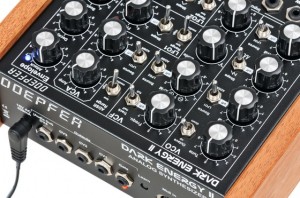
Doepfer has announced availability of its new Dark Energy II, a redesigned version of the monophonic analogue synthesizer with USB/MIDI interface and CV connectivity.
So why the need to redesign something so successful so soon? Simple. Needs must. And who better to explain this than company CEO Dieter Doepfer himself: “As the Dark Energy had to be discontinued, because an important electronic component (CEM3394) is no longer available, we decided to do a redesign. The new Dark Energy II looks like the Dark Energy at first glance, but the basic sound of the Dark Energy II is clearly different because of the new circuits for the VCO, VCF, and VCA.”
Given the absence of that rich-sounding, analogue ‘synthesizer-voice-on-a-chip’ (CEM3394) from Curtis Electromusic Specialities successor OnChip, how does the Dark Energy II sound? Still rich, still analogue — with 20 to 30 minutes tuning time needed for the VCO’s temperature-controlled pure analogue circuitry, but different… mainly because of the completely different filter type.
Notable differences in specification between the two — together with a number of functional additions to the Dark Energy II — are as follows: firstly, the Dark Energy II features a sawtooth-based VCO core (compared to the Dark Energy’s triangle-based one), which, as implied, outputs a sawtooth waveform, with a waveform Shape switch for selecting sawtooth, off, or clipped/inverted sawtooth; meanwhile, that all-important, sounding-defining VCF is centred around a 12dB multimode filter with lowpass, notch, highpass, and bandpass, together with an all-new filter Mode control for continuous transition from lowpass via notch and highpass around to bandpass (as opposed the 24dB lowpass variety with linear frequency modulation (LFM) control found on the Dark Energy); the VCF’s exponential frequency modulation (XFM) control also has a polarization function, whereby the modulation source (LFO2 or ADSR) selected by the Source switch can affect the filter frequency with a positive or negative behaviour (by rotating rightwards or leftwards, respectively); finally, the VCA has an exponential scale (unlike the Dark Energy’s combined linear/exponential scale).
Benefitting those with a modicum of electronics know-how, the Dark Energy II offers much more internal expansion possibilities than its ‘Mk I’ predecessor courtesy of pin header terminals for the following functions: rectangle and sawtooth VCO outputs, linear FM input for VCO, hard sync input for VCO, lowpass/bandpass/highpass VCF output, rectangle and triangle outputs for each LFO, and optional reset/direction features for each LFO — all conspiring to make this already flexible synthesizer even more flexible!
The upshot of those differences is that sounds created on a Dark Energy II of course cannot be replicated on a Dark Energy (and vise versa) — though there is nothing to stop the two distinctive synthesizers from being daisy-chained together to produce an even wider palette of sounds. Indeed, several units can be polyphonically or monophonically cascaded (via internal MIDI out/MIDI in connections) to create an ‘über-synth’ of sorts!
Dark Energy II is available to purchase online within Germany directly from Doepfer for 428 EUR incl. VAT, or from an authorised dealer. An optional Glide control option is also available for self-installation for 10 EUR incl. VAT.
Analog Synthesizer SX-150 Mark II
http://www.thinkgeek.com/ed85?cpg=yt
Hotblack Desiato, Figrin D’an, some members of the Hong Kong Cavaliers – all these folks have one thing in common: the love of analog synthesizers. Sure the tech might have been a little different long, long ago or far in the future, but the principles of wave generation and alteration has been a staple of electronic music ever since, well, it was invented. And now you can leap into the electronic dance party with your very own Analog Synthesizer SX-150 Mark II.
The Analog Synthesizer SX-150 Mark II is quite an advanced little synth. With ten controllable parameters, line in and out, and a four octave range, you’re gonna love it. The Analog Synthesizer SX-150 Mark II uses an electrode stylus to play tones, and you can even overlay a keyboard to play exact notes (see link below). We want to write more for you, but we need to go jam now. With our Analog Synthesizer SX-150 Mark II, that is.
For some additional info on how this synth works click here. It’s an instruction manual for the previous version of the SX-150, but it still has some awesome info at the bottom.
Also, for a printable keyboard overlay (it goes between the screws) click here. Just stick in place and tune up a note and you’re ready to go.
Analog Synthesizer SX-150 Mark II
- Fully-functional analog synthesizer, ready to help you rock the world.
- Four octave range.
- Achieve vibrato, tremolo, and “wah” effect with VCF and LFO buttons.
- 10 Parameters to control: cutoff, resonance, attack, decay, pitch ENV, LFO wave, LFO rate, LFO depth, VCF modulation, and LFO modulation.
- Tunable to play nice with other instruments.
- Line in and line out (standard 3.5mm headphone jack size) to expand your synth voice.
- Batteries: 4 AA (not included)
- Dimensions: approx. 6.5″ x 4.75″ x 1.5″
DATAMASKIN

