
iNALOG – Submarine Drift [live dub techno on KORG iPolysix]
Rutger Muller explores yesterday´s release from KORG – the Polysix for iPad, details below:
Jamming on an iPad 1 with the official demo ‘Submarine Drift’ track I made for KORG’s new iPolysix app.
– App Store: https://itunes.apple.com/app/korg-ipolysix/id579232173
– More of my KORG iOS music: http://www.Soundcloud.com/iNALOG
– KORG iPolysix introduction video: https://www.youtube.com/watch?v=KH6eiiouFjw
More of my works:
– Hypnotic School (dreampop/triphop):
https://www.youtube.com/watch?v=_oMEgwWyD00
– AuxPulse (acid/IDM on Nintendo DS):
https://www.youtube.com/watch?v=aPPPuGTKslI
– DS-10 Dominator (various EDM/acid on Nintendo DS):
https://www.youtube.com/watch?v=kTPFcn7fTsk
– My complete portfolio:
http://www.RutgerMuller.nl
Moog Source “Get The Drive”
Synthesizer demo track by RetroSound
“Get The Drive”
Moog’s Source was their first to offer patch memory storage as well as some other new features. It boasted 16 memory locations so you could finally save and recall your synth patches. A casette-tape jack was also implemented to transfer your patches to and from an external tape and free up the on-board memory for additional new patches. But in an effort to modernize with the eighties, the Moog had replaced all buttons, knobs and sliders with flat-panel membrane buttons and a single data-wheel assignment format. At the time, this may have seemed far-out, but in all actuality it is the Source’s downfall.

Parameters are edited not with hands-on sliders and knobs but by assigning a selected parameter to the dedicated data wheel. This is very tedious and does not allow for true hands-on tweaking during performances nor can you adjust different parameters simultaneously or while playing. These days, the membrane buttons don’t always seem to work quite right either. However, those famous monophonic Moog sounds are still inside this synth which has two fat analog oscillators and the legendary 24 dB Moog filter.
all sounds: Moog Source Analog Synthesizer + EHX Big Muff guitar effect pedal
drums: Korg ES1 MkII
recording: multi-track without midi
fx: a little bit delay and reverb
Attention! this is not a soft ambient track! 😀
the track @ soundcloud:
http://soundcloud.com/retrosound-ii/moog-source-get-the-drive
Anushri Drum Tweaking
Mutable Instruments latest analog DIY synth Anushri. Tweaking the digital drum sounds with a Doepfer Pocket Control sending Midi CC.
Elektron Analog Four — Four Voice Synthesizer
Here’s a brand new video from Elektron showing off their new analog beast
Analog Four is a 4 voice analog synthesizer with state-of-the-art digital controls. Explore the world of rich, warm and gritty sounds in an updated and refined way. http://www.elektron.se
The Analog Four is a four voice analog synthesizer. Analog oscillators and filters ensure the most organic sounds imaginable and the Elektron step sequencer caters for the innovative sound control. With sequencer features like parameter locks and variable length per track, intricate Analog Four compositions can be created quickly and efficiently. Add the completely new and incredibly well-crafted effects to the mix and experience the next chapter in analog sounds. It just sounds right.
Not only a splendid sound making device, the Analog Four can also make other gear sing. Thanks to the CV/Gate and DIN sync outputs, legacy analog gear can be controlled in great detail. Sequencer features like arpeggiators and parameter locks will breathe new life in old equipment and make any modular synthesizer rig truly come alive.
Live performance features are aplenty. The special performance mode gives direct access to user-defined parameters and direct pattern change makes it possible to change patterns at any sequencer step. The arpeggiator can be instantly toggled on or off for swirling melody lines. Improvising when playing live has never been this easy. The Analog Four was born for the stage.
All 4 tracks have been sequenced inside the new Elektron Analog Four. I wanted to show various parameters for Filters, Oscillators and ‘how it sounds’ while playing this composition. There is no external processing, everything you hear is from the Analog Four.
Antique Synthesizer 1970-1979
All you can eat vintage synths on this nice Sunday morning, featured gear listed below:
MOOG Minimoog / ARP Odyssey / KORG MS-20 / E-MU Modular System / MOOG System 55 / Sequential Circuits prophet-5 / Oberheim SEM / Oberheim OB-1 / RML ElectroComp 100 / Roland-SH-2 / KORG 800DV / EMS Synthi AKS / YAMAHA CS10
Elektron has officially announced the Analog Four synthesizer

Elektron has officially announced the Analog Four synthesizer – a new synth that combines ‘the power of analog synthesis, enhanced with precise Elektron sequencing. This is an analog synthesizer for the modern age. Release date for the Analog Four is expected to be Dec 3rd.
Here’s what they have to say about the Elektron Analog Four:
The Analog Four is a four voice analog synthesizer. Analog oscillators and filters ensure the most organic sounds imaginable and the Elektron step sequencer caters for the innovative sound control. With sequencer features like parameter locks and variable length per track, intricate Analog Four compositions can be created quickly and efficiently. Add the completely new and incredibly well-crafted effects to the mix and experience the next chapter in analog sounds. It just sounds right.
Not only a splendid sound making device, the Analog Four can also make other gear sing. Thanks to the CV/Gate and DIN sync outputs, legacy analog gear can be controlled in great detail. Sequencer features like arpeggiators and parameter locks will breathe new life into old equipment and make any modular synthesizer rig truly come alive.
Live performance features are aplenty. The special performance mode gives direct access to user-defined parameters and direct pattern change makes it possible to change patterns at any sequencer step. The arpeggiator can be instantly toggled on or off for swirling melody lines. Improvising when playing live has never been this easy. The Analog Four was born for the stage.
Here are the details.
Specifications:
- 4 synth voices
- 2 Analog oscillators per voice
- 2 Analog filters per voice
- 1 Analog overdrive circuit per voice
- Multiple LFOs and envelopes per voice
- Elektron step sequencer with parameter locks
- Kit and Sound storage
- All new hi-quality effects
- 2x dual CV/Gate outputs
- Dedicated CV/Gate and FX sequencer tracks
- 2x External inputs
- 2x Main outputs
- 1x Headphones output

WOPR – new polyphonic virtual analog synthesizer with unique evolving modulation
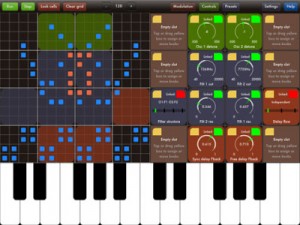
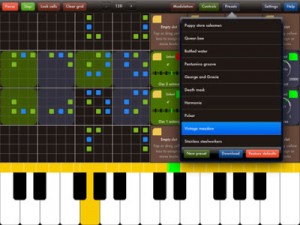
WOPR is a polyphonic, stereo virtual analog synthesizer with totally unique evolving modulation driven by vintage 1970s cellular automata. It’s made for iPad 2 or later only. WOPR is a performance instrument, a stand-alone instrument in the same spirit as the Korg Monotron.
It’s brilliantly playable: the full-width Wribbon keyboard lets you play pitch-perfect notes every time, then bend them like a guitar god to convey your inner pain to the screaming masses.
It’s performance-friendly: you can create customized control panels for comfortable access to parameters. That’s much better than contorting your fingers to fit some tiny panel layout.
WOPR is a seriously powerful analog, but what sets it apart is its modulation grid: you paint a pattern of cells into a grid, set the tempo, hit ‘run’ and let the cellular automata evolve your pattern. You link areas of the grid to any of the synth’s parameters and your patches come to life, rhythmically pulsating as the patterns shift with each beat. Constrain parameters to ranges for tight control over rhythmic modulation, or set them free to dynamically breed new patches.
Being a virtual analogue synthesizer, we’d be remiss if we didn’t include some allusion to the past. Here it is: the modulation grid is a bona fide 1970s invention called Conway’s Game of Life. Look it up, marvel at the infinite variety of patterns, geek out on the math, then put them to work twisting knobs in WOPR.
The core synth engine justifies its powerful modulation. WOPR has:
– 2 pannable oscillators with sine, saw, square and triangle waves. Each oscillator has an incredible range: 32′ to 1′, with +/- 500 cent detune (a perfect fourth either way). There’s also a white noise generator.
– 3 ADSR envelopes, 2 assignable between osc 1 & 2 and the third dedicated to the noise source.
– 2 fruity, resonant 24Db/octave low pass filters, assignable to osc 1 & 2 or to the left and right stereo channels.
– 2 delays, a free-running delay with fine control over low intervals, and a tempo-synced delay running from 32nds to two whole beats. Delays are independent, or can be assigned to feed eachother in any sequence. Howls, rings and reverbs are easy to create; so are good, old-fashioned solid, rhythmic delays.
– 2 octave, full-width Wribbon keyboard: play piano like a guitar, bending individual notes or entire chords. All without losing fixed-key pitch accuracy when you don’t want to bend. Best of all the whole width of your iPad 2 is there for performance.
– 6 voice polyphony. If that’s not enough (maybe you have tiny fingers), it comes with the best note stealing algorithm on the iPad.
– Modulation matrix: use this to link controls to the Game of Life, or simply use it to define a custom control panel for easy performance.
WOPR is version 1.0.0. It doesn’t yet have these features, but they’re being worked on:
– Audio copy/paste (it’s coming soon.)
– A giant preset library. (More are available for free download within the app.)
WOPR’s architecture might change a bit too. It’s young and has a lot of growing up to do. Right now Omnivore is experimenting with stereo BPF & LPF filters that you can insert into various places in the signal pipeline. We’re looking at ways to drive a wavetable library from the grid, too. Feedback is welcome, so please send your requests to feedback@omnivoresoft.com.
Finally, what does WOPR stand for? Anything you like. Wave Oscillator Piano Replacement? Wickedly Optimized for Phat Response? Who knows. All we can say is that it’s the synth David Lightman would choose…
SOUNDS of the delta by Synth Magic
Sample library of the Korg Delta DL-50 analogue synth.
Available for Kontakt 4 and 5.
All the raw oscillators and strings have been sampled and a library of sounds made on a real Delta have been sampled.
Over 200 presets included.
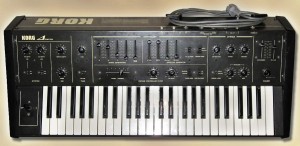
Korg’s Delta is an analog semi-poly synth/string machine, basically a slimmed down version of the Korg Trident. Though limited in the range of sounds compared with other synths of the same genre, the sheer quality of the sound from this little beastie really does make it something of a marvel. It can be found used for cheap and is worth it for the retro synth strings and fat bass synth tones.
The synth is split into two sections, Strings and Synth, for which there are separate audio outputs along with a combined output for headphones or mixing. Each section has its own controls. The String section has two pitch sliders (16′ and 8′) along with two tone controls (Bass and Treble) and variable Attack and Release controls to modify the sound. The Synth section has four pitch sliders (16′, 8′, 4′ and 2′). There is also a white noise generator along with a very effective 24dB/oct low pass filter (high pass and band pass options are included too) and full ADSR controls. The synth has no memory storage or MIDI, however it does has voltage control and gate ins and outs.
The string sounds are very basic but with its separate outputs and when mixed together with the polysynth you do get that classic ‘layered’ sound which is useful enough on this synth; and it’s fully polyphonic, so you wont be running out of notes! There is a handy joystick to the left of the 49-note keyboard for pitch bending and modulation capabilities. The construction is solid and heavy partly due to the implementation of a wooden base but also because it was designed for heavy usage on the road. Added bonuses: noise modulation, stereo out (strings/synth split), and the ability to combine synth and strings or turn off oscillators in the mixer section.
Eurypharynx – new 4-voice virtual analog synth for the iPad
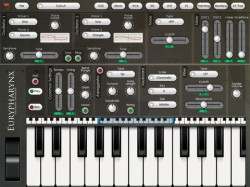
Developer Sobal Corp has introduced Eurypharynx, a 4-voice virtual analog synth for the iPad.
Key Features:
- In each OSC, you can select two waveforms and also morph them.
- Flexible patching operation is available with Matrix Patching.
- Alter numerous parameters sequentially with Modulation Sequencer.
- Intuitive performance is available with XY Pad Control.
- It is possible to save up to 256 patches.
It’s CoreMIDI compatible and $1.99, so check out the details and let us know what you think of it!
Specifications:
- 4-Voice Polyphony
- OSC x 2 / NG x 1
- OSC Modulation
- Ring Modulation
- OSC Sync
- Glide
- Filter x 1
- EG x 2
- LFO x 2
- Arpeggiator Type x 6
- Matrix Patching
- Modulation Sequencer
- XY Pad Control x 2
- FX
- Delay
- Chorus
- Over Drive
- Keyboard (Scale) x 35
- Real-Time Recording
- Others:
- Wireless Sync-Start Technology (WIST) is supported.
- AudioCopy is supported.
- CoreMIDI is supported.
Eurypharynx is available now in the App Store for $1.99.
Arturia Minibrute: “Mega Brute” Ableton Live Pack
50 Ableton Live Instruments, created with samples from the Arturia MiniBrute. This collection of analog synth instruments takes the power of the MiniBrute and combines it with that of Ableton Live. Extremely playable and useful instruments with tons of effects and macro knobs for control.
Available at: http://afrodjmac.spinshop.com
DATAMASKIN

