
Time machine: Vintage Synthesizers – Vermona Synthesizer
A voyage into the heart of the Vermona Analog Synthesizer from the year 1982.
Exploration by Marko Ettlich (RetroSound)
very rare analog synthesizer made in east-germany (GDR)
also called “Zonen-Moog” 😉
monophonic
2 VCO with Pulse, Saw, Square and Noise waveforms
24 dB/Oct VCF with Brilliance, Cut-Off and Resonance
10 presets for VCF and VCA envelope
44 keys
Synapse Audio releases Antidote – new synth for the Reason Rack Extension
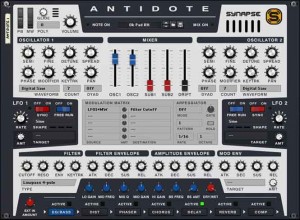
Synapse Audio has released Antidote, a new Rack Extension for Propellerhead Reason. Here’s how they describe it in their own words:
Antidote is an exclusive virtual-analog synthesizer, which combines highest audio quality, flexibility and a fast work flow in an easy-to-use plug in. Antidote has been specifically developed to complement Reason, and to integrate well into its environment. It can be used both as an instrument, and as a powerful multi-effect unit.
Antidote comes with two stereo oscillator banks, each emitting a stack of high quality oscillator waveforms. The oscillators pass through the filter stage, which employ the latest zero-delay feedback designs. Envelopes and LFOs further shape the sound, and the powerful modulation matrix, which can modulate almost any sound parameter, adds the necessary depth to realize complex sounds.
The output of the synthesis stage finally passes through a big effect chain with Distortion, EQ, Phaser, Chorus, Delay, Reverb, Compressor and a unique Bass enhancement effect, which models the bass frequency response of some vintage analog gear.
Antidote ships with 300 Presets and 10 Combinator patches, covering a wide range of music genres.
Pricing and Availability:
Antidote is available at an introductory price of €79 until December 31st, 2012 (the regular price will be €119).
More information:
Time machine: Synth solo with the analog vintage Roland SH 2000
Solo with the analog, one VCO mono synth, Roland SH-2000.
Pad: Oberheim OBXa
EFX: Roland DEP-5
Reverb: Sonar
Live played and recorded by magevers 04-11-2012
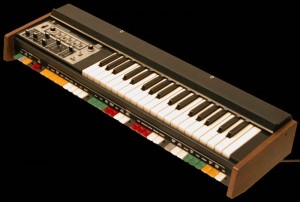
The SH-2000, introduced in 1973, is Roland’s second synthesizer and is essentially a limited version of the SH-1000. Like the 1000, it is a single-oscillator monophonic analog Preset synthesizer designed to sit atop a home organ. It’s got a great old analog sound but its lack of edit-ability and connectivity compared to the SH-1000 is what ultimately holds it back from being really great. (Perhaps Roland wanted to simplify it for the target demographic at the time – churches and casual home organists.)
Below its 37-note keyboard are several colorful tab switches which are used to select any one of its 30 Preset sounds. They range from the usual to the unusual: Tuba, Trombone, French Horn, Trumpet, Saxophone, Bassoon, Oboe, Flute, Clarinet, Cello, Violin, Bass Guitar, Hawaiian Guitar, Banjo, Fuzz Guitar I, Fuzz Guitar II; Piano, Harpsichord, Accordion, Vibraphone, Xylophone; Singing Voice, Song Whistle, Popcorn, Space Reed, Planet, Frog Man, Funny Cat, Growl Wow and Wind.
Left of the keyboard are the only editable controllers available on the SH-2000. They include the filter’s cutoff, resonance and modulation sliders, LFO modulation rate, portamento, vibrato, pitch bend, volume and master tuning. The filter and LFO are severely limited and there are no ADSR envelope controls. However, the cool ‘Growl’ and ‘Wow’ effects and the Random Note Generator from the SH-1000 are here, which is nice. Amazingly, this 1973 synth has aftertouch, called the ‘Touch Effect’ which can be assigned to modulate the volume, Vibrato, pitch, ‘Wow’ and ‘Growl’ effects. A few other drawbacks to the SH-2000 is the total lack of CV/Gate for external communication and no user memory.
The SH-2000 is great for squeaky effects and growling bass notes. However the SH-1000 offers much more flexibility and a better sounding filter.
Daft Punk cover Derezzed x AtomoSynth Krakken
Background description:
www.atomosynth.com
Hello this is my cover of Daft punk derezzed, using the AtomoSynth Krakken analog synthesizer for the lead (great for knob tweaking !!), a MkorgXL for the sub bass and Motif for the 909 drums, all sequenced by midi and recorded in Cubase in one take…
Time machine: Exploring the Moog Source, Minimoog and Roland JD-800
A voyage into the heart of the Moog Source from the year 1981.
Exploration by Marko Ettlich
monophonic analog synthesis 2 VCO I Saw, Square, PWM,
Filter – 24dB lowpass
sample/hold
step sequencer, arpeggiator
and more
A voyage into the heart of the Moog Minimoog from the year 1970.
Exploration by Marko Ettlich
monophonic analog synthesis 3 VCO I Saw, Square, Spaced Saw, Pulse,
Filter – 24dB lowpass
44 keys, single-trigger, low-note priority
A voyage into the heart of the Roland JD-800 from the year 1991.
Exploration by Marko Ettlich
rom sample based digital synth
24 voices
6 part multitimbral
multimode filter, lfo
61 keys with velocity and aftertouch
Time machine: ROLAND JUNO-6 Analog Synthesizer 1982
“This is the Roland Juno-6 (or: who stole the programmer on my Juno-60?). The sound and the sound architecture is identical to the Juno-60. But the highpass filter of the Juno-6 is infinitely variable, whereas on the Juno-60 you can choose from 4 settings.
I played the Juno-6 dry without any additional effects.”
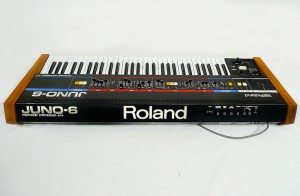
The first in a series of amazingly affordable quality synthesizers from Roland’s amazing Juno family! The Juno-6 is a six voice polyphonic analog synthesizer! It’s a very stable synth thanks to its digitally controlled analog oscillators. The Juno-6 sounds great, however it lacks basic necessities like MIDI control and patch memory storage.
The next generation Juno-60 version added 56 patches of memory storage. Both of these synths sound virtually the same and are considered by many to sound better (punchier) than the popular follow up, the Juno-106. The Juno-6 and 60 are very rich sounding synthesizers and are great analog machines as long as you can overlook the absence of MIDI control. Of course nobody can deny that the wooden side panel look is a true sign of Vintage status!
Jordan Passmore Demo of the Roland JX-10, Roland SH-2, Akai MPC-60
This is a demonstration of two Roland analog synths, a JX-10 and a SH-2, combined with the sequencer/sampler the MPC-60. The MPC-60 is loaded with Linn LM-1 samples (courtesy of ToneBldr, http://www.drivenmachinedrums.com ) and is also sequencing the JX-10 and SH-2. The SH-2 is doing the bass while the JX-10 is doing the melody; Jordan is playing lines over the melody on the JX-10 occasionally. All sounds are mixed on a StudioMaster mixer and there is an analog delay (Washburn Accellerator) on one send and a EH HolyStain on another.
“The MPC-60 is sort of out of shot so near the end I bring the camera around to show what I’m doing with that.”
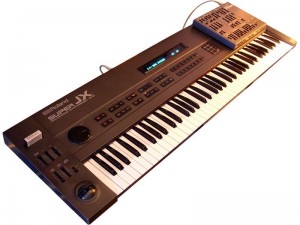
Released in 1985 the JX-10 (Super JX) combines two individual JX-8P’s for an outstandingly warm, rich and analog sound which is still used in many modern studios all over the world. This synth was the first Roland Synth to be fitted with a quality 76 note keyboard with velocity and aftertouch. Two DCO’s per voice, two ADSR envelope generators per voice, and a resonant lowpass & non-resonant highpass filters are only the beginning. It has a 12 voice polyphony for a total of 24 oscillators and it is by far one of the most programmable synths of its time! However, as on the JX-8P, knobs and sliders have been replaced by low-profile buttons and a nice LCD display. Although this may look sleek and elegant, it makes editing a chore. Assign parameters to the alpha dial for tweaking, one at a time, or get the optional PG-800 Programmer to provide traditional, hands-on, dedicated sliders for editing the JX-10’s parameters.
The JX10 has a Chorus effect and a chase-play Delay function. The chase-play function allows programmable delayed repeats of voices by alternating patches of the upper and lower modules. The simple chorus effect is either off, slow or fast. It has two programmable sliders (if you don’t use the PG-800) for some real-time control which can be recorded along with other effects and keyboard modes into one of the 64 Program Patches. This is in addition to its standard 50 preset and 50 user patch memory. A simple sketch-pad 1-track real-time sequencer is also on-board. It stores sequence data directly to an M16C card, or an M64C card for Patch/Tone OR sequence data. The M16C has a capacity of 400 notes, the M64C 1440, according to the manual.
The JX-10 also comes in a rack-mount version known as the MKS-70. It’s worth noting that the JX-10 can not be edited via SysEx, however the MKS-70 can which is one reason many have chosen the rack version of the keyboard. The JX-10 can make bulk dumps of its sounds over sysex, but only with (discontinued) Roland M64C RAM cartridges.
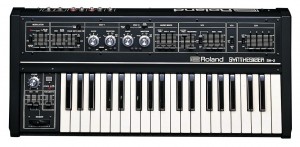
The SH-2 is one of Rolands’ early synthesizers. It is very simple in design, look and function. It sounds much like the SH-101 synth, including the typical SH-style sub-oscillator. But the SH-2 employed 2 oscillators for a much fatter sound. It has the typical Roland SH sound – it’s a monophonic bass synth that’s flexible enough to provoke punchy analog basses, leads and squelchy sounds. The oscillators can be de-tuned as well, another feature the popular SH-101 lacks. But it isn’t very pretty to look at as it shares the same design and layout as the SH09. Still it makes a simple and easily programmable mono-synth that can be used in place of the more common SH-101. However the SH-2 is harder to find and so it usually has a higher price than other SH-type synthesizers from Roland.
Korg MS-20 vs. Korg MS-20
Background description:
OK. This is not a song.
I had my friends MS-20 visiting mine for a brief moment. One of them is missing that legendary screw. You might have heard about this.
There’s two different filters in the MS-20. The Korg35 is in every unit which is lacking that screw in the VCA section, in the middle of the synth’s panel.
Rumours has it that the Korg35 filter makes the MS-20 sound more harsch.
You be the judge, but I for one can’t tell the difference.
Since I only had my friends MS-20 next to mine for a an hour or two, I wanted to take the opportunity to try them side by side.
I was only noodling and tweaking nothing but the filters or the parameters affecting the filters (envelope and LFO).
To make things more complicated, there’s MS-20 units with screws but still with the Korg35 filter inside.
I’ve had my MS-20 for about 18 years but never opened it up to see which filter it has.
Eowave MAGMA – Analog Bassline Synth Released
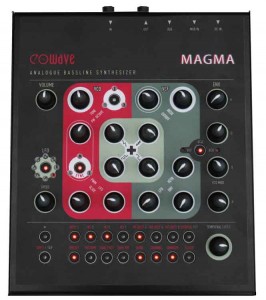
Eowave tells us that MAGMA is now available. It’s an analogue bassline synthesizer inspired by classical synths from the 1980s which offers the possibility to mix 4 different waveforms (saw, square, sub, noise). Eowave says that the 24 dB low-pass filter is also inspired from classical filters from the 80s.
“To this particular sound of the 80s, we added a touch of modernity with modern controls and parameters saving features. The 16 steps sequencer has 4 rows: 1 for the notes and 3 freely assignable to a parameter of your choice that enables to create living sequences with sonorities like Vince Clark or Jan Hammer.”
Here’s the specs from Eowave:
Oscillator section
- analogue VCO with square saw sub (sub can be 1 or 2 octaves below the master freq), noise.
- VCO can be modulated by LFO and PW
- Variable glide
- mixer to mix the 4 waveforms
Filter section
- Full analogue VCO, filter, VCA.
- external audio with a trimmer to feed the filter
- 24dB low pass filter roland style for a classical 80s sound
- filter can be modulated by env2, KB, lfo.
VCA section
- Vca is affected to env1
- 2 envelopes ADSR modulate respectively the amplitude and the filter. Attack goes from 2ms to 10s.
LFOs section
- 2 x LFO with 8 waveforms (triangle, ramp up, ramp down, square, random, digital noise, staircase up, staircase down)
Connections
- audio in
- audio out
- MIDI in
- USB (for software update and MIDI in&out)
Sequencer
- 16 steps sequencer with LED
- 4 rows: 1 row controls gates and notes.
- 3 other rows are freely assignable to any parameter of the front panel.
- Swing and shuffle per note – You can transpose the sequencer with an external MIDI keyboard.
Pricing and Availability:
539 € excl. VAT
More information:
Three Vintage Analogue String Synthesizers
Analogue synths can’t synthesize every sound, but the attempts made to replicate the sound of orchestral strings were so successful that so-called string machines became much-loved instruments in their own right.
DATAMASKIN

